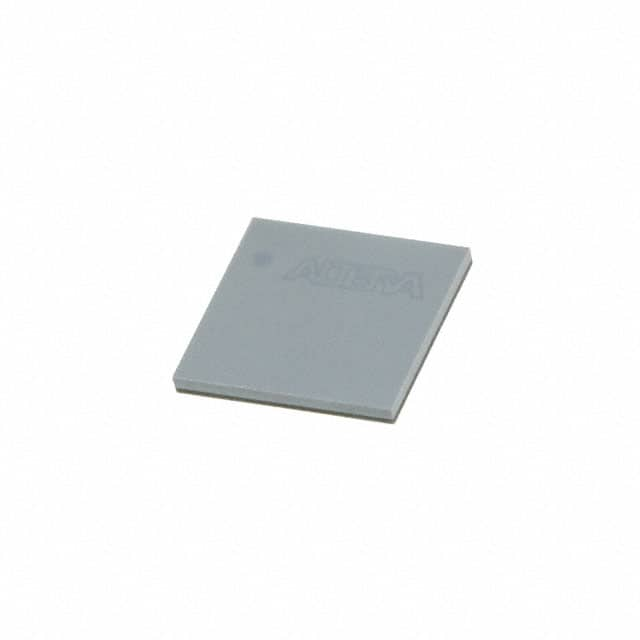
Overview of Intel 10M08SAE144C8G
The Intel 10M08SAE144C8G is a member of the MAX 10 family, a series of field-programmable gate arrays (FPGAs) that offer low-power, non-volatile memory solutions for a variety of embedded applications. This FPGA is designed for applications requiring high logic density, fast configuration time, and a compact form factor. It provides instant-on functionality with its integrated flash memory, reducing the need for external configuration devices. The device is ideal for cost-sensitive applications that still require the flexibility and reconfigurability typical of FPGAs.
Device Architecture and Logic Resources
The Intel 10M08SAE144C8G provides a well-balanced architecture, offering sufficient resources for moderate-to-high complexity embedded systems.
* Logic Elements (LEs): Approximately 8,640 logic elements consisting of Look-Up Tables (LUTs) and flip-flops, which are ideal for implementing a wide variety of combinational and sequential logic
* Embedded Memory: Around 160 Kbits of embedded memory, distributed across multiple memory blocks, providing flexible storage and buffering capabilities for real-time data processing
* Analog Integration: Includes one 12-bit analog-to-digital converter (ADC), enabling mixed-signal functionality for sensor applications and real-time signal processing
* Digital Signal Processing (DSP): Supports embedded DSP blocks for high-speed arithmetic operations, making it suitable for signal processing, image processing, and communications tasks
* I/O Pins: 144 user-configurable I/O pins, supporting various voltage standards and configurable drive strengths to meet the needs of different interface requirements
Performance and Speed Grade
The Intel 10M08SAE144C8G is designed to offer efficient performance for embedded applications that require moderate logic capacity and moderate-speed operation.
* Speed Grade: -1, providing a good balance between speed and power efficiency
* Core Voltage: 1.2 V nominal, typical for devices in the MAX 10 family
* I/O Voltage: Supports flexible I/O voltage levels ranging from 1.2 V to 3.3 V, making it suitable for various interfacing standards
* Maximum Operating Frequency: The core logic operates up to approximately 150 MHz, suitable for embedded control systems and real-time data processing
* ADC Resolution and Performance: Includes 12-bit resolution for the ADC, with a sample rate up to 1 MSPS (million samples per second), providing accurate analog-to-digital conversion
Configuration and Programming
The MAX 10 family’s integrated flash memory allows for fast configuration, reducing the need for external devices and ensuring instant-on capability.
* Configuration Memory: The 10M08SAE144C8G comes with embedded flash memory that stores the configuration bitstream. This enables the FPGA to configure itself on power-up, eliminating the need for external configuration memory
* Configuration Modes: The device supports multiple configuration modes, including passive serial, active serial, JTAG, and SelectMAP, allowing flexible programming and system integration
* Security: Built-in bitstream encryption and authentication mechanisms help protect the device’s intellectual property and prevent unauthorized access or reprogramming
* Instant-On Feature: The device leverages its integrated non-volatile memory to offer instant-on capability, reducing system boot times compared to traditional SRAM-based FPGAs
Power Consumption and Thermal Characteristics
The 10M08SAE144C8G is optimized for low power consumption, making it suitable for battery-powered or power-sensitive applications.
* Typical Power Consumption: Approximately 300 mW in typical operating conditions, though this can vary depending on the specific application, design complexity, and switching activity
* Standby Power Consumption: The device has a very low standby power consumption due to its non-volatile flash-based configuration, allowing it to remain in a low-power state when not actively processing
* Thermal Resistance: Typical junction-to-ambient thermal resistance is around 20°C/W, depending on the board design and cooling mechanisms employed
* Power Management Features: The device supports power-down modes and dynamic clock gating to reduce power consumption in idle states
Package and Mechanical Details
The Intel 10M08SAE144C8G is available in a compact, high-density package, making it suitable for space-constrained embedded systems.
* Package Type: SAE144 (Small-Outline Exposed Pad Ball Grid Array)
* Pin Count: 144 balls in a BGA package, offering a good mix of I/O flexibility and density for various applications
* Package Dimensions: Approximately 10 mm × 10 mm in size, compact enough for small embedded systems
* Ball Pitch: 0.8 mm pitch, providing good routing flexibility while maintaining a compact form factor
* Mounting: Surface-mount technology (SMT) for automated PCB assembly, ideal for mass production of embedded systems
Operating Conditions and Environmental Specifications
The 10M08SAE144C8G is built for industrial-grade reliability, capable of operating in harsh environments.
* Operating Temperature Range: –40°C to +100°C, ensuring the device can perform reliably in industrial and automotive applications
* Storage Temperature Range: –65°C to +150°C, suitable for a wide range of environments and conditions
* Electrostatic Discharge (ESD) Protection: Meets or exceeds standard ESD protection levels (Human Body Model and Machine Model) to prevent damage during handling and operation
* Moisture Sensitivity Level: MSL 3, ensuring proper moisture handling and compatibility with standard SMT assembly processes
Development Tools and Ecosystem
The Intel MAX 10 family is supported by Intel’s advanced development environment, making it easier for designers to implement, test, and debug FPGA-based systems.
* Design Software: Intel Quartus Prime Lite and Standard Editions for device design, synthesis, simulation, and programming
* IP Cores: Extensive library of pre-built intellectual property (IP) cores for communication interfaces, memory controllers, and peripheral drivers
* Debugging Tools: Supports SignalTap II logic analyzer for in-system debugging and real-time signal monitoring
* HDL Support: Full support for VHDL, Verilog, and SystemVerilog to provide designers with flexibility in hardware description
Typical Applications
The Intel 10M08SAE144C8G is ideal for applications that require moderate-to-high logic capacity, low power consumption, and a compact form factor.
* Industrial Automation: Can be used in control systems, sensor integration, and real-time monitoring
* Automotive Electronics: Provides customizable logic for automotive control systems, such as advanced driver-assistance systems (ADAS)
* Communications: Suitable for communication equipment requiring low-to-moderate bandwidth and flexible I/O capabilities
* Consumer Electronics: Ideal for portable devices, home appliances, and multimedia systems that require low power and rapid configuration
* Medical Devices: Can be integrated into medical instrumentation and diagnostics systems, offering custom logic and analog processing
* Embedded Systems: Useful in a wide variety of embedded system applications, including robotics, IoT devices, and field programmable controls
Summary
The Intel 10M08SAE144C8G FPGA from the MAX 10 family combines low power, instant-on configuration, and sufficient logic resources for a wide range of embedded applications. With its integrated non-volatile flash memory, 12-bit ADC, and flexible I/O options, it offers an ideal platform for industrial, automotive, and consumer systems where low power and quick startup are crucial. The 10M08SAE144C8G’s robust package, along with its extensive development tool support, ensures that designers can quickly bring their FPGA-based systems to life with high reliability and performance.