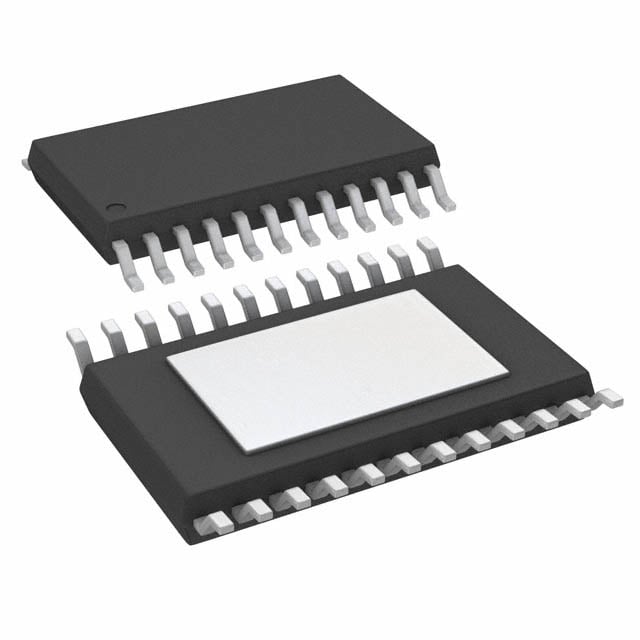
The Texas Instruments UCC3916DPTRG4 is a precision electronic circuit breaker and hot-swap controller designed for power distribution protection in 3 V to 8 V bus systems. It is part of the UCC391x family of hot-swap and power management devices that integrate current limiting, fault detection, and controlled load switching to protect both the power source and downstream circuitry during insertion events, overload conditions, and short-circuit faults.
## Functional Architecture and Device Purpose
The UCC3916 is designed to manage inrush current and provide fault isolation in systems where load boards or subsystems are inserted into a live backplane. It functions as an electronic circuit breaker that monitors load current and controls an external pass element, typically a power MOSFET, to regulate power delivery.
The device continuously senses load current through an external sense resistor and compares the sensed voltage to an internal threshold reference. When the load current exceeds the programmed limit, the controller responds by limiting gate drive to the external MOSFET, thereby maintaining current regulation rather than allowing uncontrolled overcurrent flow.
This architecture enables safe hot-plug operation by preventing high inrush currents that could otherwise cause connector damage, supply droop, or system instability.
## Current Limiting and Protection Mechanism
The core protection function of the UCC3916 is based on precision current limiting. The device regulates the voltage across an external sense resistor to maintain a controlled current threshold. When the sensed current reaches the programmed limit, the internal control loop adjusts the gate drive of the external MOSFET to operate it in its linear region.
In addition to continuous current limiting, the device includes fault detection logic that identifies persistent overload or short-circuit conditions. When such a condition is detected, the controller initiates a protective response that may include shutdown or timed retry behavior depending on device configuration and fault duration.
This dual-mode operation—linear current regulation followed by fault shutdown—provides both immediate protection and system-level fault isolation.
## Gate Drive Control and External MOSFET Operation
The UCC3916 provides a gate drive output intended to control an external N-channel MOSFET used as the pass element in the power path. The gate driver is designed to provide controlled ramping of the MOSFET gate voltage, which directly regulates the rate of current increase during power-up events.
By controlling the gate voltage slew rate, the device limits inrush current during capacitor charging at the load side. This is essential in hot-swap systems where large bulk capacitances can otherwise generate high transient currents upon insertion.
The external MOSFET operates as a variable resistance element during startup and fault conditions, allowing precise control of power delivery without requiring fully on/off switching transitions.
## Fault Timing and Thermal Considerations
The UCC3916 incorporates timing-based fault management to distinguish between transient overloads and sustained fault conditions. If an overcurrent condition persists beyond an internal timing threshold, the device transitions from current limiting mode to a shutdown or latch-off state.
Thermal stress management is indirectly achieved through controlled current regulation, as limiting current reduces power dissipation in the external MOSFET during fault conditions. However, system-level thermal design must still ensure that the MOSFET operates within its safe operating area during linear operation, as hot-swap controllers inherently place the MOSFET in high-dissipation conditions during current limiting events.
## Undervoltage and Supply Monitoring
The device includes undervoltage lockout functionality to ensure that the power path remains disabled or controlled until the input supply reaches a valid operating range. This prevents partial conduction states in the external MOSFET that could result in undefined system behavior during power ramp-up.
The undervoltage detection threshold ensures that the controller only enables gate drive when sufficient headroom is available for proper MOSFET operation and stable current regulation.
## Sense Resistor Interface and Current Measurement
The UCC3916 relies on an external sense resistor placed in series with the load path to measure current flow. The voltage drop across this resistor is continuously monitored by internal comparators and control amplifiers.
The accuracy of current limiting is therefore directly dependent on the precision of the sense resistor and the stability of the internal reference threshold. This architecture allows flexibility in setting the current limit by selecting appropriate resistor values, enabling adaptation to a wide range of system power levels.
The sense interface is designed to operate with low offset error to ensure predictable current limiting behavior across temperature and supply variations.
## Control Logic and Operational Modes
The device operates through a set of defined functional states including startup, current regulation, fault detection, and shutdown recovery. During startup, the MOSFET is gradually enhanced to allow controlled charging of load capacitance. During normal operation, the device remains transparent, allowing current to flow with minimal voltage drop across the MOSFET.
In overload conditions, the device transitions into current regulation mode, actively controlling MOSFET conduction to maintain the current threshold. If the fault persists, the device transitions into a protective shutdown state.
This state machine ensures predictable behavior under all operating conditions and prevents uncontrolled thermal or electrical stress.
## Application Role in Power Distribution Systems
The UCC3916 is typically deployed in distributed power architectures such as backplane systems, industrial control modules, and telecom equipment. Its primary role is to protect shared power buses from localized faults while allowing individual subsystem insertion and removal without system-wide disruption.
In such systems, multiple UCC3916 devices may be used in parallel to protect independent power rails or modular load sections. This modular protection strategy improves overall system reliability and maintainability.
## System-Level Design Considerations
Proper implementation of the UCC3916 requires careful selection of the external MOSFET to ensure safe operation within its safe operating area during current limiting events. Since the MOSFET may operate in its linear region for extended periods during faults, both thermal dissipation and secondary breakdown limits must be considered.
PCB layout must minimize parasitic resistance in the sense path to ensure accurate current measurement. Additionally, gate drive routing should be designed to minimize inductive coupling and ensure stable control behavior during fast transient events.
## Conclusion
The Texas Instruments UCC3916DPTRG4 is a hot-swap and electronic circuit breaker controller designed for controlled power insertion and fault protection in 3 V to 8 V systems. It implements precision current limiting through external MOSFET gate control, integrates fault detection and undervoltage monitoring, and provides controlled inrush current management for safe hot-plug operation. Its primary engineering value lies in enabling robust power distribution architectures with predictable fault handling, scalable current limiting, and protection of both source and load circuitry in modular electronic systems.