Q1: What is the Texas Instruments NE555P?
A1: The Texas Instruments NE555P is a popular timer IC widely used in a variety of electronic circuits. It can be configured as a monostable multivibrator (one-shot pulse generator), astable multivibrator (oscillator), or bistable multivibrator (flip-flop). It is commonly used for timing, pulse generation, and signal conditioning applications.
Q2: What is the supply voltage range for the NE555P?
A2: The NE555P operates within a supply voltage range of 4.5V to 15V, which makes it suitable for a wide range of circuits and applications.
Q3: What is the output configuration of the NE555P?
A3: The NE555P features a push-pull output configuration, which allows it to provide both high and low output states, making it ideal for driving LEDs, relays, or other digital circuits.
Q4: What is the maximum output current of the NE555P?
A4: The NE555P can source or sink a maximum output current of 200mA, allowing it to drive a variety of low-power loads directly.
Q5: How does the NE555P function in astable mode?
A5: In astable mode, the NE555P continuously oscillates between its high and low states, making it ideal for generating clock pulses, tone generators, and frequency modulators.
Q6: How does the NE555P function in monostable mode?
A6: In monostable mode, the NE555P generates a single pulse of a specific duration in response to an external trigger. This mode is often used in pulse-width modulation (PWM) circuits and timing applications.
Q7: What is the typical timing accuracy of the NE555P?
A7: The NE555P offers a high degree of timing accuracy, with a typical error of less than 1% for the timing interval when configured properly with external resistors and capacitors.
Q8: What is the temperature range of the NE555P?
A8: The NE555P operates within a temperature range of -55°C to 125°C, making it suitable for industrial and automotive applications.
Q9: What is the input trigger voltage for the NE555P in monostable mode?
A9: In monostable mode, the NE555P requires a trigger voltage below 1/3 of the supply voltage to initiate the timing pulse.
Q10: Does the NE555P have built-in overcurrent protection?
A10: No, the NE555P does not have built-in overcurrent protection, so external current-limiting components such as resistors should be used to prevent damage to the IC.
Q11: What is the typical power consumption of the NE555P?
A11: The NE555P has low power consumption, typically drawing less than 10mA of current at 5V, making it suitable for battery-powered and low-energy applications.
Q12: How many pins does the NE555P have?
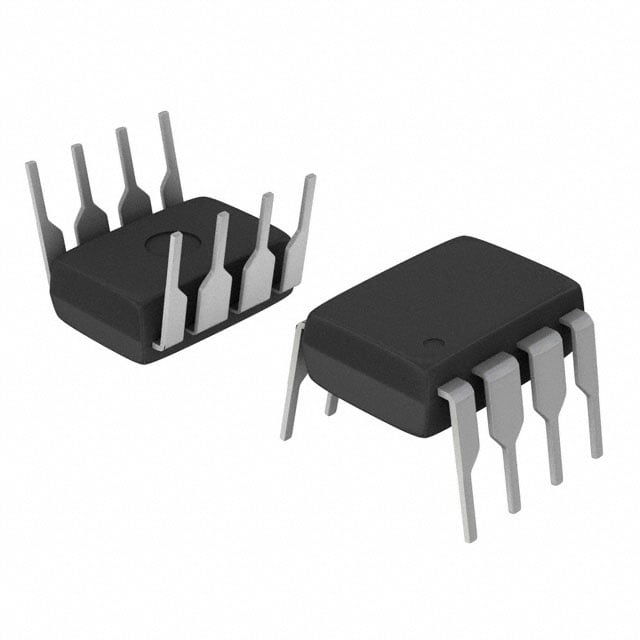
A12: The NE555P comes in an 8-pin Dual In-line Package (DIP) configuration, with all pins clearly labeled for easy integration into electronic circuits.
Q13: What is the frequency range of the NE555P when used in astable mode?
A13: The NE555P can generate frequencies from a few Hz up to several hundred kHz when used in astable mode, depending on the external resistor and capacitor values.
Q14: Can the NE555P be used to generate a PWM signal?
A14: Yes, the NE555P can be used to generate a PWM signal by adjusting the duty cycle through external resistors and capacitors in the astable configuration.
Q15: What is the maximum operating frequency of the NE555P?
A15: The maximum operating frequency of the NE555P is typically around 500 kHz, though this can vary based on the application and component values used.
Q16: How does the NE555P handle noise or power fluctuations?
A16: The NE555P is relatively noise-immune, but careful decoupling and proper design are necessary to ensure stable operation, especially in environments with electrical noise or power supply fluctuations.
Q17: What is the NE555P’s output voltage when sourcing current?
A17: When sourcing current, the output voltage of the NE555P is typically Vcc - 1.7V, depending on the load and the operating conditions.
Q18: How is the NE555P triggered in monostable mode?
A18: The NE555P in monostable mode is triggered by applying a low voltage (below 1/3 of the supply voltage) to the trigger input, which starts the timing cycle.
Q19: Can the NE555P be used in high-speed applications?
A19: The NE555P is not typically used in high-speed applications, as its maximum frequency is limited to around 500 kHz. For faster timing, other specialized ICs may be more appropriate.
Q20: What applications is the NE555P commonly used for?
A20: The NE555P is widely used in a variety of applications such as pulse generation, time delays, waveform generation, tone generation, LED blinkers, and frequency modulation in both industrial and hobbyist circuits.