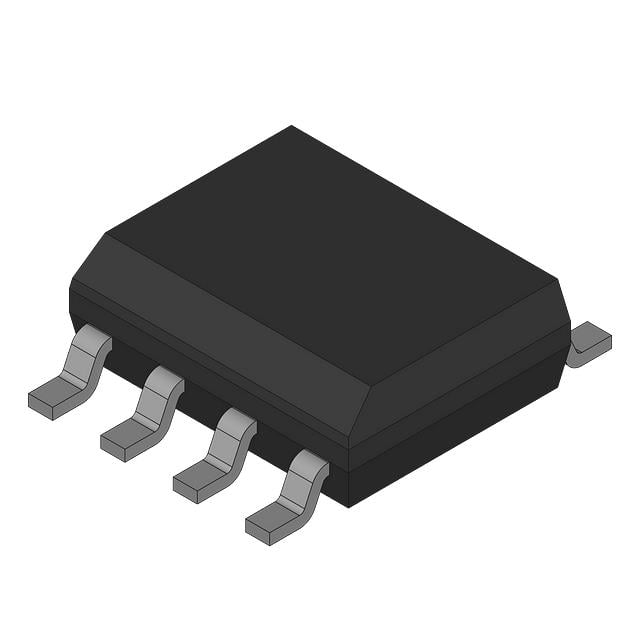
The Texas Instruments LM239J is a high-speed, quad voltage comparator designed for applications requiring precise and rapid analog signal comparison. Each device contains four independent voltage comparators with high gain and fast response time, suitable for a wide range of industrial and consumer electronics applications. The LM239J operates over a wide supply voltage range and provides differential input capability with low input bias currents, enabling flexible interface with analog signal sources. It is commonly used in level detection, zero-crossing detectors, analog-to-digital conversion, waveform shaping, and oscillator circuits.
## Electrical Characteristics
The LM239J supports supply voltages ranging from 3 V to 32 V in single-supply mode or ±1.5 V to ±16 V in dual-supply configurations. The device exhibits a typical input offset voltage of 2 mV and a maximum input offset voltage of 7 mV, ensuring accurate signal comparison. Input bias currents are nominally 25 nA at 25°C, and input offset current is typically 5 nA. The typical common-mode rejection ratio (CMRR) is 70 dB at a supply voltage of ±15 V, which allows stable operation in environments with varying common-mode signals.
The LM239J has a low supply current of approximately 0.8 mA per comparator, making it suitable for battery-powered and low-power applications. The input voltage range extends from the negative rail (V−) to approximately 2 V below the positive rail (V+), allowing versatile interfacing with various analog signals.
## Switching Performance
The LM239J is optimized for high-speed operation. It features a typical propagation delay of 700 ns for a 100 mV overdrive at V+ = 15 V, ensuring rapid response to input signal changes. The output stage is an open-collector configuration, capable of sinking up to 20 mA of current, which allows flexible interfacing with logic circuits and external pull-up resistors. The device is capable of direct wired-OR connections, enabling multiple outputs to share a common line without additional logic gates.
## Input and Output Specifications
The device inputs are designed to handle both differential and common-mode voltages with high accuracy. Input voltage range extends from 0 V to V+ − 2 V under standard conditions, and each comparator maintains low offset and bias currents over the full operating temperature range of −40°C to +85°C. The open-collector output is compatible with TTL, CMOS, and MOS logic levels, provided a suitable pull-up resistor is used.
The LM239J also exhibits low output leakage current in the off state, typically 100 nA, allowing accurate interfacing with high-impedance nodes. The device’s output voltage saturation is typically 0.2 V for a 4 mA sink current, ensuring reliable logic low levels in digital systems.
## Protection and Reliability Features
The LM239J includes input protection diodes to safeguard against voltage transients exceeding the supply rails. The device is designed to tolerate differential input voltages up to ±32 V without degradation of performance. Thermal and electrical robustness ensures stable operation across a wide temperature range, and the device is specified for operation from −40°C to +85°C.
## Application Considerations
Proper layout and external component selection are important for optimizing performance. Pull-up resistors for the open-collector outputs must be chosen to match the desired output voltage swing and current capability. For high-speed applications, minimizing parasitic capacitance on input and output nodes is critical to preserve fast response times. The LM239J can be used in combination with hysteresis networks to reduce noise-induced output chatter in applications with slow or noisy input signals.
Typical applications include zero-crossing detectors, pulse-width modulation circuits, analog-to-digital converters, level shifters, comparator-based oscillators, and voltage monitoring circuits. Its ability to handle wide voltage swings and interface with various logic families makes it versatile in mixed-signal environments.
## Package and Mechanical Details
The LM239J is available in a 14-lead dual in-line package (DIP) and 14-lead small outline integrated circuit (SOIC) package. The compact packaging allows for space-efficient design in circuit boards. The device has a maximum power dissipation of approximately 500 mW in the DIP package and 400 mW in the SOIC package, with appropriate derating above 25°C ambient temperature.
## Performance Metrics
In standard test conditions with V+ = 15 V and V− = 0 V, the LM239J exhibits the following typical characteristics: propagation delay of 700 ns, input offset voltage of 2 mV, input bias current of 25 nA, common-mode rejection ratio of 70 dB, and output voltage low of 0.2 V at 4 mA sink current. The device maintains performance over the full operating temperature range, ensuring reliability in industrial and automotive applications.
The high-speed operation, low input bias current, and wide voltage range make the LM239J suitable for precision analog signal processing in applications requiring fast and accurate threshold detection. The combination of robustness, low-power operation, and compatibility with multiple logic levels ensures its integration into diverse electronic systems.