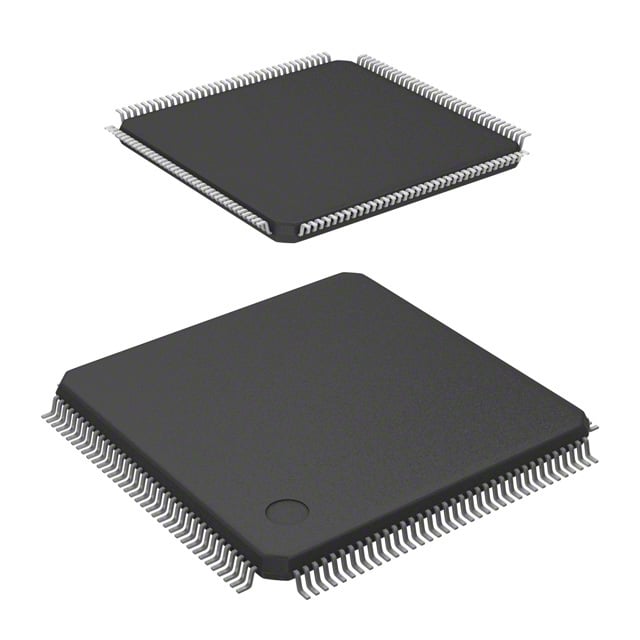
The STMicroelectronics ST10F296 is a high-performance 16-bit microcontroller from the ST10 family, designed for automotive and industrial applications that require real-time control, high computational performance, and robust peripheral integration. It combines a 16-bit CPU core, flash memory, SRAM, and a comprehensive set of on-chip peripherals optimized for embedded control applications such as engine management, transmission control, and industrial automation. The device provides deterministic execution, multiple communication interfaces, and analog integration, making it suitable for mixed-signal real-time control systems.
## Key Features
* CPU Core: 16-bit ST10 microcontroller core, supporting deterministic instruction execution
* Operating Frequency: Up to 16 MHz maximum CPU clock
* Memory:
* 64 KB on-chip flash memory for program code
* 2 KB SRAM for data storage and stack operations
* Operating Voltage: 5 V ±10% typical supply for automotive applications
* Temperature Range: -40°C to +125°C ambient operation
* Package Type: 48-pin or 52-pin LQFP depending on variant for high-density designs
* Low-Power Modes: Wait and Stop modes for energy-efficient operation
* Peripherals:
* 12-bit Analog-to-Digital Converter (ADC) with multiple channels
* Timers including 16-bit and 32-bit for event timing and pulse generation
* Pulse Width Modulation (PWM) channels for motor or actuator control
* Serial communication interfaces: SCI, SPI, and I²C
* Watchdog timer and clock monitoring for enhanced system reliability
* Interrupts: Multiple vectored interrupts with priority levels for real-time responsiveness
* Clock Sources: Internal RC oscillator and optional external crystal for precision timing
* Safety Features: On-chip voltage monitor and watchdog for fault detection and system protection
## Electrical Characteristics
* Supply Voltage (VDD): 4.5 V to 5.5 V
* Input High Voltage (VIH): 0.7 × VDD typical
* Input Low Voltage (VIL): 0.3 × VDD typical
* Output High Voltage (VOH): VDD - 0.4 V at standard load
* Output Low Voltage (VOL): 0.4 V typical at standard load
* Operating Current:
* Active mode: 15–20 mA at 16 MHz
* Wait mode: <1 mA typical
* ADC Characteristics:
* Resolution: 12 bits
* Conversion time: 4.8 µs typical per channel
* Input range: 0 V to VDD
* Clock Frequency: Up to 16 MHz using external crystal or oscillator
## Functional Description
The ST10F296 is built around a 16-bit ST10 CPU core with pipelined architecture that provides deterministic instruction execution critical for real-time control systems. The core supports arithmetic, logical, and bit manipulation instructions optimized for embedded applications. Flash memory serves as program storage, with on-chip SRAM used for temporary variables, stack, and data storage.
The integrated ADC allows direct interfacing with sensors and analog signals, supporting event-triggered or continuous conversions. Timers and PWM modules provide precise timing control, essential for motor drives, engine management, and pulse-width controlled actuators. Serial communication interfaces, including SCI, SPI, and I²C, allow deterministic data exchange with peripheral devices, external memories, and sensors.
Peripheral registers are memory-mapped, enabling fast access and efficient peripheral control. The vectored interrupt system allows low-latency response to analog or digital events, enabling synchronous control in real-time applications.
## Peripherals and Communication
* Analog Functions: 12-bit ADC with multiple channels supporting single-ended and differential measurements
* Timers:
* Multiple 16-bit timers configurable for input capture, output compare, and PWM generation
* 32-bit timers for event sequencing and motor control
* PWM Modules: High-resolution PWM outputs suitable for driving motors, solenoids, and actuators
* Serial Communication:
* SCI interface supports asynchronous communication
* SPI interface for high-speed synchronous data exchange
* I²C interface for multi-device sensor and peripheral communication
* Interrupt System: Multiple vectored interrupts with configurable priority levels for deterministic control
* Safety and Monitoring: Watchdog timer ensures system recovery in case of software hang; voltage monitor provides low-voltage detection
## Applications
* Automotive engine and transmission control systems
* Industrial automation and robotics control
* Motor drives for fans, pumps, and actuators
* Sensor acquisition and analog signal processing
* Embedded control systems in automotive safety and convenience features
* Real-time control applications requiring deterministic performance
## Package and Mechanical Information
* Package Type: LQFP, 48-pin or 52-pin depending on configuration
* Pin Pitch: 0.8 mm standard for automotive-grade PCB integration
* Package Dimensions: 10 mm × 10 mm typical for LQFP body
* Thermal Performance: Junction-to-ambient thermal resistance ~60°C/W without additional heatsinking; improved by copper pours and thermal vias
* Lead Finish: RoHS-compliant tin or tin-lead for automotive assembly
* Mechanical Reliability: Qualified for automotive vibration, thermal cycling, and standard SMT reflow processes
## Design Considerations
When designing with the ST10F296, careful attention should be paid to power supply decoupling, analog signal routing, and thermal management. Decoupling capacitors must be placed close to VDD pins to suppress noise and maintain stable operation. Analog traces for ADC inputs should be isolated from high-current or high-frequency digital lines to minimize measurement noise.
The flash memory can be programmed in-system, enabling firmware updates without physical removal. Care must be taken to manage CPU and peripheral clock sources for timing-critical applications, particularly in motor control or automotive timing systems. Low-power modes should be utilized to reduce energy consumption during idle periods.
Peripheral configuration should consider priority and timing of interrupts to ensure deterministic response, particularly for real-time control loops. PWM modules and timers must be configured with appropriate prescalers and clock sources to achieve desired duty cycles and frequency precision.
## Reliability and Compliance
* Automotive Grade: Qualified for -40°C to +125°C ambient operation
* Watchdog Timer: Ensures recovery from software or system faults
* Voltage Monitor: Protects against undervoltage events
* Electrostatic Discharge Protection: Integrated on all I/O pins
* Junction Temperature: Maximum 125°C to ensure reliable long-term operation
* Mechanical Robustness: Designed to withstand automotive vibration and thermal cycling
## Summary
The STMicroelectronics ST10F296 is a 16-bit microcontroller designed for real-time control applications in automotive and industrial environments. It combines a high-performance ST10 CPU core, 64 KB flash, 2 KB SRAM, and a broad range of peripherals including ADC, timers, PWM, and serial interfaces. Its low-power modes, deterministic execution, and robust safety features make it ideal for engine management, motor control, sensor interfacing, and other embedded real-time applications. The automotive-grade packaging, wide operating temperature, and integrated safety features ensure reliable operation in demanding environments.