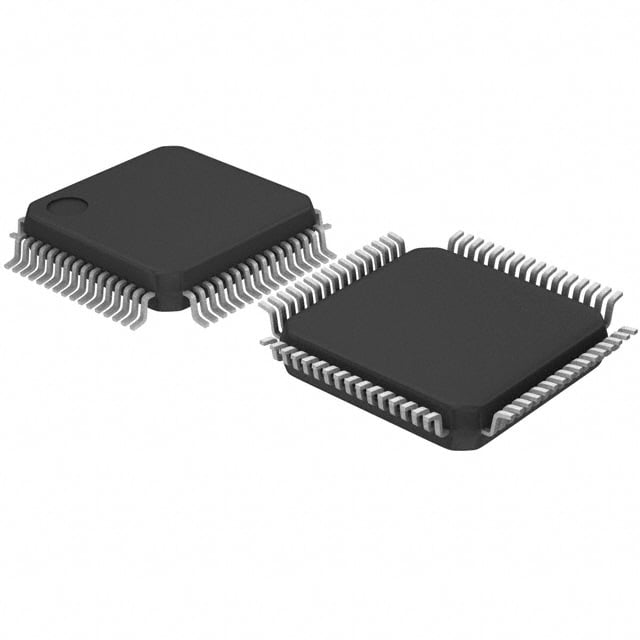
The Microchip Technology ATSAM3N00AA-AUR is a 32-bit ARM Cortex-M3 based microcontroller belonging to the SAM3N family. It integrates a high-performance ARM Cortex-M3 processor core, embedded Flash memory, SRAM, analog peripherals, communication interfaces, timers, clock management functions, and multiple general-purpose I/O resources into a single low-power microcontroller device. The ATSAM3N00AA-AUR is the 16 KB Flash memory variant of the SAM3N00 series and is supplied in a 48-pin LQFP package with industrial temperature capability from −40 °C to +85 °C.
The device is based on the ARM Cortex-M3 revision 2.0 processor architecture, which provides a 32-bit RISC processing environment with Thumb-2 instruction support. The Cortex-M3 core is optimized for embedded control applications requiring higher computational performance than traditional 8-bit and 16-bit microcontrollers while maintaining low power consumption.
The ATSAM3N00AA-AUR is designed for industrial control, embedded instrumentation, consumer electronics, automation equipment, and other applications requiring integrated processing capability, mixed-signal peripheral support, and efficient real-time control functions. The device combines digital processing resources with analog acquisition and conversion functions, allowing system designers to implement compact embedded solutions with reduced external circuitry.
## Processor Core Architecture
The central processing unit of the ATSAM3N00AA-AUR is an ARM Cortex-M3 core operating at a maximum frequency of 48 MHz. The Cortex-M3 architecture incorporates a Harvard architecture with separate instruction and data paths, enabling efficient instruction execution and improved memory access performance compared with conventional single-bus architectures.
The processor supports the Thumb-2 instruction set, which combines the code density advantages of 16-bit Thumb instructions with the performance capabilities of 32-bit ARM instructions. This allows embedded applications to achieve efficient Flash utilization while maintaining adequate computational performance.
The Cortex-M3 core includes integrated debugging support through the ARM CoreSight technology framework. This enables standard embedded development functions such as software debugging, program execution control, and system-level analysis.
The processor architecture also includes a 24-bit SysTick timer, which is commonly used for operating system timing functions, task scheduling, and periodic interrupt generation in embedded software environments.
## Memory Architecture and Storage Resources
The ATSAM3N00AA-AUR integrates 16 KB of embedded Flash memory for program storage. The nonvolatile Flash memory allows firmware code, configuration data, and application software to be stored directly within the microcontroller without requiring external memory components.
The device includes 4 KB of SRAM for temporary data storage during program execution. SRAM is used for runtime variables, stack operation, buffers, communication data, and peripheral processing tasks.
The integrated memory architecture is optimized for embedded applications where program size and data requirements are moderate. The combination of internal Flash and SRAM reduces system complexity and improves reliability by minimizing external memory interfaces.
The Flash memory supports in-system programming capabilities, allowing firmware updates through supported programming interfaces. This feature simplifies manufacturing processes and enables field firmware maintenance.
## Clock System and Power Management
The ATSAM3N00AA-AUR incorporates a flexible clock management system designed to support performance optimization and low-power operation. The clock system includes internal and external clock sources, phase-locked loop functionality, and programmable clock distribution mechanisms.
The SAM3N architecture supports operation from a wide supply voltage range of 1.62 V to 3.6 V. The internal voltage regulator provides the required core voltage from the external supply, allowing the processor core and internal logic to operate at optimized voltage levels.
The integrated power management system supports multiple operating modes, including normal operating mode, sleep mode, wait mode, and backup mode. These power states allow the system designer to balance processing performance and energy consumption according to application requirements.
The internal voltage regulator supports normal operation with reduced static current consumption and provides low-power behavior during standby modes. In backup mode, the regulator consumption can be reduced to below 1 μA according to the device specifications.
## Digital Peripheral Interface Resources
The ATSAM3N00AA-AUR integrates multiple communication interfaces to support connection with external sensors, memories, communication modules, and peripheral devices.
The device includes USART interfaces supporting serial communication functions. USART peripherals provide flexible communication capabilities including standard asynchronous serial communication and additional protocol support depending on configuration.
The microcontroller provides Two-Wire Interface (TWI) peripherals compatible with I²C communication protocols. These interfaces allow connection to common peripheral devices such as EEPROMs, sensors, and control ICs.
SPI communication capability is also integrated, providing high-speed synchronous serial communication suitable for external converters, displays, memory devices, and industrial peripherals.
These communication interfaces reduce the requirement for external communication controllers and allow direct connection between the microcontroller and system components.
## Timer, Counter, and PWM Functions
The ATSAM3N00AA-AUR includes multiple timer and counter peripherals for real-time control applications. The SAM3N family provides up to six 16-bit Timer/Counter channels with capture, waveform generation, compare functions, and PWM operating modes.
The timer/counter peripherals support accurate timing generation, event measurement, pulse-width measurement, and motor or actuator control functions.
PWM functionality allows the microcontroller to generate precisely controlled output waveforms. PWM outputs are commonly used for applications such as motor control, power regulation, LED control, and actuator management.
The timer architecture also supports advanced functions including waveform generation and external event counting, making the device suitable for applications requiring deterministic hardware timing.
## Analog Peripheral Integration
The ATSAM3N00AA-AUR integrates analog peripherals including a 10-bit analog-to-digital converter (ADC) and digital-to-analog conversion capability within the SAM3N family architecture.
The ADC provides multi-channel analog measurement capability, allowing direct connection to analog sensors, monitoring circuits, and instrumentation signals without requiring external ADC components.
The integrated ADC includes configurable channels and supports sampling operations suitable for embedded measurement and control systems. Proper analog layout, reference voltage management, and grounding techniques are required to achieve accurate conversion performance.
The integrated DAC capability allows generation of analog output signals for applications requiring programmable voltage outputs or analog control functions.
The combination of ADC and DAC peripherals makes the ATSAM3N00AA-AUR suitable for mixed-signal embedded applications where digital processing and analog interfacing are required in the same controller.
## General-Purpose Input and Output Capability
The ATSAM3N00AA-AUR provides multiple programmable general-purpose I/O pins through the integrated Parallel I/O Controller architecture. The I/O pins support digital input, digital output, peripheral multiplexing, and external interrupt functions.
The SAM3N family incorporates configurable I/O functionality, allowing individual pins to be assigned to different peripheral functions depending on application requirements.
The I/O controller supports features such as programmable pull-up resistors, input filtering, and interrupt generation. These functions simplify connection to switches, sensors, communication interfaces, and external control devices.
Because the device is supplied in a 48-pin LQFP package, the available peripheral resources are balanced with package pin limitations to provide a compact embedded solution.
## Reset, Debug, and System Control Features
The ATSAM3N00AA-AUR includes integrated system management functions for reliable embedded operation. These functions include reset control, power supervision, clock management, and debugging support.
The reset controller manages device startup and ensures correct initialization of internal hardware blocks. The power supply monitoring functions help maintain reliable operation during supply voltage variations.
Debugging capability is integrated through standard ARM development interfaces, allowing software developers to perform firmware debugging and system analysis during development.
These integrated system functions reduce external supervisory circuitry requirements and improve overall system reliability.
## Package Configuration and Reliability Characteristics
The ATSAM3N00AA-AUR is packaged in a 48-lead LQFP package. The LQFP package provides a compact surface-mount solution suitable for automated PCB assembly and embedded system designs requiring moderate pin count.
The device is specified for industrial temperature operation from −40 °C to +85 °C, making it suitable for industrial and embedded environments where temperature variation must be considered.
The package design provides adequate electrical connection density while maintaining compatibility with standard PCB manufacturing processes. Proper power distribution, decoupling capacitor placement, and clock routing are required to achieve reliable operation.
## Application Analysis and System Integration Considerations
The ATSAM3N00AA-AUR is intended for embedded control applications requiring a 32-bit processing core, integrated memory, communication interfaces, timing resources, and analog functionality.
Typical system designs using this device may include industrial controllers, sensor processing units, instrumentation equipment, automation systems, and embedded monitoring devices.
During hardware design, engineers must consider power supply filtering, clock source selection, reset circuit implementation, analog signal routing, and electromagnetic compatibility. The mixed-signal nature of the microcontroller requires separation between noisy digital circuits and sensitive analog sections.
Firmware design should consider the Cortex-M3 interrupt architecture, peripheral configuration, memory allocation, and low-power operating modes to fully utilize the device capabilities.
## Conclusion
The Microchip Technology ATSAM3N00AA-AUR is a 32-bit ARM Cortex-M3 microcontroller optimized for embedded control applications requiring efficient processing performance, integrated peripherals, and low-power operation. It combines a 48 MHz Cortex-M3 processor core, 16 KB Flash memory, SRAM, communication interfaces, timers, ADC/DAC functions, and flexible I/O resources in a compact 48-pin LQFP package.
The device provides a balanced combination of digital processing capability and mixed-signal peripheral integration, making it suitable for industrial and embedded applications where system integration, reliability, and efficient hardware implementation are important considerations. Its architecture provides a practical platform for real-time control, measurement, communication, and embedded automation systems.