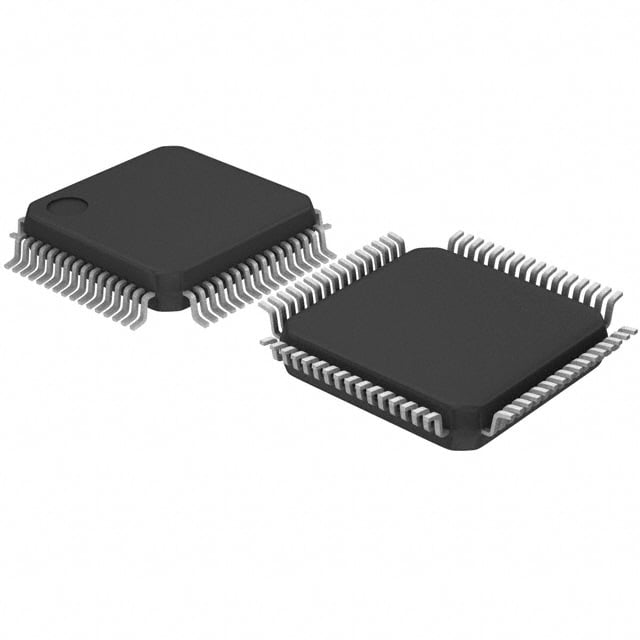
The Microchip Technology ATSAM3A4CA-CU is a high-performance 32-bit microcontroller based on the ARM Cortex-M3 processor, optimized for embedded applications requiring real-time performance, rich peripheral integration, and low power operation. It is part of the SAM3A family, targeting applications in industrial control, human-machine interfaces (HMI), consumer electronics, and connectivity systems. The device integrates flash memory, SRAM, multiple serial interfaces, timers, analog modules, and robust power management, making it suitable for complex embedded systems requiring deterministic control, efficient computation, and flexible connectivity.
## Core Architecture
The ATSAM3A4CA-CU leverages the ARM Cortex-M3 core for deterministic, high-efficiency processing:
* 32-bit ARM Cortex-M3 Core: Operates at up to 84 MHz, providing high-performance computation and low interrupt latency
* Thumb-2 Instruction Set: Enhances code density and execution efficiency for embedded applications
* Nested Vectored Interrupt Controller (NVIC): Provides deterministic interrupt handling with up to 36 interrupt sources
* Memory Protection Unit (MPU): Supports segmentation and protection for safer embedded code execution
* Low-Power Sleep Modes: Includes Sleep, Wait, and Backup modes for energy-efficient operation
The core architecture balances computational performance with low power consumption, supporting real-time processing in embedded systems.
## Memory and Storage
The ATSAM3A4CA-CU integrates both non-volatile and volatile memory to support application and data storage requirements:
* Flash Memory: 256 KB on-chip flash for program storage, supporting in-system programming and read-while-write functionality
* SRAM: 64 KB of internal SRAM for high-speed data processing and stack operations
* EEPROM Emulation Support: Flash can be used to emulate non-volatile storage for configuration parameters
* Memory Interface: Single-cycle access to SRAM and efficient flash access for deterministic performance
* Bootloader Support: Internal boot ROM provides in-system programming and debugging support
This memory configuration supports complex embedded applications requiring both large code footprints and fast data access.
## Peripheral Integration
The ATSAM3A4CA-CU offers extensive peripheral resources to support connectivity, control, and analog integration:
* Timers and PWM: Multiple 16-bit and 32-bit timers with capture/compare functionality and pulse-width modulation support
* Serial Interfaces:
* Up to 3 USARTs for asynchronous and synchronous communication
* 2 SPI interfaces for high-speed peripheral interfacing
* I²C/TWI interface for sensor and device communication
* USB Device Port: Full-speed USB 2.0 device interface for connectivity with host systems
* Analog Modules:
* 12-bit Analog-to-Digital Converter (ADC) with up to 16 channels and configurable sampling time
* 12-bit Digital-to-Analog Converter (DAC) for precise voltage generation
* External Bus Interface (EBI): For connection to external memories or peripherals
* General-Purpose I/Os: Up to 66 programmable pins supporting multiple functions including interrupt-on-change
The combination of timers, serial interfaces, and analog modules enables versatile application integration without the need for external components.
## Electrical Characteristics
The ATSAM3A4CA-CU operates over a broad range of voltage and temperature conditions suitable for industrial and consumer applications:
* Supply Voltage (VDD): 1.8 V to 3.6 V
* Operating Frequency: Up to 84 MHz maximum CPU clock
* Active Mode Current Consumption: 65 mA typical at 84 MHz, VDD = 3.3 V
* Sleep Mode Current: 1.2 mA typical with SRAM retention
* Backup Mode Current: 1 µA typical
* I/O Pin Characteristics: 5 mA source/sink capability per pin
* Operating Temperature Range: -40°C to +85°C industrial grade
* Junction Temperature (TJ): 125°C maximum
These electrical characteristics provide efficient operation in battery-powered or thermally constrained designs while maintaining reliability in industrial environments.
## Clock and Reset Management
The device integrates flexible clocking and reset options for robust system operation:
* Phase-Locked Loop (PLL): Allows frequency scaling for CPU and peripheral domains
* External and Internal Oscillators: Supports 32.768 kHz crystal for real-time clock (RTC) and high-speed crystals up to 12 MHz
* Power-On Reset (POR) and Brown-Out Detector (BOD): Ensures safe startup and operation under voltage fluctuations
* Watchdog Timer (WDT): Provides system supervision for autonomous recovery from software errors
These features support precise timing, deterministic execution, and robust system reliability.
## Power Management
The ATSAM3A4CA-CU is optimized for low-power embedded designs:
* Multiple low-power modes including Sleep, Wait, and Backup
* SRAM retention in low-power modes for fast wake-up without data loss
* Peripheral clock gating to minimize active current consumption
* Optimized core for high-efficiency instruction execution, reducing active-mode energy use
* Brown-out detection with programmable thresholds for battery-operated systems
Efficient power management allows operation in portable and energy-sensitive embedded applications.
## Package and Mechanical Features
The ATSAM3A4CA-CU is offered in a thermally efficient and compact package:
* Package Type: 100-pin LQFP (Low-profile Quad Flat Package)
* Package Dimensions: 14 mm × 14 mm typical
* Pin Count: 100 leads with dual-row configuration
* Lead Finish: RoHS-compliant, tin-lead-free for environmental safety
* Thermal Considerations: Exposed pad can be connected to PCB ground plane for heat dissipation
* Mechanical Stability: Compatible with automated PCB assembly and reflow soldering
The package ensures high pin density for complex embedded designs while supporting thermal management in high-performance applications.
## Applications
The ATSAM3A4CA-CU is suitable for a wide range of embedded applications:
* Industrial control systems with real-time processing requirements
* Human-Machine Interface (HMI) applications with multi-touch and display interfaces
* Embedded connectivity modules using USB, SPI, or I²C peripherals
* Motor control and power management in robotics and consumer electronics
* Data acquisition and sensor interfacing for instrumentation
* Low-power battery-operated systems requiring extended standby time
Its combination of high-performance ARM Cortex-M3 core, integrated peripherals, and flexible power management supports complex, real-time embedded systems.
## Conclusion
The Microchip Technology ATSAM3A4CA-CU is a high-performance 32-bit ARM Cortex-M3 microcontroller designed for complex embedded applications. With up to 84 MHz CPU clock, 256 KB flash, 64 KB SRAM, multiple serial interfaces, ADC/DAC support, and logic-level GPIOs, it offers both computational efficiency and peripheral versatility. Its low-power operation, sleep modes, and efficient peripheral clocking make it suitable for battery-powered and energy-sensitive designs. The device provides robust electrical, thermal, and package characteristics, ensuring reliable operation across industrial and consumer-grade conditions. The ATSAM3A4CA-CU is ideal for real-time control, HMI, connectivity, and sensor-based embedded systems requiring high-performance computation and flexible interfacing.