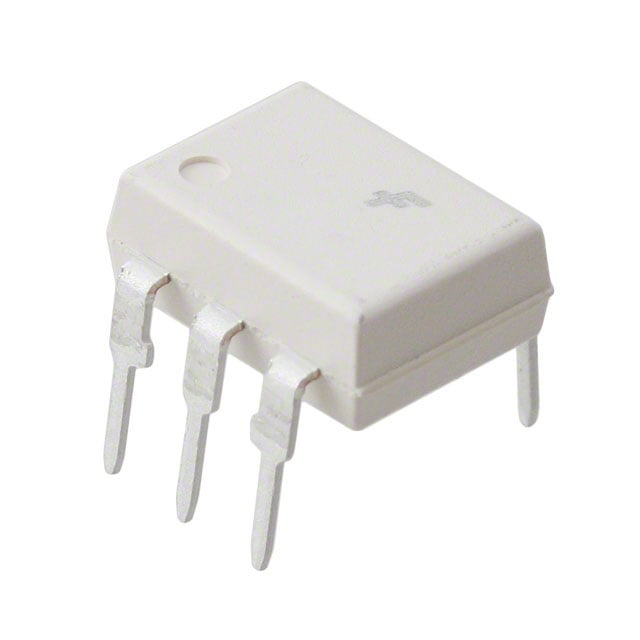
onsemi H11B2W Overview
The onsemi H11B2W is an optocoupler, specifically a phototransistor-type optocoupler designed to provide electrical isolation between circuits while transmitting data or signals. It is often used to separate different parts of an electrical system, such as isolating high-voltage components from low-voltage control circuits, protecting sensitive devices from power surges, and improving signal integrity in noisy environments. This component is ideal for applications requiring both electrical isolation and fast signal transmission.
Key Specifications
* Input LED Forward Voltage: The H11B2W features an input LED forward voltage of 1.2V (typical), which is the voltage drop across the LED when it is in operation. This ensures efficient energy usage when the input current flows through the LED.
* Output Voltage: The output phototransistor of the H11B2W has a collector-emitter voltage of 80V (maximum), allowing it to handle moderate voltage levels commonly encountered in control and signal transmission systems.
* Current Transfer Ratio (CTR): The H11B2W provides a current transfer ratio (CTR) between 50% and 600% at a forward current of 10mA. The CTR defines how effectively the input current is transferred to the output side, with a higher ratio indicating more efficient transmission of signals.
* Operating Temperature Range: The device is capable of operating within an extended temperature range of -40°C to +85°C, making it suitable for use in both industrial and commercial environments that experience varying temperatures.
* Isolation Voltage: The H11B2W provides a voltage isolation of 5kV RMS (min), ensuring that high voltages on the input side are safely isolated from the low-voltage circuits, protecting the sensitive components.
* Forward Current (If): The H11B2W is designed to handle a forward current of 50mA (max) through the LED input, making it capable of driving higher currents when required in applications with more demanding input conditions.
* Response Time: The optocoupler has a response time (tPLH/tPHL) of 10µs (max), allowing it to provide quick switching between states, making it suitable for high-speed signal transmission.
* Package Type: The H11B2W comes in a 4-pin DIP (Dual In-line Package), making it easy to integrate into both through-hole and surface-mount applications. This package type is compact and offers good mechanical stability, ensuring reliability in various systems.
Key Features
* Electrical Isolation: The primary feature of the H11B2W is its electrical isolation between the input and output. This isolation prevents high-voltage spikes and surges from damaging sensitive circuits, providing protection to downstream components.
* High-Speed Switching: With a response time of just 10µs, the H11B2W can switch signals quickly and accurately. This is crucial in applications where data or signal transmission speed is essential, such as in communication systems and switching power supplies.
* Low Power Consumption: The device operates with a low forward current and a small voltage drop across the LED, making it an efficient component for energy-sensitive applications. The low power consumption is beneficial in battery-powered systems and other low-energy designs.
* Noise Immunity: The optocoupler helps to protect against electromagnetic interference (EMI) and electrical noise, making it suitable for environments with high levels of noise or other electromagnetic disturbances.
* Compact and Robust Package: The DIP package is compact and robust, making it suitable for a variety of designs, from industrial control systems to consumer electronics. The packaging ensures that the optocoupler can handle mechanical stress and provide consistent performance over its lifecycle.
Applications
* Signal Isolation: The H11B2W is commonly used in signal isolation applications where electrical isolation between high-voltage and low-voltage sections is needed. It is ideal for interfacing microcontrollers or low-voltage logic systems with power electronics like motors and relays.
* Switching Power Supplies: The device is often used in switching power supplies to provide feedback between different stages of the power supply circuit while maintaining electrical isolation.
* Microprocessor Interfacing: It is frequently employed in microprocessor interfacing, particularly in systems where the microprocessor needs to communicate with high-voltage systems or peripherals while maintaining isolation for safety.
* Industrial Control Systems: The H11B2W is suitable for industrial control systems where high reliability and protection are required for the control circuits interfacing with sensors, actuators, and other industrial devices.
* Relay Drivers: The optocoupler is often used in relay driver circuits to control the operation of relays, providing isolation between the low-voltage control circuit and the high-power relay coil.
* Data Communication: The H11B2W can be used in data communication systems to transmit signals between different circuit parts, ensuring that high-voltage spikes from one part of the circuit do not affect the other parts of the system.
Conclusion
The onsemi H11B2W is a versatile and efficient optocoupler, providing both electrical isolation and high-speed signal transmission. With its wide operating voltage range, fast response time, low power consumption, and high isolation voltage, it is an ideal component for various industrial, control, and signal processing applications. Its compact DIP package and robust performance characteristics make it well-suited for integration into both consumer electronics and industrial systems, offering reliability and protection in environments where electrical isolation is crucial.