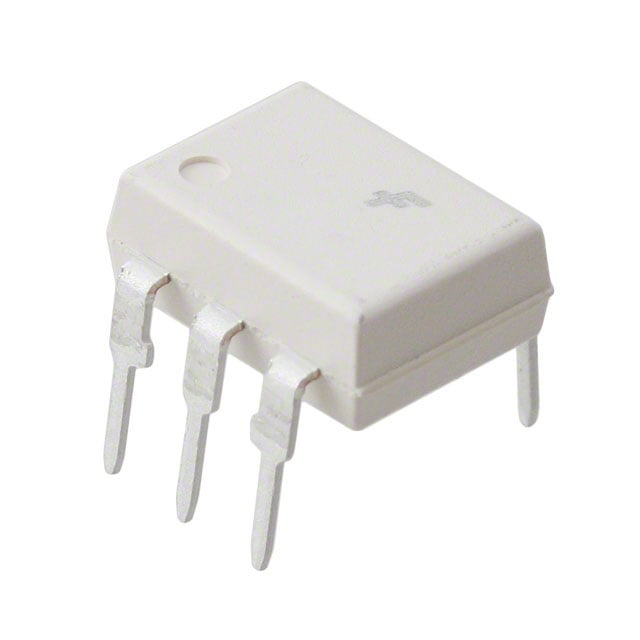
The onsemi H11AA1SR2M is a dual-channel optically coupled isolator designed specifically for AC input detection and zero-crossing sensing applications. It belongs to the H11AA1 family of optocouplers, which integrate two infrared-emitting diodes in inverse-parallel configuration on the input side and a phototransistor on the output side. This architecture enables direct interfacing with AC signals without requiring external bridge rectification, making it suitable for AC line monitoring, phase detection, and isolated logic interfacing. The device provides galvanic isolation between input and output circuits, ensuring safety and noise immunity in high-voltage environments. The SR2M suffix indicates a specific packaging and tape-and-reel configuration variant optimized for automated assembly processes.
## Device Function and Operating Principle
The H11AA1SR2M operates by converting AC input current into optical radiation using two anti-parallel infrared LEDs. Because of this inverse-parallel configuration, the device responds to both positive and negative half-cycles of an AC waveform. When either LED is forward biased, it emits infrared light proportional to the input current. This light is detected by a silicon NPN phototransistor on the output side, which switches accordingly.
The output phototransistor operates in a common-emitter configuration and provides a digital-like output signal corresponding to the presence or absence of sufficient input current. This makes the device suitable for zero-cross detection and AC presence indication rather than analog signal transmission.
The galvanic isolation barrier between input and output typically provides isolation voltage ratings in the kilovolt range, ensuring safe operation in mains-connected systems.
## Electrical Input Characteristics
The input side consists of two infrared GaAs LEDs connected in inverse parallel. Each LED has a forward voltage characteristic typical of infrared emitters, and the device requires a forward current to achieve proper optical coupling. The forward current required for guaranteed operation is specified in datasheet conditions and is typically in the milliampere range, depending on required output current transfer ratio (CTR).
The inverse-parallel configuration allows operation directly from AC mains or AC signal sources without polarity sensitivity. The device is designed to withstand repetitive forward current pulses corresponding to line-frequency operation (50/60 Hz), with adequate surge capability for transient conditions.
Input power dissipation is determined by LED forward voltage and input current, and must be controlled within maximum ratings to prevent thermal overstress.
## Output Electrical Characteristics
The output stage is a silicon NPN phototransistor. Its collector-emitter breakdown voltage is typically rated to support standard logic interface voltages and isolated signal conditioning circuits. When illuminated, the phototransistor enters saturation depending on input LED current and load resistance.
Key electrical parameters include current transfer ratio (CTR), which defines the ratio between input LED current and output collector current. This parameter is not fixed and varies with temperature, input current, and device aging. The CTR range is specified in grouped bins in datasheet classification and is a critical design parameter for ensuring reliable switching behavior.
The output saturation voltage is defined under specified collector current and LED input current conditions and is typically low enough to allow direct interfacing with CMOS or TTL logic inputs when properly biased.
Switching times include turn-on and turn-off delays determined by LED recombination time and phototransistor storage time. These parameters define the device’s suitability for low-frequency AC detection and digital signal isolation.
## Isolation and Safety Characteristics
The H11AA1SR2M provides reinforced galvanic isolation between input and output circuits. The isolation voltage rating is defined for safety compliance in mains-connected systems and is typically specified as either RMS or peak withstand voltage depending on regulatory classification.
Isolation performance is achieved through an optically transparent insulating barrier within the package. This barrier ensures no electrical conduction between input and output, providing protection against high-voltage transients and ground potential differences.
Creepage and clearance distances within the package are designed to meet safety agency requirements for reinforced or basic insulation, depending on application classification.
## Thermal and Mechanical Characteristics
The device is housed in a standard dual-in-line or surface-mount optocoupler package depending on suffix configuration. The SR2M variant is typically supplied in tape-and-reel format for automated SMT assembly.
Thermal performance is primarily determined by LED power dissipation and phototransistor collector dissipation. Junction temperature limits are specified to ensure long-term reliability under continuous operation. Derating curves define allowable current as a function of ambient temperature.
Mechanical robustness includes resistance to vibration and thermal cycling consistent with industrial-grade optoelectronic components. The encapsulation material is designed to maintain optical coupling stability over time and environmental exposure.
## Applications
The H11AA1SR2M is primarily used in AC line monitoring circuits, including zero-cross detection for phase control systems such as TRIAC-based dimmers and motor speed controllers. It is also used in industrial automation systems for detecting AC presence or failure conditions in power distribution networks.
Additional applications include isolated input sensing for microcontroller-based systems, where direct connection to mains or high-voltage AC signals is required without electrical hazard. It is also used in PLC input modules, power supply monitoring circuits, and energy metering systems where galvanic isolation and AC waveform detection are required.
## Conclusion
The onsemi H11AA1SR2M is a dual LED-input phototransistor optocoupler optimized for AC input detection and galvanically isolated signal transfer. Its inverse-parallel LED configuration enables direct AC interface capability, while the phototransistor output provides reliable switching for digital systems. Key characteristics include controlled LED forward current operation, CTR-dependent output behavior, and reinforced isolation suitable for mains-connected applications. The device is widely used in zero-cross detection, AC presence sensing, and industrial isolation interfaces where safety and signal integrity are critical requirements.