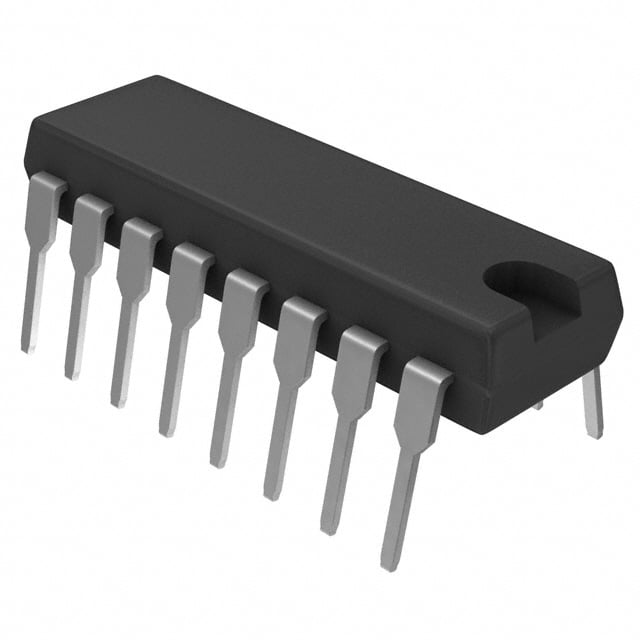
The Texas Instruments SN74ALS157ADR is a quad 2-input multiplexer/demultiplexer that offers versatile data routing capabilities in digital circuits. Designed for high-speed applications, this device is well-suited for data switching and multiplexing in various digital systems. Its TTL-compatible inputs and outputs ensure compatibility with a wide range of logic families.
## Key Features
1. Quad 2-Input Multiplexer/Demultiplexer:
- Contains four independent 2-input multiplexers, allowing for the selection of one of two inputs for each channel.
2. High-Speed Operation:
- Typical propagation delay of 8 ns at Vcc = 5 V, making it ideal for high-speed applications.
3. TTL-Compatible:
- Designed to operate with TTL logic levels, ensuring compatibility with existing TTL circuits.
4. Low Power Consumption:
- Operates with a low supply current, which is beneficial for battery-operated devices.
5. Wide Supply Voltage Range:
- Operating voltage ranges from 4.5 V to 5.5 V, providing flexibility for various power supply designs.
6. High Noise Immunity:
- Features a noise margin that ensures reliable operation even in noisy environments.
7. Pin Configuration:
- Offered in a 16-pin TSSOP package, which is compact and suitable for space-constrained applications.
## Specifications
## Electrical Characteristics
- Supply Voltage (Vcc): 4.5 V to 5.5 V
- Input Voltage (VIH): Minimum 2 V (high level), Maximum 5.5 V
- Input Voltage (VIL): Maximum 0.8 V (low level)
- Output Voltage (VOH): Minimum 2.4 V (high level at 4.5 V)
- Output Voltage (VOL): Maximum 0.4 V (low level at 4.5 V)
- Supply Current (ICC): 1 mA (maximum)
- Propagation Delay (tPD): 8 ns (typical at Vcc = 5 V)
- Rise Time (tR): 6 ns (typical)
- Fall Time (tF): 5 ns (typical)
## Performance Characteristics
- Input Capacitance (CIN): 3 pF (typical)
- Output Capacitance (COUT): 5 pF (typical)
- Power Dissipation (PD): 1.5 mW (typical)
- Operating Temperature Range: -40°C to +85°C
## Logic Diagram
The device operates as a multiplexer, where each multiplexer can select between two inputs (A or B) based on the control signal (S). The selected input is directed to the output (Y).
## Applications
The SN74ALS157ADR is widely used in various applications, including:
1. Data Routing:
- Ideal for routing data between multiple sources and destinations in communication systems.
2. Signal Switching:
- Useful in applications where switching between different signal paths is required.
3. Digital Signal Processing:
- Can be employed in DSP applications for selecting between different data streams.
4. Microprocessor Interfaces:
- Commonly used in microprocessor-based designs for expanding input/output capabilities.
5. Multiplexing Applications:
- Effective in multiplexing data from multiple sources to a single output line.
## Design Considerations
When using the SN74ALS157ADR, consider the following design aspects:
- Power Supply Decoupling:
- Ensure adequate decoupling capacitors are placed close to the power supply pins to minimize noise and stabilize operation.
- Signal Integrity:
- Maintain short traces for signal paths to reduce capacitance and potential signal degradation.
- Temperature Range:
- Verify that the operating conditions stay within the specified temperature range to ensure reliable performance.
## Development Tools and Resources
Texas Instruments provides a variety of resources to aid in the development process, including:
- Datasheets:
- Comprehensive documentation detailing specifications, electrical characteristics, and application notes.
- Evaluation Modules:
- Available evaluation boards to facilitate testing and prototyping.
- Simulation Models:
- SPICE models are accessible for simulation in design software, aiding in the validation of circuit performance.
## Conclusion
The Texas Instruments SN74ALS157ADR is a reliable and versatile quad 2-input multiplexer/demultiplexer that is well-suited for high-speed data routing applications. With its low power consumption, TTL compatibility, and compact package, it is an excellent choice for a variety of digital design needs. For more detailed information, designers can refer to the official Texas Instruments datasheet.