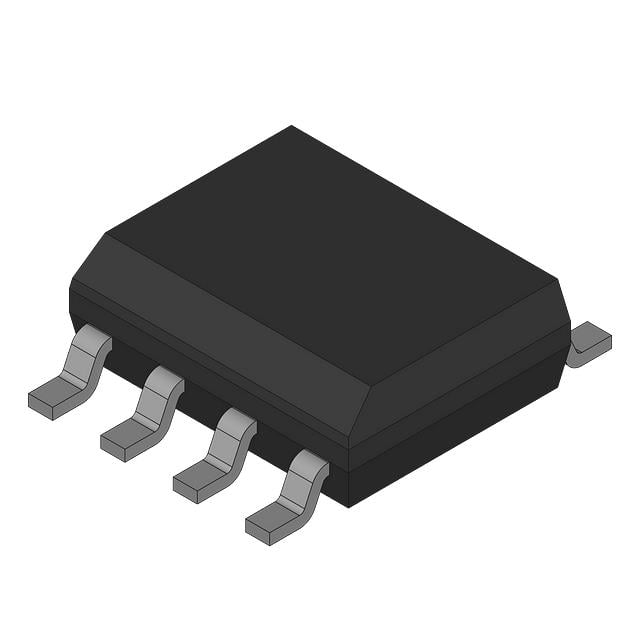
Q1: What is the Texas Instruments OPA2333AIDR?
A1: The Texas Instruments OPA2333AIDR is a precision, low-power operational amplifier (op-amp) designed for use in a variety of applications requiring low offset voltage, low drift, and low power consumption.
Q2: What is the typical input offset voltage of the OPA2333AIDR?
A2: The OPA2333AIDR typically features an input offset voltage as low as 25 µV, making it ideal for precision measurement applications.
Q3: What is the supply voltage range for the OPA2333AIDR?
A3: The OPA2333AIDR operates over a supply voltage range of 1.8V to 5.5V, allowing it to be used in both low-voltage and standard systems.
Q4: What is the power consumption of the OPA2333AIDR?
A4: The OPA2333AIDR has very low power consumption, typically consuming just 4 µA of supply current, making it suitable for battery-operated devices and power-sensitive applications.
Q5: Does the OPA2333AIDR have a rail-to-rail output?
A5: Yes, the OPA2333AIDR features a rail-to-rail output, which allows the op-amp to output voltage levels that can range from the negative supply rail to the positive supply rail.
Q6: What is the typical gain-bandwidth product of the OPA2333AIDR?
A6: The OPA2333AIDR has a typical gain-bandwidth product of 0.08 MHz, which provides sufficient bandwidth for many general-purpose applications.
Q7: What is the quiescent current of the OPA2333AIDR?
A7: The OPA2333AIDR has a very low quiescent current, typically around 4 µA, making it ideal for low-power designs.
Q8: Is the OPA2333AIDR suitable for precision measurement applications?
A8: Yes, due to its low input offset voltage, low drift, and high precision, the OPA2333AIDR is well-suited for applications requiring accurate measurements, such as sensor interfacing and instrumentation.
Q9: What is the output voltage swing of the OPA2333AIDR?
A9: The OPA2333AIDR provides a wide output voltage swing, typically from (Vss + 0.002V) to (Vdd - 0.002V), depending on the load.
Q10: What are the key features of the OPA2333AIDR?
A10: Key features of the OPA2333AIDR include low input offset voltage, low drift, rail-to-rail output, low power consumption, and small package sizes, making it ideal for precision, low-power applications.
Q11: Does the OPA2333AIDR have any special temperature characteristics?
A11: Yes, the OPA2333AIDR features a low temperature coefficient, with input offset voltage typically drifting at only 0.05 µV/°C, ensuring stable performance over a wide temperature range.
Q12: Can the OPA2333AIDR be used in automotive applications?
A12: Yes, the OPA2333AIDR can be used in automotive applications, especially in low-power sensors or systems requiring high precision and reliability under varying temperature conditions.
Q13: What is the package type for the OPA2333AIDR?
A13: The OPA2333AIDR is available in a 5-pin SOT-23 package, which is small and compact, suitable for space-constrained applications.
Q14: What is the input voltage range of the OPA2333AIDR?
A14: The input voltage range of the OPA2333AIDR is from 0V to (Vdd - 0.5V), which makes it compatible with a wide range of signal sources.
Q15: Is the OPA2333AIDR ideal for audio applications?
A15: Yes, the OPA2333AIDR is suitable for audio applications that require low distortion, low noise, and high precision, such as audio amplification and signal processing.
Q16: Does the OPA2333AIDR have short-circuit protection?
A16: Yes, the OPA2333AIDR includes internal short-circuit protection, ensuring robust operation even under fault conditions.
Q17: What is the input bias current of the OPA2333AIDR?
A17: The OPA2333AIDR has an ultra-low input bias current of 0.1 nA, making it ideal for high-impedance applications where low current leakage is critical.
Q18: Is the OPA2333AIDR suitable for use in industrial applications?
A18: Yes, the OPA2333AIDR is suitable for industrial applications that require precision, low power, and high reliability, such as process control systems and sensor interfacing.
Q19: Can the OPA2333AIDR be used in medical devices?
A19: Yes, the OPA2333AIDR’s low power consumption, precision, and reliability make it suitable for use in medical devices such as diagnostic instruments and patient monitoring systems.
Q20: What is the common-mode rejection ratio (CMRR) of the OPA2333AIDR?
A20: The OPA2333AIDR features a typical common-mode rejection ratio (CMRR) of 120 dB, ensuring excellent rejection of common-mode signals in differential applications.