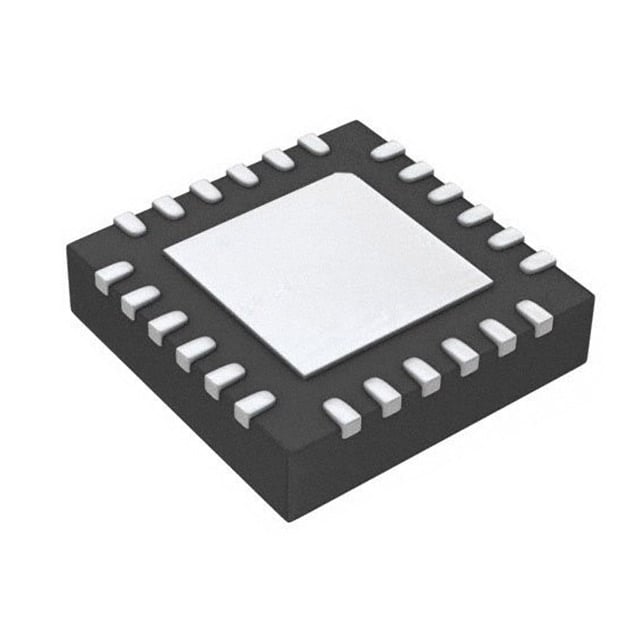
Overview of Silicon Labs CP2109-A01-GM
The Silicon Labs CP2109-A01-GM is a highly integrated USB-to-UART bridge controller designed to facilitate easy and reliable communication between USB and serial UART interfaces. It enables seamless connectivity for devices that require USB communication but natively support UART, such as embedded systems, industrial equipment, and communication devices. The CP2109 series is renowned for its robust USB compliance, low power consumption, and versatile feature set, making it a popular choice for developers requiring efficient USB to serial conversion.
Key Features
* Fully integrated USB-to-UART bridge controller supporting USB 2.0 full-speed (12 Mbps)
* Single-chip solution with integrated USB transceiver, oscillator, and power management
* Supports asynchronous UART interface with programmable baud rates up to 1 Mbps
* Multiple UART data formats supported including 5, 6, 7, or 8 data bits, parity, and stop bits
* Integrated EEPROM for customization of USB descriptors, device ID, and product strings
* Supports automatic baud rate detection and hardware flow control (RTS/CTS)
* Low power consumption with support for USB suspend mode and selective suspend
* Robust USB compliance with Microsoft WHQL certification and wide OS driver support (Windows, Linux, macOS)
* USB suspend current typically less than 2 mA, operational current around 25 mA
* Integrated voltage regulator supporting single 3.3 V or 5 V power supply
* Supports flexible power modes: bus-powered or self-powered operation
* Provides multiple GPIO pins for general-purpose control or handshaking
* 24 MHz crystal oscillator or external clock input support for USB timing
* Operating temperature range: –40°C to +85°C for industrial applications
* Available in a compact 28-pin QFN package ideal for space-constrained designs
Electrical Specifications
* USB Specification: USB 2.0 full-speed (12 Mbps) compliant
* UART Interface: Asynchronous serial interface with programmable baud rates from 300 bps up to 1 Mbps
* Supply Voltage: 3.0 V to 3.6 V (core), USB 5 V supply support via VBUS
* Power Consumption:
* Active mode: Approximately 25 mA typical
* Suspend mode: Less than 2 mA typical
* EEPROM: Integrated with capacity around 1 KB for user customization
* GPIO Pins: Up to 4 configurable GPIO pins for additional functionality
* Operating Temperature Range: –40°C to +85°C
* Package: 28-pin QFN, 5 mm × 5 mm body size
Functional Description
The CP2109-A01-GM serves as a bridge between USB and UART communication protocols by converting USB data streams into UART-compatible signals and vice versa. This device is widely used in embedded systems that require USB connectivity but internally communicate via serial ports.
Its integrated USB transceiver and oscillator simplify system design by eliminating the need for external USB interface components. The onboard EEPROM allows device-specific configuration, enabling manufacturers to customize USB vendor and product IDs, serial numbers, and other descriptors to meet branding or functional requirements.
The UART interface supports a wide range of baud rates, data formats, and hardware flow control options (RTS/CTS), ensuring compatibility with diverse UART-enabled devices. Automatic baud rate detection eases integration in systems where baud rate changes may occur dynamically.
The CP2109's power management features include USB suspend and selective suspend modes, reducing power consumption during idle periods and facilitating compliance with USB power standards.
The inclusion of multiple GPIO pins extends the device’s versatility, enabling additional hardware signaling or control without extra microcontroller resources.
Its compatibility with major operating systems through native drivers, including Windows (with signed drivers), Linux, and macOS, allows plug-and-play functionality and broad application scope.
Package and Mechanical Details
* Package Type: 28-pin Quad Flat No-lead (QFN)
* Package Dimensions: 5 mm × 5 mm body size
* Pin Pitch: 0.5 mm
* Mounting Style: Surface mount technology (SMT)
* Thermal Resistance Junction-to-Ambient (RθJA): Typically around 40°C/W depending on PCB layout
* Moisture Sensitivity Level (MSL): Level 3 or better, compatible with standard reflow soldering
* RoHS Compliant and Lead-Free
Typical Applications
* USB to serial converters for embedded systems
* Industrial automation equipment with legacy serial interfaces
* USB connectivity for consumer electronics and handheld devices
* Point-of-sale terminals and barcode scanners
* Medical instrumentation requiring USB communication
* Communication and networking devices
* Firmware upgrade and debugging interfaces
* Control panels and data acquisition systems
Advantages
* Highly integrated single-chip solution reduces PCB size and design complexity
* Flexible UART configuration supports a broad range of serial communication standards
* Integrated EEPROM enables product customization and differentiation
* Low power consumption with support for USB power management enhances energy efficiency
* Multiple GPIO pins add system control and expandability options
* Broad operating temperature range ensures reliability in harsh environments
* Robust USB compliance and native OS driver support simplify system integration
* Compact QFN package optimizes space without sacrificing thermal performance
Conclusion
The Silicon Labs CP2109-A01-GM is a robust, flexible, and power-efficient USB-to-UART bridge controller tailored for modern embedded and industrial applications that require seamless USB connectivity with legacy serial interfaces. Its rich feature set, including flexible UART configurations, customizable EEPROM, and low power modes, combined with broad OS compatibility and compact packaging, makes it an ideal solution for developers seeking to integrate reliable USB communication in space-constrained and power-sensitive designs.