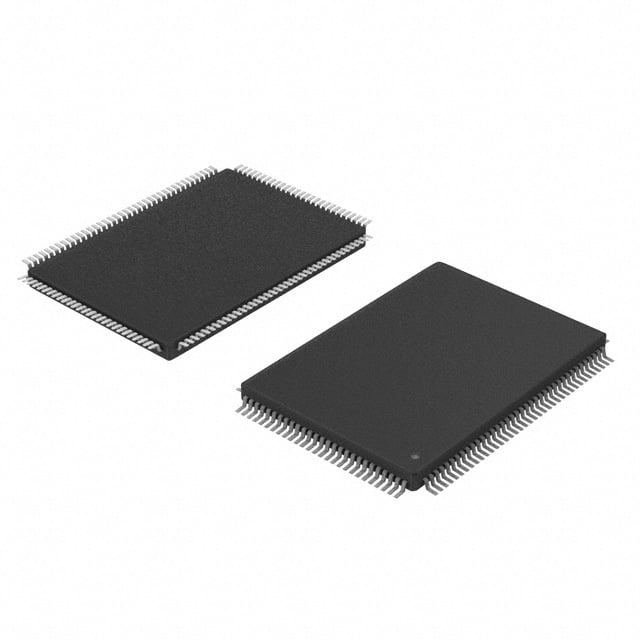
Here are 20 FAQs for the NXP Semiconductors MCIMX287CVM4C:
Q1: What is the NXP Semiconductors MCIMX287CVM4C?
A1: The MCIMX287CVM4C is a high-performance microcontroller from NXP's i.MX series, built around the ARM Cortex-M4 core. It is designed for embedded applications requiring high-speed processing, low power consumption, and multimedia capabilities.
Q2: What is the core architecture of the MCIMX287CVM4C?
A2: The MCIMX287CVM4C is based on the ARM Cortex-M4 core, which provides a good balance between performance and power efficiency, particularly for real-time control applications.
Q3: What is the clock speed of the MCIMX287CVM4C?
A3: The MCIMX287CVM4C operates at a clock speed of up to 200 MHz, providing the processing power needed for demanding embedded tasks.
Q4: How much RAM does the MCIMX287CVM4C have?
A4: The MCIMX287CVM4C includes 256KB of SRAM, which is useful for storing variables, buffers, and other real-time data.
Q5: How much flash memory is available on the MCIMX287CVM4C?
A5: The MCIMX287CVM4C has 512KB of internal flash memory, providing ample storage for program code, configuration data, and other non-volatile information.
Q6: What peripherals are available on the MCIMX287CVM4C?
A6: The MCIMX287CVM4C includes a wide variety of peripherals such as UARTs, I2C, SPI, GPIOs, CAN, and PWM outputs, allowing it to interface with a range of external devices.
Q7: What is the voltage range for the MCIMX287CVM4C?
A7: The MCIMX287CVM4C operates with a voltage range of 3.0V to 3.6V, making it suitable for most modern embedded systems.
Q8: Does the MCIMX287CVM4C support real-time processing?
A8: Yes, the MCIMX287CVM4C, with its ARM Cortex-M4 core, is optimized for real-time processing, making it ideal for applications such as motor control, industrial automation, and sensors.
Q9: What is the power consumption of the MCIMX287CVM4C?
A9: The MCIMX287CVM4C is designed for low-power applications, with typical current consumption of around 20mA during normal operation, depending on the configuration and workload.
Q10: Does the MCIMX287CVM4C have a built-in DSP or FPU?
A10: Yes, the MCIMX287CVM4C includes a floating-point unit (FPU) and a digital signal processor (DSP) capability, which enhances its performance in applications involving signal processing or complex mathematical calculations.
Q11: What is the temperature range for the MCIMX287CVM4C?
A11: The MCIMX287CVM4C operates within a temperature range of -40°C to +105°C, making it suitable for industrial and automotive environments.
Q12: Does the MCIMX287CVM4C have an integrated display controller?
A12: Yes, the MCIMX287CVM4C has an integrated display controller that can drive a small display, such as an LCD, which is useful in applications requiring user interfaces.
Q13: What communication interfaces are available on the MCIMX287CVM4C?
A13: The MCIMX287CVM4C offers several communication interfaces including UART, I2C, SPI, and CAN, enabling connectivity with a wide range of external devices and systems.
Q14: Is the MCIMX287CVM4C suitable for automotive applications?
A14: Yes, the MCIMX287CVM4C is designed to meet the requirements of automotive applications, including robust temperature performance and support for communication protocols such as CAN.
Q15: Does the MCIMX287CVM4C support DMA (Direct Memory Access)?
A15: Yes, the MCIMX287CVM4C supports DMA, allowing high-speed data transfers between memory and peripherals without involving the processor, which improves system performance.
Q16: Can the MCIMX287CVM4C interface with external memory?
A16: Yes, the MCIMX287CVM4C has support for external memory interfaces, including external flash and SRAM, to expand storage or RAM capacity for larger applications.
Q17: What development tools are compatible with the MCIMX287CVM4C?
A17: The MCIMX287CVM4C is compatible with popular development tools such as NXP’s MCUXpresso IDE, as well as third-party tools like Keil and IAR Embedded Workbench.
Q18: Does the MCIMX287CVM4C support software libraries for specific applications?
A18: Yes, NXP provides various software libraries, including real-time operating system (RTOS) support, peripheral drivers, and application-specific libraries to accelerate development with the MCIMX287CVM4C.
Q19: What are some common applications for the MCIMX287CVM4C?
A19: The MCIMX287CVM4C is ideal for automotive, industrial control, IoT devices, robotics, sensor processing, and other embedded applications requiring real-time control, low power, and flexibility.
Q20: How can I start a project with the MCIMX287CVM4C?
A20: To start a project with the MCIMX287CVM4C, you can use NXP’s development kits, available from their website, and use MCUXpresso IDE or other compatible tools for software development. NXP’s reference designs and application notes are also great resources to begin with.