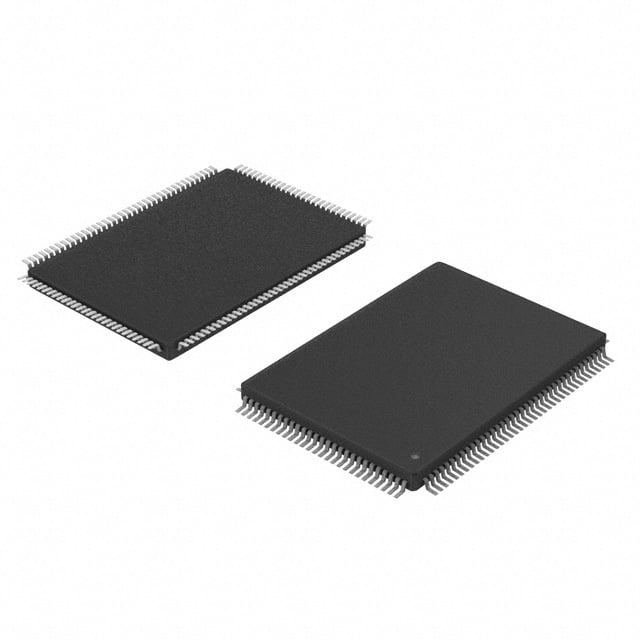
The Microchip Technology USB5807CT-I/KD is a high-performance, fully integrated USB 3.1 Gen 1 hub controller designed to expand a single upstream USB host port into multiple downstream USB ports with enhanced bandwidth management, robust power control, and industrial-grade reliability. It is intended for embedded systems, docking stations, industrial hubs, and computing platforms requiring deterministic USB expansion with integrated power and port management capabilities.
## Device Function and System Positioning
The USB5807CT-I/KD is a seven-port USB 3.1 Gen 1 hub controller that provides one upstream port and multiple downstream ports for peripheral expansion. It operates as a protocol-layer USB hub compliant with USB 3.1 Gen 1 (5 Gbps signaling rate on SuperSpeed links), while maintaining backward compatibility with USB 2.0 and USB 1.1 devices through integrated multi-speed transaction routing.
The device integrates hub repeater logic, transaction translator functionality, and USB protocol engine into a single monolithic IC. It is positioned for systems requiring centralized USB expansion with integrated port power switching, overcurrent detection, and configuration flexibility through external EEPROM or SMBus/I²C-based configuration mechanisms.
## USB Architecture and Data Path Organization
The hub implements a dual-bus architecture separating SuperSpeed (USB 3.1 Gen 1) and high/full/low-speed (USB 2.0/1.1) traffic. This separation enables independent routing of high-bandwidth and legacy traffic, improving overall throughput efficiency and minimizing contention between different device classes.
The internal SuperSpeed hub logic manages packet routing at 5 Gbps per lane, while the USB 2.0 transaction translator handles protocol conversion between upstream and downstream devices operating at different speeds. This architecture ensures backward compatibility without degrading high-speed channel performance.
Each downstream port is individually managed for link training, power enable control, and fault isolation, allowing independent operation of connected peripherals.
## Key Electrical and Functional Parameters (Datasheet-Level Defined Characteristics)
The device operates from a single main supply rail typically used for 3.3 V or derived internal core voltages depending on subsystem domains. Internal regulators generate required core voltages for USB PHYs, digital logic, and analog front-end circuits.
The upstream interface supports USB 3.1 Gen 1 signaling at 5 Gbps and includes integrated termination and equalization control to maintain signal integrity across PCB traces and connectors. Downstream ports also support 5 Gbps SuperSpeed operation, with automatic fallback to USB 2.0 or USB 1.1 modes when required by attached devices.
The hub includes integrated clock generation circuitry, typically based on an external crystal oscillator reference, which provides the timing base for both SuperSpeed and USB 2.0 transaction domains. Clock distribution is internally managed to minimize jitter and maintain compliance with USB eye diagram requirements.
The device supports multiple downstream ports with per-port power switching control, allowing software or hardware-driven enable/disable of individual ports. Each port includes overcurrent detection input capability for external power switch monitoring.
Configuration flexibility is provided through external non-volatile memory interfaces or strapping pins, allowing customization of vendor ID, product ID, port enablement, power modes, and hub behavior at boot.
## Power Management and Port Control
The USB5807CT-I/KD integrates advanced power management features designed to comply with USB power delivery and hub power classification requirements. It supports self-powered and bus-powered configurations depending on system implementation.
Each downstream port can be individually controlled for power enablement, allowing fine-grained management of peripheral power consumption. Overcurrent detection inputs allow the hub to respond to external power switch fault signals and protect both upstream host and downstream devices.
The device supports suspend and resume functionality in accordance with USB specifications. In suspend mode, internal logic reduces power consumption while maintaining wake-up detection capability for remote resume events initiated by downstream devices or upstream host signaling.
## Reset, Initialization, and Configuration Behavior
Upon power-up, the device enters an initialization sequence during which internal regulators stabilize and clock sources lock. Configuration data is then loaded from external EEPROM or determined via hardware strapping pins depending on system design.
The hub requires proper reset sequencing to ensure correct enumeration on the upstream USB host. After reset release, the device performs internal self-configuration and presents itself as a standard USB hub device compliant with USB enumeration protocols.
VID/PID customization and descriptor configuration are supported through external configuration memory, allowing OEM-level branding and system integration without firmware modification inside the host system.
## Signal Integrity and High-Speed Design Considerations
The USB5807CT-I/KD incorporates internal equalization and transmit pre-emphasis control to maintain signal integrity across PCB channels and external connectors. These features are critical for maintaining compliance with USB 3.1 Gen 1 eye diagram and jitter requirements.
The physical layer design includes impedance-controlled differential signaling paths for SuperSpeed lanes, requiring careful PCB layout to minimize insertion loss, crosstalk, and return loss. The integrated PHYs are designed to interface directly with standard USB connectors without external analog conditioning components beyond standard decoupling and termination networks.
The device includes integrated ESD protection structures compliant with USB interface robustness requirements, reducing the need for extensive external protection components in typical designs.
## Package and Mechanical Characteristics
The USB5807CT-I/KD is supplied in a thermally enhanced, fine-pitch surface-mount package optimized for high-density PCB integration. The package supports multiple high-speed differential pairs and power domains while maintaining controlled impedance routing constraints.
The thermal design allows heat dissipation through the exposed pad structure, which must be connected to PCB ground or thermal planes for optimal performance under sustained high-port utilization conditions.
The device is fully compatible with standard lead-free reflow soldering processes and is intended for automated assembly in high-volume manufacturing environments.
## Typical Application Scenarios
The USB5807CT-I/KD is used in embedded computing systems requiring multiple USB ports from a single upstream host connection. This includes industrial PCs, embedded controllers, and single-board computer platforms where native USB port count is insufficient.
It is also widely used in docking stations and port replicators, where a single USB upstream connection must be expanded into multiple downstream ports for peripherals such as storage devices, input devices, and communication interfaces.
Additional applications include consumer electronics hubs, automotive infotainment expansion modules, and test equipment requiring controlled USB device access and isolation between multiple peripherals.
## Conclusion
The Microchip USB5807CT-I/KD is a fully integrated seven-port USB 3.1 Gen 1 hub controller designed for high-speed USB expansion in embedded, industrial, and consumer systems. Its dual-bus architecture, integrated power management, configurable port control, and robust high-speed PHY implementation enable reliable multi-device connectivity with strict compliance to USB specifications. The device is optimized for scalable USB topology expansion where signal integrity, power control, and system-level configurability are critical design requirements.