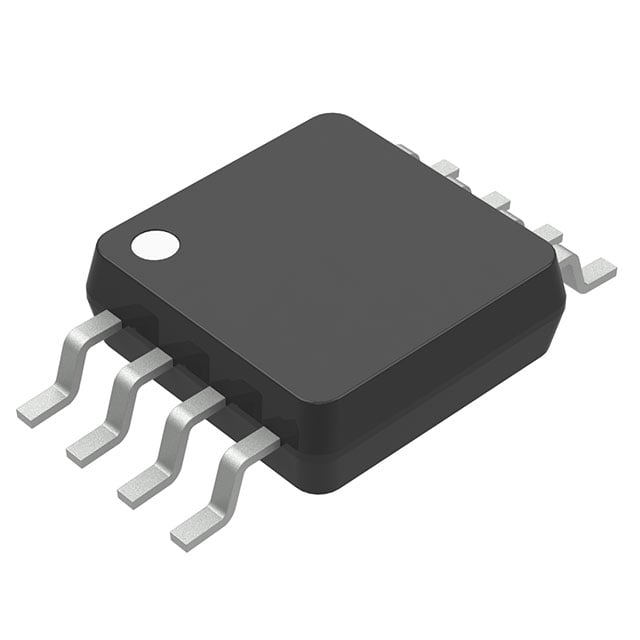
The Microchip 24LC00T-I/MC is a low-density serial Electrically Erasable Programmable Read-Only Memory (EEPROM) device designed for simple, low-cost, low-pin-count nonvolatile data storage applications. It implements a 2-wire I2C-compatible serial interface and is positioned in Microchip’s “24LCxx” family as a minimal-capacity EEPROM optimized for identification, configuration storage, and small parameter retention in embedded systems. The device is commonly used where byte-level nonvolatile memory is required without the complexity or overhead of larger EEPROM architectures.
## Device Function and Architectural Positioning
The 24LC00T-I/MC provides nonvolatile storage organized as a small EEPROM array accessed through an I2C serial interface. It operates as a slave device on a bidirectional two-wire bus consisting of serial clock (SCL) and serial data (SDA). Unlike higher-density EEPROMs in the same family, this device is characterized by a simplified addressing scheme, reflecting its extremely small memory size and reduced internal addressing overhead.
The device is intended for applications requiring storage of minimal configuration data, such as device identification codes, calibration constants, or system configuration flags. Its architecture supports byte-oriented read and write operations under standard I2C protocol transactions.
## Electrical Interface and Communication Characteristics
The device is fully compliant with the I2C serial communication protocol, operating as a slave device. It supports standard-mode operation on the I2C bus. The communication structure includes device addressing, data transfer, and acknowledge signaling consistent with I2C EEPROM behavior.
The 24LC00T-I/MC uses a fixed or minimally configurable slave addressing structure typical of very small EEPROM devices. The addressing mechanism does not require multi-byte internal memory addressing due to the extremely limited memory space. Data transactions are executed using control bytes followed directly by data bytes, depending on the bus operation mode (read or write cycle).
The SDA pin is open-drain and requires an external pull-up resistor to VCC, consistent with standard I2C bus requirements. The SCL line is driven by the bus master and synchronizes all data transfers.
## Memory Organization and Data Handling
The internal memory organization is a small EEPROM array with byte-level access. The device supports single-byte write and read operations. Due to the minimal memory capacity, internal addressing is simplified compared to larger EEPROMs; the addressing field used in I2C transactions is reduced accordingly.
Write operations involve loading a byte into the EEPROM cell array followed by an internal write cycle, during which the memory is non-volatilely programmed. Read operations allow direct retrieval of stored data bytes via sequential bus transactions.
The EEPROM architecture ensures data retention without power, enabling reliable storage of configuration parameters across power cycles. The write cycle is internally timed, and the device requires completion of the write cycle before new write operations can be initiated.
## Electrical Specifications and Operating Conditions
The 24LC00T-I/MC operates within a defined supply voltage range suitable for low-voltage digital systems. The device is designed for operation in industrial temperature-grade environments, indicated by the “I” suffix in the part number. This denotes extended temperature capability appropriate for embedded and industrial control systems.
The device features low standby current consumption, making it suitable for battery-powered or low-power embedded applications. Active current consumption is present during read and write cycles, with significantly reduced current in standby state when the I2C bus is idle.
Input and output logic levels are compatible with standard CMOS/TTL interfacing within the specified supply voltage range. The open-drain architecture of SDA ensures compatibility with multi-device I2C buses.
## Timing and Write Cycle Characteristics
The device supports standard I2C timing parameters including setup and hold times for data relative to the clock signal. The maximum clock frequency is defined according to standard-mode I2C operation.
Write cycle time is an important operational parameter, as internal EEPROM programming requires a finite duration to complete. During this time, the device will not acknowledge further write commands. This behavior is typically handled in system firmware through acknowledge polling or timed delays.
Read operations are faster compared to write cycles and are immediately responsive following correct bus addressing and command issuance.
## Package and Mechanical Configuration
The 24LC00T-I/MC is provided in a small-outline surface-mount package suitable for compact PCB designs. The “MC” suffix indicates a specific Microchip package variant, commonly associated with an 8-lead SOIC form factor. This package supports standard reflow soldering processes and is widely used in industrial and consumer embedded designs requiring minimal board footprint.
The package provides direct access to SDA, SCL, VCC, and GND pins, with additional pins depending on configuration or no-connect requirements typical for this low-density EEPROM class.
## Typical Application Scenarios
The device is used in embedded systems requiring nonvolatile storage of small data sets. Typical applications include storing device configuration parameters in consumer electronics, retaining calibration data in industrial sensors, and maintaining identification or serial number information in communication modules.
It is also widely used in systems where a unique device identifier is required at production level, enabling traceability or system authentication. The low pin count and minimal external circuitry make it suitable for space-constrained designs such as small PCBs in portable or distributed electronic systems.
The device is particularly suited for applications where larger EEPROM densities would be unnecessary and cost-inefficient, allowing system designers to optimize BOM cost and PCB area.
## Conclusion
The Microchip 24LC00T-I/MC is a minimal-capacity, I2C-compatible EEPROM designed for extremely low-overhead nonvolatile storage applications. Its architecture prioritizes simplicity, low pin count, and reduced system complexity while maintaining reliable byte-level data retention. It is best suited for small configuration storage, identification data retention, and embedded system parameter persistence in industrial and consumer electronics where memory requirements are strictly limited.