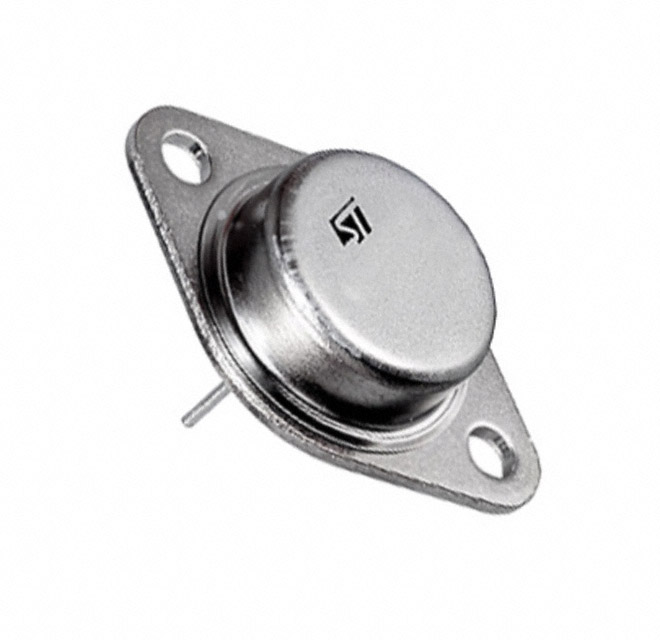
Q1: What is the Harris Corporation 2N3053 and what type of device is it?
A1: The Harris Corporation 2N3053 is an NPN silicon bipolar junction transistor designed for general-purpose amplification and switching applications. It is capable of handling moderate currents and voltages, making it suitable for use in a variety of RF and low-frequency circuits. Its TO-39 metal can package provides good thermal performance and mechanical durability.
Q2: What are the main applications for the Harris Corporation 2N3053?
A1: The Harris Corporation 2N3053 is commonly used in audio amplifiers, signal processing stages, driver circuits for power transistors, RF oscillators, and small motor control circuits. Its combination of moderate gain, power handling, and frequency response makes it versatile for both analog and switching designs.
Q3: What is the maximum collector-emitter voltage for the Harris Corporation 2N3053?
A1: The Harris Corporation 2N3053 typically supports a maximum collector-emitter voltage (Vceo) of around 40 V. This rating ensures it can handle a range of low-to-medium voltage applications without risk of breakdown, provided proper heat dissipation and load conditions are maintained.
Q4: What is the maximum collector current rating of the Harris Corporation 2N3053?
A1: The Harris Corporation 2N3053 can handle a maximum collector current of about 700 mA. This makes it suitable for driving small loads directly or as a driver stage for larger power transistors in multi-stage amplifier configurations.
Q5: How much power can the Harris Corporation 2N3053 dissipate safely?
A1: With adequate heatsinking, the Harris Corporation 2N3053 can dissipate up to approximately 800 mW. The metal TO-39 package aids in heat conduction, but proper thermal management is essential to prevent overheating in demanding applications.
Q6: What is the typical current gain (hFE) range of the Harris Corporation 2N3053?
A1: The Harris Corporation 2N3053 has a typical DC current gain (hFE) in the range of 20 to 100, depending on the collector current and operating conditions. This makes it effective for medium-gain amplification stages and as a pre-driver in higher power systems.
Q7: How high in frequency can the Harris Corporation 2N3053 operate effectively?
A1: The Harris Corporation 2N3053 features a transition frequency (fT) of around 100 MHz, allowing it to be used in RF amplifier and oscillator applications in the VHF range. It is suitable for use in communication equipment, signal generators, and other high-frequency circuits.
Q8: How should the Harris Corporation 2N3053 be biased for linear amplification?
A1: For linear operation, the Harris Corporation 2N3053 should be biased with a stable voltage divider network on the base, providing the correct base-emitter voltage to set the desired quiescent current. Emitter degeneration resistors are often added to improve thermal stability and linearity.
Q9: Can the Harris Corporation 2N3053 be used in switching applications?
A1: Yes, the Harris Corporation 2N3053 can be used as a switch for low-to-moderate current loads. For fast switching performance, the base should be driven with sufficient current to saturate the transistor, and a base-emitter resistor can be used to improve turn-off speed.
Q10: How does the TO-39 package benefit the Harris Corporation 2N3053’s performance?
A1: The TO-39 metal can package of the Harris Corporation 2N3053 offers excellent thermal conductivity, good mechanical strength, and resistance to environmental factors. This makes it robust in industrial environments and suitable for designs where heat dissipation and mechanical durability are critical.
Q11: What precautions should be taken to protect the Harris Corporation 2N3053 from damage?
A1: To protect the Harris Corporation 2N3053, avoid exceeding its voltage, current, and power limits, provide proper heatsinking, and use clamping diodes when switching inductive loads to suppress voltage spikes. Additionally, proper biasing ensures long-term reliability.
Q12: Can the Harris Corporation 2N3053 be used for driving inductive loads?
A1: Yes, the Harris Corporation 2N3053 can drive inductive loads such as small motors and relays, but a flyback diode should be placed across the load to protect the transistor from voltage transients generated during switching.
Q13: How does temperature affect the operation of the Harris Corporation 2N3053?
A1: Like other BJTs, the Harris Corporation 2N3053’s current gain and leakage current vary with temperature. At higher temperatures, leakage current increases and gain may change, so biasing should be designed to ensure stable operation over the expected temperature range.
Q14: What is the typical base-emitter voltage drop for the Harris Corporation 2N3053?
A1: In normal operation, the Harris Corporation 2N3053 has a base-emitter voltage drop of about 0.6 to 0.7 V when conducting. This value varies slightly with current and temperature, and it should be accounted for in biasing networks.
Q15: How is the Harris Corporation 2N3053 used in RF oscillator circuits?
A1: The Harris Corporation 2N3053’s high transition frequency and moderate gain make it suitable for RF oscillators in the VHF range. It can be configured in Colpitts, Hartley, or Clapp oscillator topologies, providing stable output for transmitters and signal generators.
Q16: What is the safe operating area (SOA) for the Harris Corporation 2N3053?
A1: The safe operating area of the Harris Corporation 2N3053 defines the permissible combinations of voltage, current, and duration that will not damage the transistor. Staying within these boundaries ensures the device can handle both continuous and pulsed loads without failure.
Q17: Can the Harris Corporation 2N3053 be used in complementary push-pull amplifier stages?
A1: Yes, the Harris Corporation 2N3053 can be paired with a suitable PNP transistor to form complementary push-pull stages in audio or RF amplifiers. This configuration improves efficiency and reduces distortion in output stages.
Q18: How does the Harris Corporation 2N3053 compare to small-signal transistors in terms of power handling?
A1: Compared to typical small-signal transistors, the Harris Corporation 2N3053 can handle higher currents and dissipate more power, making it more suitable for driver and intermediate power stages rather than purely low-power signal applications.
Q19: Is the Harris Corporation 2N3053 suitable for hobbyist and educational projects?
A1: Yes, the Harris Corporation 2N3053 is popular among hobbyists and in educational labs due to its versatility, availability, and ability to demonstrate both amplification and switching principles. Its metal can package also makes it easy to handle and mount.
Q20: What testing methods can be used to verify a Harris Corporation 2N3053 is functioning correctly?
A1: A Harris Corporation 2N3053 can be tested using a digital multimeter with a transistor test function to measure hFE and check junction integrity. For more detailed checks, a curve tracer can be used to plot its characteristics, or it can be placed in a simple test circuit to observe gain, frequency response, and switching behavior.