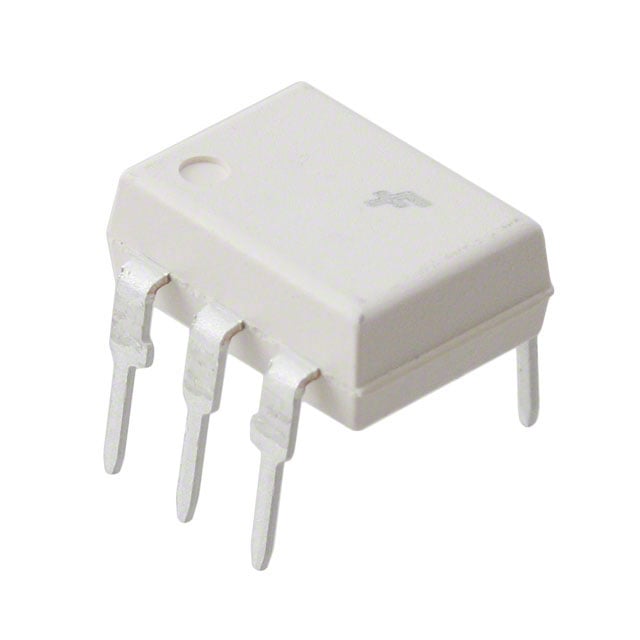
Q1: What is the onsemi TIL111?
A1: The onsemi TIL111 is an optocoupler that is commonly used for isolating digital signals, offering electrical isolation between high-voltage and low-voltage circuits.
Q2: What is the primary function of the TIL111 optocoupler?
A2: The primary function of the TIL111 optocoupler is to provide electrical isolation while transferring digital signals between circuits. It is particularly useful in protecting sensitive components from high-voltage spikes.
Q3: What is the output configuration of the TIL111?
A3: The TIL111 optocoupler has an open collector output, which is suitable for driving external transistors or logic inputs in various applications.
Q4: What is the maximum operating voltage of the TIL111?
A4: The TIL111 optocoupler is designed to operate with a maximum input voltage of 5V and can handle an output voltage up to 30V.
Q5: What is the isolation voltage of the TIL111?
A5: The isolation voltage of the TIL111 is typically rated at 5,000V, providing strong protection against electrical surges and noise between the input and output.
Q6: What is the typical rise time of the TIL111?
A6: The typical rise time of the TIL111 is approximately 40 microseconds, depending on the driving conditions and load.
Q7: Can the TIL111 be used for switching high-speed signals?
A7: The TIL111 is suitable for medium-speed signal switching but may not be ideal for very high-speed applications, as its rise and fall times are in the microsecond range.
Q8: What is the operating temperature range of the TIL111?
A8: The TIL111 operates within a temperature range of -40°C to +85°C, making it suitable for industrial and automotive applications.
Q9: Is the TIL111 suitable for use in industrial control systems?
A9: Yes, the TIL111 is commonly used in industrial control systems, especially for signal isolation and noise reduction between control and power circuits.
Q10: What is the package type of the TIL111?
A10: The TIL111 is typically available in a 4-pin through-hole package, making it easy to integrate into various circuit designs.
Q11: How does the TIL111 protect circuits from high-voltage spikes?
A11: The TIL111 uses optical isolation to separate the input and output, preventing high-voltage spikes from reaching sensitive low-voltage components and ensuring safety.
Q12: What is the maximum input current for the TIL111?
A12: The maximum input current for the TIL111 is typically around 50mA, which is suitable for most standard input signal levels in digital systems.
Q13: Can the TIL111 be used for data transmission applications?
A13: Yes, the TIL111 is often used in data transmission applications where isolation and noise immunity are required to ensure reliable signal transfer.
Q14: What are the typical applications for the TIL111 optocoupler?
A14: Typical applications for the TIL111 include signal isolation in digital circuits, motor control systems, power supply systems, and communication interfaces.
Q15: Does the TIL111 have a built-in LED?
A15: Yes, the TIL111 contains an LED on the input side, which, when energized, activates the phototransistor on the output side to provide signal transfer.
Q16: How does the TIL111 help with ground loop issues?
A16: The TIL111 helps eliminate ground loop issues by isolating the input and output, preventing unwanted current from flowing through the ground path between two circuits.
Q17: Can the TIL111 be used in automotive applications?
A17: Yes, the TIL111 is suitable for automotive applications where electrical isolation is needed, especially in systems that involve different voltage levels.
Q18: What is the typical current transfer ratio (CTR) of the TIL111?
A18: The typical current transfer ratio (CTR) of the TIL111 is between 50% and 200%, depending on the operating conditions.
Q19: How is the TIL111 powered?
A19: The TIL111 is powered by a low-voltage DC supply, typically between 3V and 5V, for the LED input side. The output side can interface with higher voltages, depending on the application.
Q20: Is the TIL111 suitable for high-current applications?
A20: The TIL111 is not designed for high-current applications. It is suitable for signal-level currents, typically in the milliamperes range, rather than for power control applications.