Product Overview
The onsemi MCT2202300 is an advanced silicon phototransistor optocoupler designed to provide electrical isolation between high-voltage and low-voltage circuits while allowing signal transmission via optical coupling. It is widely used in switching power supplies, microprocessor input/output isolation, signal isolation in industrial control systems, and other applications requiring galvanic isolation for noise immunity and safety.
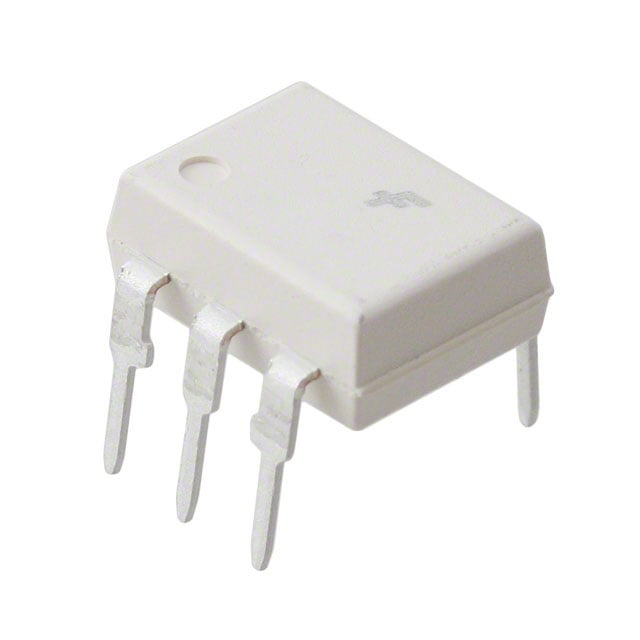
The MCT2202300 combines an infrared LED input and a phototransistor output housed in a compact 6-pin DIP package, optimized for high-speed switching and low input current requirements. Its design enables robust isolation with a high common-mode transient immunity and low propagation delay, ensuring signal integrity in electrically noisy environments.
Key Features
* Phototransistor output optocoupler
* High isolation voltage: 5,300 Vrms (typical)
* CTR (Current Transfer Ratio) range: 20% to 300% (depending on test conditions)
* High collector-emitter voltage: 70 V maximum
* Fast switching time (typical rise/fall time ~3 µs)
* Input forward current: 20 mA maximum
* Wide operating temperature range: –55°C to +100°C
* High common-mode transient immunity (CMTI)
* Low input current for LED activation
* Available in standard 6-pin DIP package
* UL recognized component for safety compliance
Electrical Specifications
* Input (LED) Characteristics:
* Forward Voltage (VF): 1.2 V (typical at 10 mA)
* Forward Current (IF): 10 mA (recommended operating), 20 mA (maximum)
* Reverse Voltage (VR): 6 V (maximum)
* Output (Phototransistor) Characteristics:
* Collector-Emitter Voltage (VCEO): 70 V (maximum)
* Emitter-Collector Voltage (VECO): 7 V (maximum)
* Collector Current (IC): 50 mA (maximum continuous)
* Current Transfer Ratio (CTR): 20% to 300% (IF = 10 mA, VCE = 5 V)
* Isolation:
* Isolation Voltage (Viso): 5,300 Vrms (typical, 1 min, AC)
* Switching Times:
* Rise Time (tr): 3 µs (typical)
* Fall Time (tf): 3 µs (typical)
* Input-Output Capacitance: ~0.6 pF (typical)
* Power Dissipation: 150 mW (output transistor)
* Operating Temperature: –55°C to +100°C
* Storage Temperature: –55°C to +125°C
Package and Pin Configuration
* Package Type: 6-pin Dual Inline Package (DIP)
* Mounting Style: Through-hole
* Pin Description:
* Pin 1: Anode (LED input)
* Pin 2: Cathode (LED input)
* Pin 3: Emitter (phototransistor output)
* Pin 4: Collector (phototransistor output)
* Pins 5 & 6: Not internally connected or reserved for mechanical stability
Functional Description
The MCT2202300 operates by converting an electrical input signal into light via its internal LED. This light is then detected by the phototransistor on the output side, which switches accordingly, providing a corresponding electrical output signal isolated galvanically from the input.
This optical isolation breaks ground loops and reduces high-voltage interference, making it ideal for interfacing logic-level circuits to high-voltage or noisy environments. The phototransistor output provides an analog switching output, suitable for driving logic inputs or interfacing with microcontrollers.
The device features a broad CTR range due to manufacturing tolerances and testing conditions; thus, designs should account for CTR variation for consistent performance.
Typical Applications
* Electrical isolation in switching power supplies
* Signal isolation for microprocessor inputs and outputs
* Motor control and industrial automation systems
* Medical equipment requiring patient safety isolation
* Communication systems requiring noise immunity
* Consumer electronics with isolated interface requirements
Design Considerations
When designing with the MCT2202300, proper drive current for the LED input should be maintained to ensure sufficient CTR and switching speed. Using series current-limiting resistors with the LED is necessary to prevent overcurrent.
The output transistor requires appropriate biasing and pull-up resistors to interface correctly with subsequent logic stages. The phototransistor’s collector voltage and current limits must be observed to avoid device damage.
Thermal management is typically not a major concern due to low power dissipation; however, PCB layout should ensure minimal coupling between input and output circuits to maintain high isolation performance.
Reliability and Compliance
The MCT2202300 complies with international safety standards, including UL recognition for insulation. Its construction and materials ensure long-term reliability in industrial and automotive environments, with wide operating temperature support and robust electrical isolation.
Summary
The onsemi MCT2202300 is a reliable, high-performance optocoupler providing electrical isolation and signal transfer between circuits operating at different potentials. Its combination of high isolation voltage, wide operating temperature range, and fast switching speeds makes it well suited for a variety of industrial, automotive, and consumer applications where safe and noise-immune signal transmission is required. The device’s compact DIP package supports easy through-hole PCB mounting, and its robust electrical specifications ensure dependable operation in demanding environments.