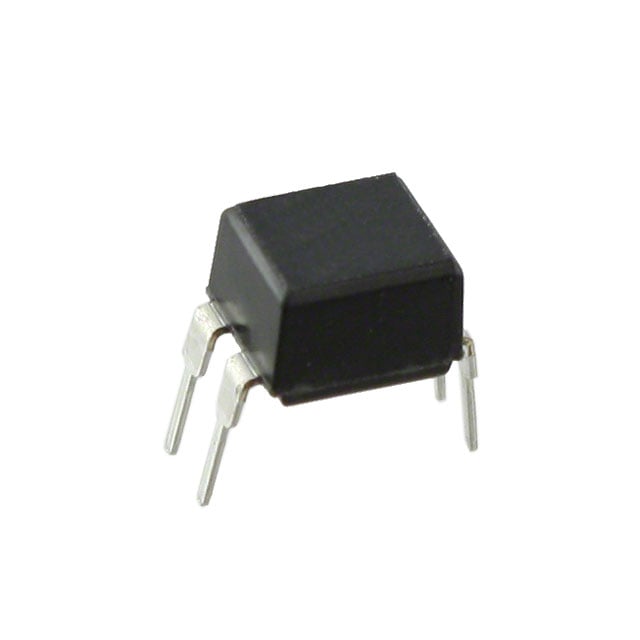
Q1: What is the Everlight Electronics EL817?
A1: The Everlight Electronics EL817 is an optocoupler (optoisolator) designed for electrical isolation and signal transmission between two circuits, with a high-speed phototransistor output.
Q2: What is the isolation voltage of the Everlight Electronics EL817?
A2: The Everlight Electronics EL817 has an isolation voltage of 5,000V (peak).
Q3: What is the output type of the Everlight Electronics EL817?
A3: The output of the Everlight Electronics EL817 is a phototransistor.
Q4: What is the forward voltage (Vf) for the LED input of the EL817?
A4: The forward voltage (Vf) for the LED input of the Everlight Electronics EL817 is typically 1.2V.
Q5: What is the maximum collector current (Ic) for the Everlight Electronics EL817?
A5: The maximum collector current (Ic) for the EL817 is 50mA.
Q6: What is the operating temperature range for the Everlight Electronics EL817?
A6: The operating temperature range for the EL817 is from -30°C to 85°C.
Q7: What is the input current (If) for the LED in the Everlight Electronics EL817?
A7: The input current (If) for the LED in the EL817 is typically 10mA.
Q8: What is the transfer gain (CTR) for the Everlight Electronics EL817?
A8: The transfer gain (CTR) for the Everlight Electronics EL817 typically ranges from 50% to 600%, depending on the specific operating conditions.
Q9: What is the maximum power dissipation for the Everlight Electronics EL817?
A9: The maximum power dissipation for the Everlight Electronics EL817 is 75mW.
Q10: What is the package type for the Everlight Electronics EL817?
A10: The Everlight Electronics EL817 comes in a 4-pin DIP (Dual Inline Package) form factor.
Q11: Can the Everlight Electronics EL817 be used for switching applications?
A11: Yes, the EL817 is suitable for switching applications, as it provides electrical isolation between input and output, making it ideal for signal transmission in power circuits.
Q12: What is the typical rise time (tr) of the Everlight Electronics EL817?
A12: The typical rise time (tr) of the EL817 is around 8µs.
Q13: What is the typical fall time (tf) of the Everlight Electronics EL817?
A13: The typical fall time (tf) of the EL817 is around 10µs.
Q14: Is the Everlight Electronics EL817 suitable for use in high-speed data transmission?
A14: Yes, the EL817 is suitable for high-speed data transmission, as it has a fast response time and a high-speed phototransistor output.
Q15: What is the maximum operating voltage for the Everlight Electronics EL817?
A15: The maximum operating voltage for the Everlight Electronics EL817 is 80V.
Q16: Does the Everlight Electronics EL817 have any built-in protection features?
A16: The EL817 is designed to provide electrical isolation, but it does not have specific built-in protection features like overcurrent or overvoltage protection.
Q17: Can the Everlight Electronics EL817 be used for logic level shifting?
A17: Yes, the EL817 can be used for logic level shifting in circuits where electrical isolation is required between different voltage levels.
Q18: What is the typical response time of the Everlight Electronics EL817?
A18: The typical response time of the EL817 is fast, with a rise time of around 8µs and a fall time of around 10µs, making it suitable for high-speed switching applications.
Q19: What is the maximum collector-emitter voltage (Vce) for the Everlight Electronics EL817?
A19: The maximum collector-emitter voltage (Vce) for the EL817 is 80V.
Q20: How is the Everlight Electronics EL817 used in industrial applications?
A20: The EL817 is commonly used in industrial applications for signal isolation, noise reduction, and protection of sensitive electronics, particularly in systems requiring high-voltage isolation between control circuits and power circuits.