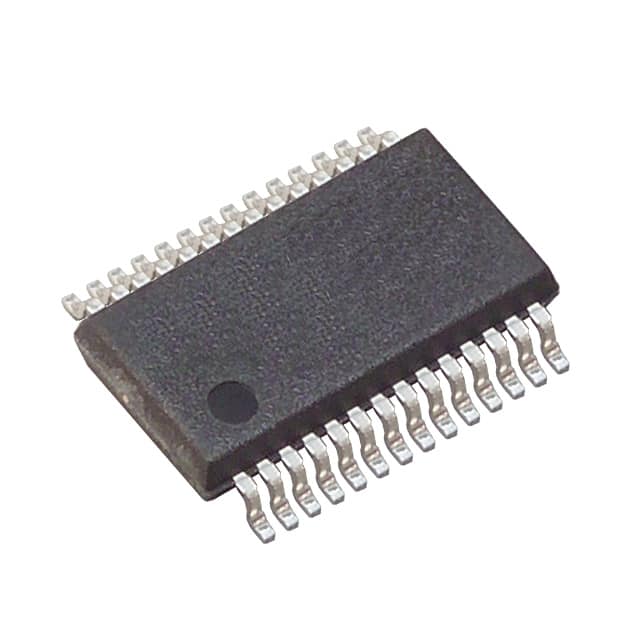
The Texas Instruments TRS3243CDBR is a 3-V to 5.5-V multichannel RS-232 line driver/receiver designed for serial communication applications requiring robust performance and low power consumption. Part of the TRS3243 family, this device integrates three drivers and five receivers, supporting data rates up to 250 kbps with ±15-kV ESD (Electrostatic Discharge) protection using the Human Body Model (HBM). It is housed in a 28-pin SSOP (Shrink Small Outline Package), making it suitable for compact designs in industrial, telecommunications, and consumer electronics applications. Below is a detailed exploration of the TRS3243CDBR, covering its specifications, features, applications, and design considerations.
Overview and Key Features
The TRS3243CDBR is a versatile RS-232 transceiver that facilitates communication between low-voltage digital systems and legacy RS-232 interfaces. It operates from a single 3-V to 5.5-V supply, making it compatible with modern low-voltage microcontrollers while maintaining compliance with the TIA/EIA-232-F standard. The device includes a dual charge-pump circuit to generate the ±10-V voltage levels required for RS-232 communication, eliminating the need for external ±12-V supplies. Its key features include low power consumption, auto-powerdown functionality, and enhanced ESD protection, making it ideal for battery-powered and noise-sensitive applications. The auto-powerdown feature reduces power consumption by disabling the drivers and charge pump when no valid RS-232 signal is detected, extending battery life in portable devices.
Electrical Specifications
The TRS3243CDBR is engineered for reliable serial communication with well-defined electrical characteristics. Below are its key specifications:
- Supply Voltage Range: 3.0V to 5.5V
- Data Rate: Up to 250 kbps
- Driver Output Voltage: ±5V (minimum) with 3-kΩ load
- Number of Drivers/Receivers: 3 drivers, 5 receivers
- ESD Protection:
- ±15 kV (Human Body Model, HBM)
- ±8 kV (IEC 61000-4-2 Contact Discharge)
- ±15 kV (IEC 61000-4-2 Air-Gap Discharge)
- Supply Current:
- 1 mA (typical) in active mode
- 1 µA (typical) in auto-powerdown mode
- Input Logic Thresholds:
- Logic low: 0.8V (maximum)
- Logic high: 2.0V (minimum)
- Receiver Input Voltage Range: ±25V
- Output Voltage Swing: ±5V (typical) with 3-kΩ load
- Propagation Delay:
- Driver: 150 ns (typical)
- Receiver: 150 ns (typical)
- Slew Rate: 30 V/µs (maximum, controlled for EMI reduction)
- Operating Temperature Range: 0°C to 70°C
- Package: 28-pin SSOP (DB package, 208 mg weight)
- Pin Count: 28 pins
- Power Dissipation: Dependent on operating conditions, typically low due to auto-powerdown
- Short-Circuit Protection: Driver outputs are short-circuit protected
- Thermal Resistance (θJA): Approximately 80°C/W (depending on PCB layout)
These specifications ensure the TRS3243CDBR meets the demands of high-speed, low-power serial communication with robust protection against electrical stress.
Functional Description
The TRS3243CDBR functions as a complete RS-232 interface, converting TTL/CMOS logic levels to RS-232 voltage levels and vice versa. The device includes three drivers to transmit signals from the digital system to the RS-232 interface and five receivers to convert incoming RS-232 signals to TTL/CMOS levels. The dual charge-pump circuit generates positive and negative voltages (typically ±10V) from a single 3-V to 5.5-V supply, enabling full RS-232 compliance without external power supplies. The drivers support data rates up to 250 kbps, suitable for applications like modems, serial ports, and industrial control systems.
The auto-powerdown feature is a standout capability, automatically disabling the drivers and charge pump when no valid RS-232 signal is detected on the receiver inputs. This reduces the supply current to 1 µA, making the device highly efficient for battery-powered applications. The device can be manually enabled or disabled using the FORCEON and FORCEOFF pins, and the INVALID output indicates when no valid RS-232 signal is present, aiding system diagnostics. The controlled slew rate of the drivers minimizes electromagnetic interference (EMI), ensuring compatibility with noise-sensitive environments.
Package and Thermal Performance
The TRS3243CDBR is packaged in a 28-pin SSOP (DB), which measures approximately 10.2 mm x 5.3 mm x 2 mm, offering a compact footprint for space-constrained designs. The SSOP package provides moderate thermal performance with a thermal resistance (θJA) of approximately 80°C/W, depending on PCB layout and airflow. Proper thermal management, including adequate copper planes and thermal vias, is recommended to maintain junction temperatures within the 0°C to 70°C operating range, especially in high-power or high-ambient-temperature conditions. The package’s small size and surface-mount compatibility make it suitable for automated assembly processes.
Applications
The TRS3243CDBR is designed for applications requiring reliable RS-232 communication in low-voltage systems. Common use cases include:
- Battery-Powered Devices: Its low power consumption and auto-powerdown feature make it ideal for portable devices like handheld terminals, barcode scanners, and GPS receivers.
- Industrial Automation: Used in PLCs, HMIs, and industrial control systems for serial communication with legacy equipment.
- Telecommunications: Powers modems, routers, and network interfaces requiring RS-232 connectivity.
- Consumer Electronics: Enables serial communication in set-top boxes, gaming consoles, and legacy PC peripherals.
- Medical Equipment: Provides reliable serial interfaces for diagnostic tools and patient monitoring systems.
- Point-of-Sale Systems: Supports communication in retail terminals and card readers.
The device’s robust ESD protection and wide supply voltage range make it suitable for environments with electrical noise or variable power sources.
Design Considerations
To optimize the performance of the TRS3243CDBR, designers should consider the following:
- Charge-Pump Capacitors: The dual charge-pump circuit requires four external capacitors (typically 0.1 µF for 3.3-V operation, 0.047 µF to 0.33 µF for 5-V operation) for the V+ and V- voltage generation. Ceramic capacitors with low ESR are recommended to ensure stable operation.
- Power Supply: The supply voltage must be within 3.0V to 5.5V. A bypass capacitor (0.1 µF) near the VCC pin is recommended to filter noise.
- Auto-Powerdown Control: The FORCEON and FORCEOFF pins allow manual control of the powerdown mode. If auto-powerdown is used, ensure the receiver inputs are driven by valid RS-232 signals to avoid unintended powerdown. The INVALID pin can be monitored to detect signal loss.
- ESD Protection: The ±15-kV HBM and IEC 61000-4-2 protection ensures robustness, but proper PCB layout (e.g., minimizing trace lengths for RS-232 signals) enhances EMI and ESD performance.
- Signal Integrity: Controlled slew rates reduce EMI, but high-speed signals should use proper termination (e.g., 3-kΩ to 7-kΩ loads) to meet RS-232 standards.
- Thermal Management: Ensure adequate PCB copper area and ventilation to manage heat, especially in high-data-rate or high-ambient-temperature applications.
Advantages
The TRS3243CDBR offers several advantages for RS-232 communication:
- Low Power Consumption: The 1-mA active current and 1-µA auto-powerdown mode extend battery life in portable applications.
- Robust ESD Protection: ±15-kV HBM and IEC 61000-4-2 protection ensure reliability in harsh environments.
- Wide Supply Range: 3.0V to 5.5V operation supports modern low-voltage systems.
- Integrated Charge Pumps: Eliminates the need for external ±12-V supplies, simplifying design.
- Compact Package: The 28-pin SSOP enables space-efficient designs.
- Flexible Power Management: Auto-powerdown and manual control via FORCEON/FORCEOFF pins optimize power usage.
Limitations
Despite its strengths, the TRS3243CDBR has some limitations:
- Data Rate Limitation: The 250-kbps maximum data rate may not suffice for high-speed applications, where devices like the TRS3237E (1 Mbps) are more suitable.
- Temperature Range: The 0°C to 70°C operating range limits its use in industrial or automotive applications requiring wider ranges (e.g., -40°C to 85°C, as offered by the TRS3243EIDBR).
- External Capacitors: The charge-pump circuit requires four external capacitors, increasing component count compared to fully integrated solutions.
- No Adjustable Baud Rate: The data rate is fixed by the device’s design, limiting flexibility in some communication protocols.
Comparison with Similar Devices
Compared to other Texas Instruments RS-232 transceivers, the TRS3243CDBR balances performance and power efficiency. The TRS3243EIDBR, a variant with a wider temperature range (-40°C to 85°C), is better suited for industrial applications but shares similar electrical characteristics. The TRS3237E (e.g., TRS3237ECDBR) supports higher data rates (1 Mbps) but consumes more power. The MAX3243CDBR, another Texas Instruments device, is functionally similar but may differ in specific ESD ratings or packaging options. For applications requiring fewer drivers/receivers, the TRS3221 (1 driver, 1 receiver) offers a smaller footprint but reduced channel count.
Reliability and Environmental Compliance
The TRS3243CDBR is manufactured by Texas Instruments, adhering to strict quality standards. It is RoHS-compliant, ensuring the absence of hazardous materials. The device’s ±15-kV ESD protection enhances reliability in environments prone to electrostatic discharge, such as industrial settings. The 0°C to 70°C operating range is suitable for commercial applications, but designers should verify thermal performance in high-power scenarios. Not all parameters are tested in production, so critical specifications should be validated in the application.
Conclusion
The Texas Instruments TRS3243CDBR is a reliable, low-power RS-232 transceiver ideal for serial communication in low-voltage systems. Its three drivers, five receivers, and ±15-kV ESD protection ensure robust performance in applications like battery-powered devices, industrial automation, and telecommunications “
# Texas Instruments TRS3243CDBR Specifications
## Overview
The Texas Instruments TRS3243CDBR is a 3-V to 5.5-V multichannel RS-232 line driver/receiver designed for serial communication applications requiring robust performance and low power consumption. It integrates three drivers and five receivers, supporting data rates up to 250 kbps with ±15-kV ESD protection (Human Body Model). Housed in a 28-pin SSOP package, it is ideal for compact designs in industrial, telecommunications, and consumer electronics applications.
## Key Specifications
- Supply Voltage Range: 3.0V to 5.5V
- Data Rate: Up to 250 kbps
- Driver Output Voltage: ±5V (minimum) with 3-kΩ load
- Number of Drivers/Receivers: 3 drivers, 5 receivers
- ESD Protection:
- ±15 kV (Human Body Model, HBM)
- ±8 kV (IEC 61000-4-2 Contact Discharge)
- ±15 kV (IEC 61000-4-2 Air-Gap Discharge)
- Supply Current:
- 1 mA (typical) in active mode
- 1 µA (typical) in auto-powerdown mode
- Input Logic Thresholds:
- Logic low: 0.8V (maximum)
- Logic high: 2.0V (minimum)
- Receiver Input Voltage Range: ±25V
- Output Voltage Swing: ±5V (typical) with 3-kΩ load
- Propagation Delay:
- Driver: 150 ns (typical)
- Receiver: 150 ns (typical)
- Slew Rate: 30 V/µs (maximum, controlled for EMI reduction)
- Operating Temperature Range: 0°C to 70°C
- Package: 28-pin SSOP (DB package, 208 mg weight)
- Pin Count: 28 pins
- Power Dissipation: Dependent on operating conditions
- Thermal Resistance (θJA): ~80°C/W (depending on PCB layout)
## Features
- Auto-Powerdown: Reduces supply current to 1 µA when no valid RS-232 signal is detected.
- Dual Charge Pumps: Generates ±10V for RS-232 compliance from a single supply.
- Low Power Consumption: 1-mA active current and 1-µA shutdown current.
- Controlled Slew Rate: Minimizes EMI for noise-sensitive applications.
- FORCEON/FORCEOFF Pins: Enable manual control of powerdown mode.
- INVALID Output: Indicates loss of valid RS-232 signal for diagnostics.
## Applications
- Battery-powered devices (e.g., handheld terminals, barcode scanners)
- Industrial automation (e.g., PLCs, HMIs)
- Telecommunications (e.g., modems, routers)
- Consumer electronics (e.g., set-top boxes, gaming consoles)
- Medical equipment (e.g., diagnostic tools, patient monitors)
- Point-of-sale systems (e.g., retail terminals, card readers)