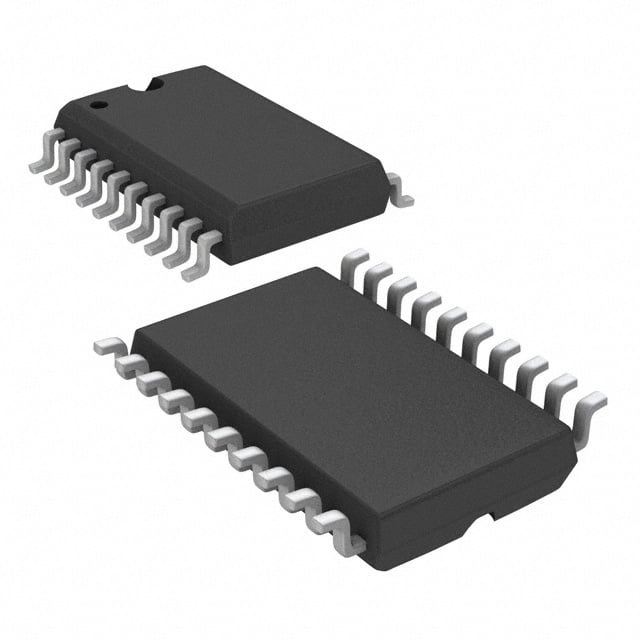
The Texas Instruments TPIC6595N is an 8-bit serial-in, parallel-out shift register with open-drain high-current outputs, designed for driving LEDs, relays, and other high-current loads in industrial, automotive, and consumer applications. It integrates features such as constant-current output, output enable control, and thermal shutdown protection, providing robust and flexible load-driving capability. The device operates with a wide supply voltage range and supports daisy-chaining, enabling control of multiple outputs with minimal microcontroller I/O pins.
## Device Type and Package
The TPIC6595N is housed in a 16-pin SOIC package, providing a compact surface-mount solution suitable for high-density PCB layouts. The device features eight open-drain output channels capable of sinking significant current, while the serial input and clocking mechanism allow efficient communication and expandability. Its open-drain outputs permit connection to a wide range of voltages, independent of the logic supply, facilitating direct interfacing with LEDs, relays, or optocouplers. The device also includes output enable (OE) and serial output (QH’) pins for cascading multiple devices.
## Maximum Ratings
The device is rated for robust electrical and thermal operation under standard conditions:
* Supply Voltage (Vcc): 7 V maximum
* Output Voltage (VO): 50 V maximum
* Output Sink Current per Channel (Iout): 150 mA continuous, 250 mA peak
* Total Package Power Dissipation (Pd): 1.0 W at 25°C with proper heatsinking
* Storage Temperature (Tstg): -65°C to +150°C
* Operating Junction Temperature (Tj): -40°C to +150°C
These ratings ensure reliable performance for driving multiple high-current loads, including LEDs, solenoids, and small motors.
## Electrical Characteristics
The TPIC6595N provides reliable digital-to-load interface performance:
* Supply Voltage (Vcc): 4.5 V to 7 V recommended for standard logic operation
* Output Low Voltage (VOL): 0.5 V typical at 150 mA sink per output
* Output Leakage Current: 0.5 µA maximum at 50 V (outputs off)
* Input High Voltage (VIH): 2.0 V minimum at Vcc = 5 V
* Input Low Voltage (VIL): 0.8 V maximum at Vcc = 5 V
* Propagation Delay (tPD): 30 ns typical for rising/falling edge from input to output
* Output Current Matching: ±5% typical between channels
* Supply Current (ICC): 1 mA typical with all outputs off
The combination of low output saturation voltage and high-current sink capability ensures efficient and consistent operation of LEDs and other loads.
## Serial Interface and Control
The device supports a standard 3-wire SPI-compatible interface:
* Serial Data Input (SER): shifts data into the 8-bit register on the rising edge of the clock
* Shift Register Clock (SRCLK): controls the timing of data transfer
* Latch Clock (RCLK): transfers the shift register content to output latches
* Output Enable (OE): active low, allows disabling all outputs while maintaining internal state
* Serial Output (QH’): allows cascading multiple TPIC6595N devices for extended channel control
The architecture allows flexible control of multiple high-current outputs with minimal microcontroller I/O, while preserving timing accuracy and load management.
## Protection Features
The TPIC6595N integrates multiple protection mechanisms:
* Overtemperature Protection: automatically disables outputs if junction temperature exceeds 150°C typical
* Thermal Shutdown Hysteresis: approximately 15°C, allowing safe automatic recovery
* Output Clamp Diodes: internal flyback diodes protect outputs from inductive load transients
* Undervoltage Lockout: prevents malfunction at low supply voltages
These protections ensure the device can handle inductive loads, high switching currents, and system-level transients without damage.
## Switching Characteristics
The device supports high-speed control of outputs:
* Maximum Clock Frequency: 25 MHz for SRCLK
* Typical Rise and Fall Times at Outputs: 20 ns
* Output Enable Delay: 50 ns typical
* Latch-to-Output Propagation: 35 ns typical
Fast switching allows real-time control of LEDs, solenoids, or relays in dynamic lighting, industrial control, and automotive applications.
## Thermal Characteristics
Thermal performance is enhanced by the SOIC package and PCB layout:
* Thermal Resistance, Junction-to-Ambient (RθJA): 90°C/W typical on a standard 2-layer PCB
* Thermal Resistance, Junction-to-Case (RθJC): 30°C/W typical
* Power dissipation management is required for continuous high-current operation across multiple channels
Sufficient copper area and heatsinking allow safe operation at maximum sink currents while maintaining junction temperature within specification limits.
## Applications
* LED matrix displays and signage control
* Relay or solenoid driving in automotive and industrial automation
* Backlighting for user interfaces, keypads, and LCDs
* Daisy-chained high-current output control in multi-channel systems
* Indicator lights, visual alarms, and signal conditioning circuits
The TPIC6595N is ideal for designs requiring precise, high-current output control with minimal microcontroller I/O footprint and robust electrical and thermal reliability.
## Electrical and Mechanical Summary
| Parameter | Min | Typical | Max | Unit |
| ----------------------------------- | ---- | ------- | --------- | ---- |
| Supply Voltage (Vcc) | 4.5 | — | 7 | V |
| Output Voltage (VO) | — | — | 50 | V |
| Output Sink Current (Iout) | — | 150 | 250 | mA |
| Output Low Voltage (VOL) | — | 0.5 | 0.8 | V |
| Input High Voltage (VIH) | 2.0 | — | Vcc + 0.5 | V |
| Input Low Voltage (VIL) | -0.5 | — | 0.8 | V |
| Propagation Delay (tPD) | — | 30 | 50 | ns |
| Supply Current (ICC) | — | 1 | 3 | mA |
| Operating Junction Temperature (Tj) | -40 | — | 150 | °C |
| Storage Temperature (Tstg) | -65 | — | 150 | °C |
## Summary
The Texas Instruments TPIC6595N is a robust 8-bit serial-in, parallel-out shift register with high-current open-drain outputs suitable for driving LEDs, relays, solenoids, and other inductive loads. Its combination of high-current sink capability, low output voltage, fast switching, and integrated protection mechanisms—including thermal shutdown, flyback diodes, and undervoltage lockout—makes it ideal for automotive, industrial, and consumer applications. The device supports daisy-chaining, allowing flexible expansion of output channels with minimal microcontroller I/O, while the SOIC package and exposed pad enable effective thermal management for reliable operation under high-current conditions.