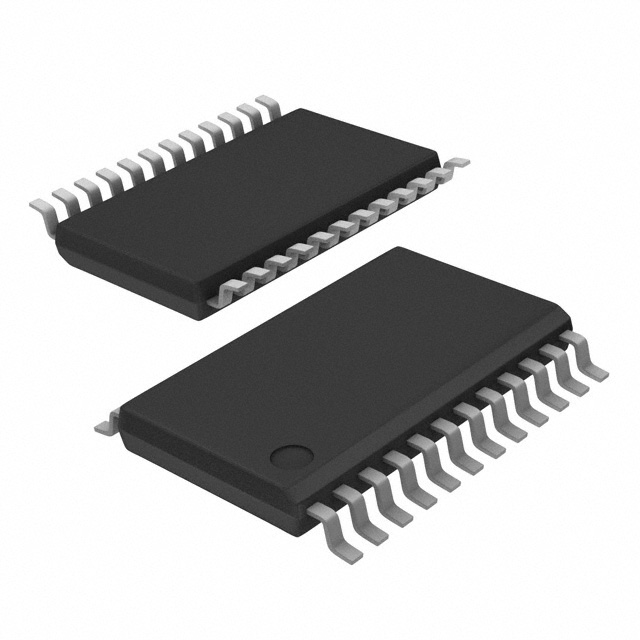
Q1: What is the Texas Instruments TCA6408ARSVR?
A: The Texas Instruments TCA6408ARSVR is an 8-bit I/O expander with an I2C interface. It is designed to provide additional input/output capabilities for microcontrollers and processors, allowing them to interface with more devices while minimizing the number of required GPIO pins. This IC is commonly used in embedded systems, automation, and consumer electronics to expand the number of I/O pins for controlling switches, LEDs, or other peripherals.
Q2: What is the main function of the TCA6408ARSVR?
A: The main function of the TCA6408ARSVR is to expand the I/O capabilities of a microcontroller or processor. It provides 8 GPIO pins that can be configured as inputs or outputs and communicates with the host device via the I2C interface. This allows for easy communication with various peripherals without needing additional hardware resources.
Q3: What is the I2C communication speed supported by the TCA6408ARSVR?
A: The TCA6408ARSVR supports standard I2C communication speeds of up to 400kHz (Fast-mode). This ensures fast and efficient communication between the expander and the host device, making it suitable for applications that require rapid control of multiple peripherals.
Q4: How many GPIO pins does the TCA6408ARSVR provide?
A: The TCA6408ARSVR provides 8 GPIO pins. These pins can be configured individually as either inputs or outputs, allowing for flexible control of external devices, such as LEDs, switches, sensors, or other digital components in embedded systems.
Q5: Can the TCA6408ARSVR handle both digital inputs and outputs?
A: Yes, the TCA6408ARSVR can handle both digital inputs and outputs. Each of the 8 GPIO pins can be individually set to either input or output mode, offering a versatile solution for controlling or monitoring external devices.
Q6: Does the TCA6408ARSVR have built-in pull-up resistors?
A: Yes, the TCA6408ARSVR includes internal pull-up resistors that can be enabled for the I/O pins when configured as inputs. This feature helps ensure reliable signal levels and simplifies the design process by reducing the need for external resistors.
Q7: What voltage levels does the TCA6408ARSVR support?
A: The TCA6408ARSVR operates with a supply voltage range of 1.65V to 5.5V, making it suitable for a wide range of applications, from low-voltage battery-powered devices to higher voltage systems. This broad voltage range allows it to be used in a variety of electronic systems and ensures compatibility with most microcontrollers.
Q8: What is the power consumption of the TCA6408ARSVR?
A: The TCA6408ARSVR is designed to have low power consumption. In typical operation, it draws very little current, making it ideal for power-sensitive applications. The device operates efficiently, reducing the overall power consumption of the system it is integrated into.
Q9: Can the TCA6408ARSVR be used to control LEDs?
A: Yes, the TCA6408ARSVR can be used to control LEDs. The GPIO pins can be configured as outputs, allowing the microcontroller to control LEDs or other similar devices. It can be used to drive LEDs in applications such as status indicators, display systems, or user interfaces.
Q10: How is the TCA6408ARSVR configured?
A: The TCA6408ARSVR is configured through the I2C interface, where the host device can write to control the configuration of each GPIO pin. By sending specific I2C commands, users can configure individual pins as inputs or outputs, set the output logic level, or read the input values from the connected peripherals.
Q11: What are the key advantages of using the TCA6408ARSVR in a design?
A: The key advantages of the TCA6408ARSVR include its ability to expand the number of GPIO pins on a microcontroller, its low power consumption, and its ease of integration via the I2C interface. Additionally, it offers flexibility in controlling or monitoring external devices, and its internal pull-up resistors simplify the design by reducing the need for external components.
Q12: Does the TCA6408ARSVR support interrupt generation?
A: Yes, the TCA6408ARSVR supports interrupt generation. When configured as an input, the GPIO pins can be set to generate interrupts on changes in their state (e.g., a change from high to low or vice versa). This feature is useful for event-driven applications, where the system needs to respond to specific input changes.
Q13: What is the maximum clock frequency supported by the TCA6408ARSVR's I2C interface?
A: The TCA6408ARSVR supports I2C clock frequencies up to 400kHz (Fast-mode), allowing for efficient communication between the expander and the host microcontroller. This speed is sufficient for many typical I/O expansion tasks in embedded systems.
Q14: Can the TCA6408ARSVR be daisy-chained with other I2C devices?
A: Yes, the TCA6408ARSVR can be daisy-chained with other I2C devices. Since the I2C bus allows multiple devices to share the same communication lines, several TCA6408ARSVR devices can be connected to the same I2C bus, expanding the number of I/O pins available in the system.
Q15: What kind of applications is the TCA6408ARSVR suitable for?
A: The TCA6408ARSVR is suitable for a variety of applications that require I/O expansion, such as embedded systems, industrial automation, consumer electronics, and robotics. It is commonly used in designs where a microcontroller has limited GPIO pins, and additional I/O is needed for controlling peripherals like LEDs, switches, sensors, or relays.
Q16: Is the TCA6408ARSVR available in different package types?
A: The TCA6408ARSVR is available in a 20-pin VQFN (Very Thin Quad Flat No-lead) package. This package type provides a compact form factor suitable for use in space-constrained designs while maintaining good thermal and electrical performance.
Q17: Can the TCA6408ARSVR be used in automotive applications?
A: Yes, the TCA6408ARSVR is suitable for automotive applications. It can be used in systems that require reliable I/O expansion and can operate within the voltage and temperature ranges typically found in automotive environments.
Q18: How does the TCA6408ARSVR handle high-speed operations?
A: The TCA6408ARSVR handles high-speed operations efficiently through its I2C interface, which allows quick communication between the device and the microcontroller. Its I2C communication speed of up to 400kHz ensures fast updates for controlling or reading inputs/outputs in real-time applications.
Q19: What type of logic levels are supported by the TCA6408ARSVR's GPIO pins?
A: The GPIO pins of the TCA6408ARSVR support standard logic levels, with the logic high voltage dependent on the supply voltage (VCC). The device is compatible with both 3.3V and 5V systems, making it flexible for use in a variety of different circuits and designs.
Q20: What are the safety features of the TCA6408ARSVR?
A: The TCA6408ARSVR includes built-in features such as ESD protection on the I/O pins and internal pull-up resistors, which help protect the device and ensure reliable operation in harsh environments. It also has low-power operation to prevent overheating, making it suitable for long-term use in embedded and industrial applications.