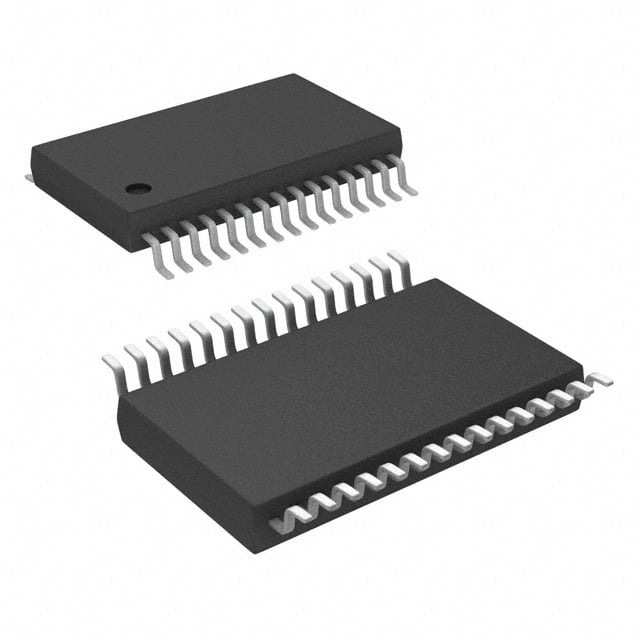
The Texas Instruments SN761678BDBTR is a high-speed, dual-channel differential transceiver designed for RS-485 and RS-422 communication standards. It is ideal for applications requiring robust communication over long distances, making it suitable for industrial automation, data acquisition systems, and multi-drop networks.
## Key Features
1. Dual Differential Channels:
- Supports two independent differential channels for simultaneous communication, enhancing flexibility in design.
2. High Data Rate:
- Capable of operating at data rates up to 20 Mbps, enabling fast communication in demanding applications.
3. Extended Operating Range:
- Designed to function over a wide supply voltage range, ensuring compatibility with various systems.
4. Low Power Consumption:
- Operates with minimal power draw, making it suitable for battery-operated devices and energy-efficient designs.
5. Fail-Safe Design:
- Incorporates fail-safe biasing to maintain a defined output state under certain conditions, enhancing reliability.
6. Wide Temperature Range:
- Rated for operation from -40°C to +85°C, suitable for harsh environments.
7. Short-Circuit Protection:
- Provides protection against output short circuits, ensuring robust operation in challenging scenarios.
## Specifications
## Electrical Characteristics
- Supply Voltage (V_CC):
- 3.0V to 5.5V
- Input Voltage Range (V_I):
- -7V to +12V (input voltage range)
- Output Voltage Levels:
- Differential Output Voltage (V_OD): ±1.5V (min), ±2.5V (typ), ±6V (max) under load.
- Input Current (I_I):
- Maximum input current: ±10 µA.
- Output Current (I_O):
- Maximum output current: ±60 mA.
- Propagation Delay (t_pd):
- Typical propagation delay: 10 ns.
## Logic Levels
- Input Logic High (V_IH):
- Minimum: 2V (for 5V operation).
- Input Logic Low (V_IL):
- Maximum: 0.8V (for 5V operation).
- Output Logic High (V_OH):
- Minimum: V_CC - 0.2V (at 50 mA).
- Output Logic Low (V_OL):
- Maximum: 0.4V (at 50 mA).
## Timing Characteristics
- Maximum Data Rate:
- Up to 20 Mbps, suitable for high-speed applications.
- Enable Time (t_enable):
- Maximum: 30 ns.
- Disable Time (t_disable):
- Maximum: 40 ns.
- Rise and Fall Times (t_r/t_f):
- Typically 10 ns, important for maintaining signal integrity at high frequencies.
## Pin Configuration
The SN761678BDBTR comes in a 16-pin TSSOP package. Here’s the pin configuration:
1. Pin 1 (A1): Non-inverting input of channel 1.
2. Pin 2 (B1): Inverting input of channel 1.
3. Pin 3 (Y1): Output of channel 1.
4. Pin 4 (GND): Ground connection.
5. Pin 5 (A2): Non-inverting input of channel 2.
6. Pin 6 (B2): Inverting input of channel 2.
7. Pin 7 (Y2): Output of channel 2.
8. Pin 8 (V_CC): Power supply connection.
9. Pin 9 (DE): Driver enable input for both channels.
10. Pin 10 (RE): Receiver enable input for both channels.
11. Pin 11-16: NC (no connect) or reserved for future use.
## Applications
1. Industrial Automation:
- Used for data communication between controllers, sensors, and actuators in automated systems.
2. Multi-Drop Networks:
- Supports network configurations where multiple devices communicate over a single bus.
3. Data Acquisition Systems:
- Ideal for collecting data from various sensors in remote locations.
4. Remote Control Systems:
- Enables reliable communication in remote control applications for devices such as cameras and robotic systems.
5. Telecommunications:
- Suitable for long-distance communication in telecommunications equipment.
## Design Considerations
- Termination Resistors:
- Ensure proper termination at both ends of the communication line to minimize reflections.
- PCB Layout:
- Careful layout is crucial to reduce noise and interference, especially in high-speed applications.
- Power Supply Decoupling:
- Include decoupling capacitors close to the V_CC pin for stable operation.
- Input Protection:
- Consider adding protection components on input lines to guard against voltage spikes.
## Conclusion
The Texas Instruments SN761678BDBTR is a versatile dual-channel differential transceiver that provides high-speed, reliable communication for a variety of applications. Its robust features, including low power consumption, wide operating range, and fail-safe design, make it an excellent choice for engineers working on complex communication systems. Understanding its specifications and capabilities allows for effective implementation in a broad range of electronic systems, ensuring reliable performance in demanding environments.