Overview
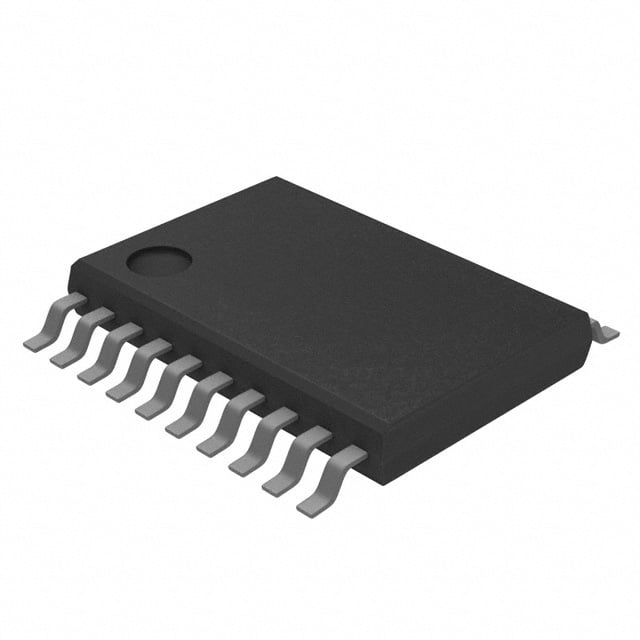
The Texas Instruments PCF8574AN is an 8-bit I/O expander designed for use with the I²C (Inter-Integrated Circuit) bus. It allows microcontrollers and processors to increase their available input/output pins using a simple serial interface. The device is widely used in applications where the number of GPIO (General Purpose Input/Output) pins is limited and additional I/O is needed without increasing the number of microcontroller pins significantly.
The PCF8574AN operates at low voltage levels, offers easy interfacing, and includes features to simplify system design. It can be used to control LEDs, switches, relays, and other peripherals, making it popular in embedded systems, industrial automation, home automation, and consumer electronics.
Key Features
* I²C Interface: Supports standard I²C bus protocol with data rates up to 100 kHz (standard mode) and 400 kHz (fast mode).
* 8-Bit Quasi-Bidirectional I/O Ports: Each of the 8 I/O pins can be individually configured as input or output. The quasi-bidirectional structure eliminates the need for external pull-up resistors in many cases.
* 7-bit Addressing: Supports up to 8 devices on the same I²C bus by using 3 hardware-configurable address pins (A0, A1, A2).
* Operating Voltage: Compatible with 2.5 V to 6 V power supply, making it suitable for a wide range of logic levels.
* Open-Drain Interrupt Output (INT): Generates an interrupt output that signals the microcontroller when an input pin changes state, improving response time and reducing polling.
* Low Power Consumption: Suitable for battery-powered and low-power applications.
* Package Options: Available in multiple packages, including DIP, SOIC, and TSSOP, providing flexibility for different PCB layouts and assembly methods.
Functional Description
The PCF8574AN acts as an I/O expander for the I²C bus. It contains eight quasi-bidirectional I/O pins that can be independently read or written by the I²C master. The device does not have direction registers; instead, the direction is controlled by writing a '1' (high) or '0' (low) to the output latch. Writing '1' allows the pin to be used as input with a weak internal pull-up, while writing '0' forces the pin low as output.
The device continuously monitors the state of the pins and can generate an interrupt when an input pin changes from high to low, which helps reduce CPU load by avoiding constant polling.
Applications
* Expansion of microcontroller I/O pins in embedded systems
* Keypad and switch interface
* LED and display control
* Industrial automation controls
* Home automation devices
* Consumer electronics requiring additional I/O pins
* Remote I/O control via I²C bus
Electrical Specifications
* Supply Voltage (Vcc): 2.5 V to 6.0 V
* Input Voltage: 0 V to Vcc
* Operating Temperature Range: -40°C to +85°C (industrial grade)
* I²C Clock Frequency: up to 400 kHz (Fast-mode)
* Input Leakage Current: Typically ±1 µA
* Output Current (per I/O pin):
* Sink current (low level): Up to 20 mA per pin
* Source current (high level): Limited by internal transistor and supply current, typically weaker (few mA)
* Quiescent Current: Typically 10 µA at 5 V
* Interrupt Output: Open-drain, active low
Pin Configuration
* P0 to P7: Eight quasi-bidirectional I/O pins
* A0, A1, A2: Hardware address pins for setting the device’s I²C slave address, allowing up to 8 devices on the same bus
* SDA, SCL: Serial Data and Clock lines for the I²C bus interface
* INT: Interrupt output pin, open-drain active low, indicates input pin state change
* Vcc: Power supply pin
* GND: Ground reference
Timing Characteristics
* Start and Stop conditions: Complies with I²C standard
* Data setup and hold times: As per I²C protocol, suitable for standard and fast modes
* Interrupt response time: Typically low latency, enabling fast response to input changes
Operation Details
The device’s quasi-bidirectional I/O architecture means that writing a '1' to a pin releases the line and allows it to be driven externally as an input, with an internal weak pull-up. Writing a '0' drives the pin low actively. Reading the port provides the current pin state regardless of the last written value.
The PCF8574AN also supports an interrupt generation mechanism. When an input pin changes from high to low, the INT output goes low, notifying the microcontroller to read the input pins, thus optimizing CPU utilization.
Advantages
* Simple interface with I²C bus
* Efficient expansion of limited microcontroller I/O
* No external pull-ups needed on I/O pins in most cases
* Interrupt output reduces processor polling overhead
* Low power consumption
* Wide operating voltage and temperature range
* Versatile packaging options for different assembly requirements
Typical Use Cases
* Adding more buttons or switches to a microcontroller-based system without increasing processor pin count
* Controlling LED arrays or LCD backlights with limited I/O availability
* Remote sensor interfacing via I²C bus
* Industrial machine I/O expansion for monitoring and control
* Home automation devices needing extra digital I/O for sensors and actuators
Summary
The Texas Instruments PCF8574AN is a highly versatile 8-bit I/O expander with an I²C interface, designed to significantly increase the number of digital I/O pins available in embedded systems. Its quasi-bidirectional pins, integrated interrupt function, and wide voltage and temperature ranges make it suitable for a broad range of industrial, automotive, consumer, and IoT applications. The device’s simple interface, low power consumption, and multiple package options make it a practical choice for systems needing efficient and reliable I/O expansion.