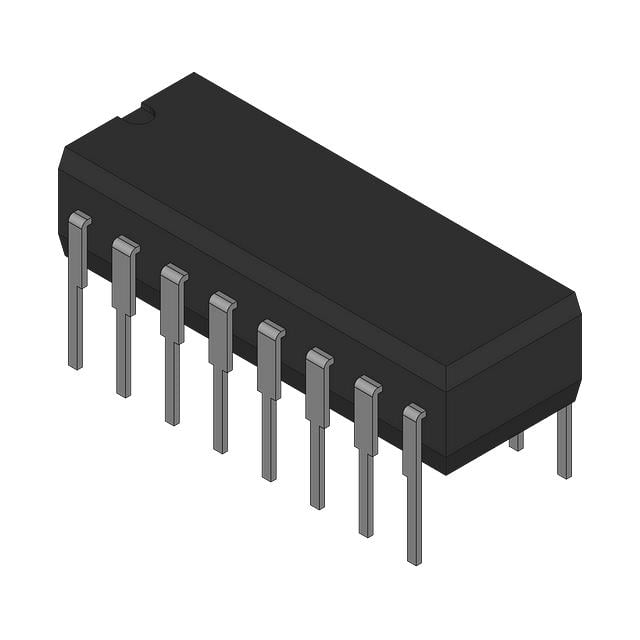
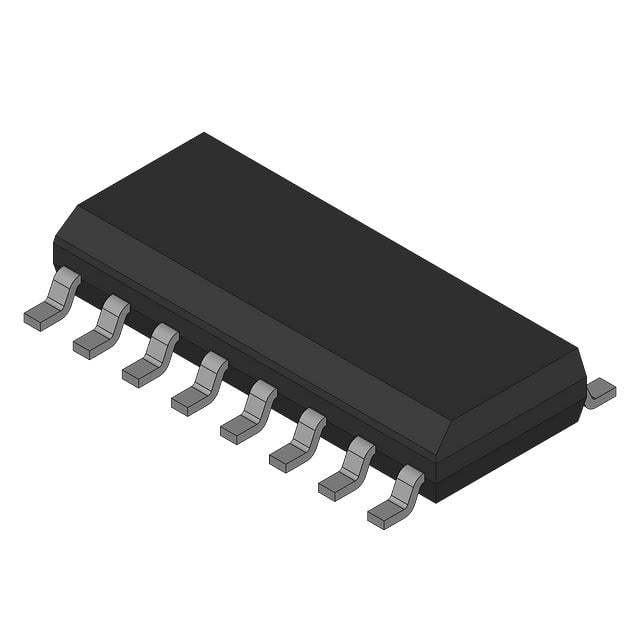
The Harris Corporation CD74HCT193E is a high-speed CMOS synchronous 4-bit binary counter that is part of the 74HCT family of logic devices. This counter is designed to provide reliable counting capabilities in digital applications, making it suitable for a variety of uses in both consumer and industrial electronics. The CD74HCT193E is particularly valued for its ability to operate at TTL (Transistor-Transistor Logic) levels while maintaining the advantages of CMOS technology, such as low power consumption and high noise immunity.
## Key Features
1. 4-Bit Binary Counter: The CD74HCT193E can count from 0 to 15 (in binary) and provides a straightforward way to implement counting functions in digital circuits.
2. Synchronous Operation: All counting operations are synchronized to a common clock input, ensuring that all bits change state simultaneously, which enhances the reliability of the counting process.
3. Up/Down Counting: The device can be configured to count in either the up or down direction, providing flexibility for various counting applications.
4. Asynchronous Reset: The counter features an asynchronous reset input that allows for immediate resetting of the counter to zero, regardless of the clock state.
5. Low Power Consumption: As a CMOS device, the CD74HCT193E consumes significantly less power compared to traditional TTL devices, making it suitable for battery-operated applications.
6. Wide Supply Voltage Range: The device operates with a supply voltage ranging from 4.5V to 5.5V, allowing for compatibility with various digital systems.
7. TTL Compatible: The outputs are compatible with TTL logic levels, facilitating easy integration with other TTL-based circuits.
## Specifications
- Supply Voltage (Vcc): 4.5V to 5.5V
- Input Voltage (Vi): 0V to Vcc
- Output Voltage (Vo): 0V to Vcc
- Input Current (Ii): ±1 µA (max)
- Output Current (Io): ±6 mA (max)
- Propagation Delay: Typically 15 ns at Vcc = 5V
- Operating Temperature Range: -40°C to +125°C
- Power Dissipation: 1 mW (typical) at Vcc = 5V
- Logic Family: HCT (High-speed CMOS, TTL compatible)
- Pin Count: 16 pins in a DIP package
## Pin Configuration
The CD74HCT193E comes in a 16-pin dual in-line package (DIP) with the following pin configuration:
1. A: Input for the least significant bit (LSB) of the counter.
2. B: Input for the second bit.
3. C: Input for the third bit.
4. D: Input for the most significant bit (MSB).
5. UP/DOWN: Control input to select counting direction (up or down).
6. CLK: Clock input for synchronizing counting operations.
7. MR: Master reset input (active low) to reset the counter to zero.
8. Q0: Output for the least significant bit (LSB).
9. Q1: Output for the second bit.
10. Q2: Output for the third bit.
11. Q3: Output for the most significant bit (MSB).
12. GND: Ground connection.
13. Vcc: Power supply connection.
14. NC: No connection (not used).
15. NC: No connection (not used).
16. NC: No connection (not used).
## Operation
The CD74HCT193E operates in a straightforward manner:
- Counting Mode: When the clock (CLK) input receives a rising edge, the counter increments or decrements its value based on the state of the UP/DOWN input. If UP/DOWN is high, the counter counts up; if low, it counts down.
- Reset Function: The asynchronous reset (MR) input allows the counter to be reset to zero immediately, regardless of the clock state. This is useful for initializing the counter in various applications.
## Applications
The CD74HCT193E is used in a variety of applications, including:
- Digital Counters: For counting events, pulses, or time intervals in digital systems.
- Frequency Division: In applications where frequency division is required, such as in clock generation circuits.
- Event Counters: For counting occurrences of specific events in industrial and consumer electronics.
- Microcontroller Interfaces: To expand counting capabilities in microcontroller-based systems.
## Conclusion
The Harris Corporation CD74HCT193E is a versatile and efficient 4-bit synchronous binary counter that offers high-speed performance and low power consumption