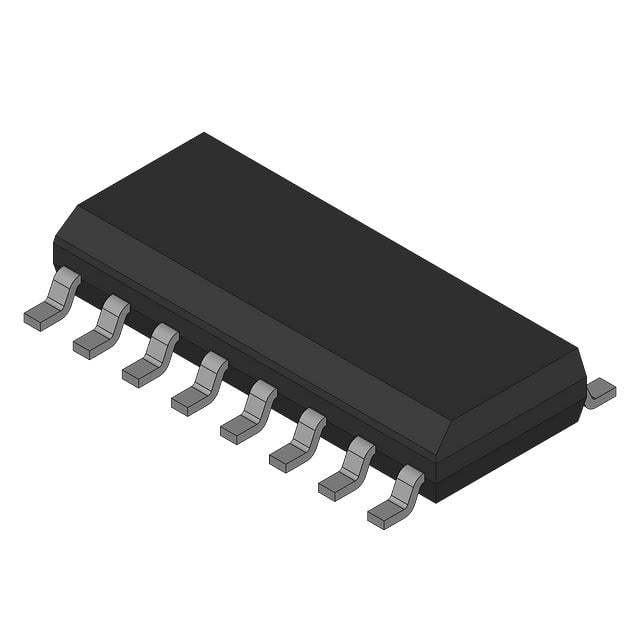
Q1: What is the Texas Instruments CD4051BM96?
A1: The Texas Instruments CD4051BM96 is an 8-channel analog multiplexer that allows you to switch between multiple analog signals using a digital control input.
Q2: What is the voltage range for the CD4051BM96?
A2: The CD4051BM96 operates within a voltage range of 3V to 18V, making it versatile for various low to moderate voltage applications.
Q3: How many channels does the CD4051BM96 support?
A3: The CD4051BM96 supports 8 channels, allowing for the selection of one of eight different analog inputs or outputs based on the digital selection inputs.
Q4: What is the input voltage range for the CD4051BM96?
A4: The input voltage range for the CD4051BM96 is from VSS (ground) to VDD, allowing it to handle both positive and negative analog signals within the supply voltage limits.
Q5: Does the CD4051BM96 support both analog and digital signals?
A5: The CD4051BM96 is designed for analog signal switching, meaning it primarily handles analog signals, but it can be controlled by digital logic signals.
Q6: What type of logic family does the CD4051BM96 belong to?
A6: The CD4051BM96 belongs to the CMOS (Complementary Metal-Oxide-Semiconductor) logic family, known for its low power consumption and high noise immunity.
Q7: What is the maximum switching speed of the CD4051BM96?
A7: The CD4051BM96 has a typical propagation delay time of 20ns, allowing it to switch analog signals with minimal delay.
Q8: Can the CD4051BM96 be used for both analog-to-digital and digital-to-analog conversion?
A8: While the CD4051BM96 is an analog multiplexer, it does not perform conversion tasks directly. However, it can be used in circuits that interface with ADCs or DACs for signal routing purposes.
Q9: What is the power supply requirement for the CD4051BM96?
A9: The CD4051BM96 typically operates with a supply voltage between 3V and 18V, depending on the application requirements.
Q10: How many control pins are required to operate the CD4051BM96?
A10: The CD4051BM96 requires 3 control pins (S0, S1, and S2) to select one of the 8 channels, along with an enable pin to activate the multiplexer.
Q11: Can the CD4051BM96 be used in audio signal processing?
A11: Yes, the CD4051BM96 can be used in audio applications where multiple analog audio signals need to be routed or switched, such as in mixers or signal routing circuits.
Q12: What is the resistance of the switch channels in the CD4051BM96?
A12: The CD4051BM96 has an on-resistance (R\_ON) typically around 50 ohms, which is relatively low for most applications, ensuring minimal signal loss during switching.
Q13: What is the current consumption of the CD4051BM96?
A13: The CD4051BM96 has a typical supply current of 2µA in a quiescent state, making it a low-power device suitable for battery-operated systems.
Q14: Can the CD4051BM96 be used in microcontroller interfacing applications?
A14: Yes, the CD4051BM96 can be used in microcontroller-based applications for selecting analog signals from multiple sensors or devices, and can be controlled by the microcontroller's digital outputs.
Q15: What is the output impedance of the CD4051BM96?
A15: The output impedance of the CD4051BM96 is low when the channel is selected, allowing it to provide a strong signal output with minimal attenuation.
Q16: How does the enable pin work on the CD4051BM96?
A16: The enable pin on the CD4051BM96 allows the entire multiplexer to be disabled when set low, effectively isolating all the channels from the output.
Q17: What are the typical applications of the CD4051BM96?
A17: Typical applications include signal routing, analog switching, audio signal processing, sensor multiplexing, and communication systems requiring multiple signal paths.
Q18: Is the CD4051BM96 suitable for high-speed applications?
A18: The CD4051BM96 is suitable for most standard switching applications, but its speed is limited by the on-resistance and propagation delay, making it less ideal for high-frequency RF or high-speed digital applications.
Q19: Does the CD4051BM96 have a protection diode for ESD (Electrostatic Discharge)?
A19: Yes, the CD4051BM96 includes internal protection diodes to help protect against electrostatic discharge, ensuring reliable performance in environments where ESD might be a concern.
Q20: How does the CD4051BM96 compare to similar analog multiplexers?
A20: The CD4051BM96 offers 8-channel multiplexing with low power consumption and moderate switching speed. It is often compared to other analog multiplexers in the 4000-series CMOS logic family, with similar performance characteristics but in a different pin configuration or voltage range.