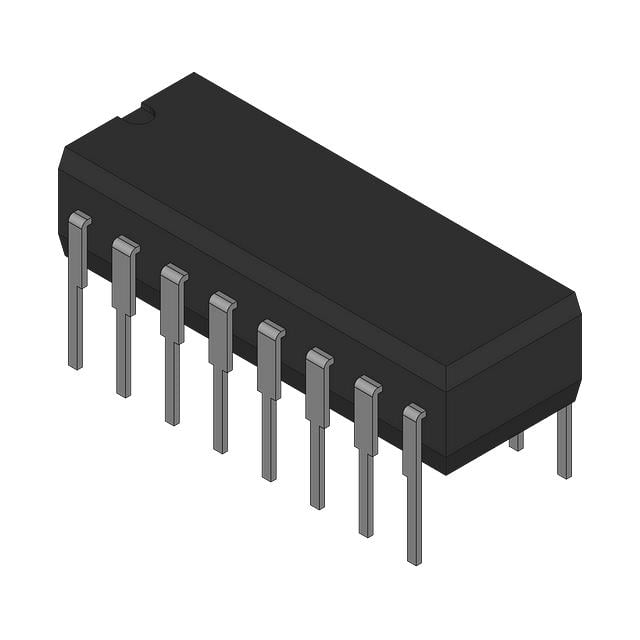
The Texas Instruments CD4043BPWR is a versatile quad Schmitt-trigger buffer/driver designed for use in a variety of digital applications. This device is part of the CD4000 series of CMOS logic devices, which are known for their low power consumption, high noise immunity, and wide operating voltage range. The CD4043BPWR is particularly useful in applications requiring signal conditioning, level shifting, and interfacing between different logic families.
## Key Specifications
1. General Features:
- Device Type: Quad Schmitt-trigger buffer/driver
- Number of Buffers: 4 independent Schmitt-trigger buffers
- Package Type: TSSOP (Thin Shrink Small Outline Package)
- Pin Count: 14 pins
2. Electrical Characteristics:
- Supply Voltage (V_DD): 3V to 15V
- Input Voltage Range: 0V to V_DD
- Output Voltage Range: 0V to V_DD
- Input Current: Typically 1 µA (at V_DD = 15V)
- Output Drive Current: Up to 6 mA (at V_DD = 15V)
3. Logic Levels:
- Threshold Voltage (V_T+ and V_T-): The Schmitt-trigger inputs provide hysteresis, which helps to eliminate noise and provide clean transitions between high and low states. The typical threshold voltages are:
- V_T+ (positive-going threshold): Approximately 1/3 V_DD
- V_T- (negative-going threshold): Approximately 2/3 V_DD
4. Propagation Delay:
- Typical Propagation Delay: 20 ns (at V_DD = 5V)
- Maximum Propagation Delay: 50 ns (at V_DD = 15V)
5. Power Consumption:
- Static Power Dissipation: Typically 0.1 µA (at V_DD = 15V)
- Dynamic Power Dissipation: Depends on the frequency of operation and load capacitance.
6. Temperature Range:
- Operating Temperature: -40°C to 125°C, making it suitable for automotive and industrial applications.
## Functional Description
The CD4043BPWR features four independent Schmitt-trigger buffers, which are designed to provide a clean output signal in response to noisy or slow input signals. The Schmitt-trigger action introduces hysteresis into the input signal, ensuring that the output transitions occur at distinct voltage levels, thus improving noise immunity.
The device can be used to interface between different logic families, such as TTL and CMOS, and can also be employed for level shifting applications. The output stage of the buffers is capable of driving capacitive loads, making it suitable for driving LEDs, relays, and other devices.
## Applications
The CD4043BPWR is suitable for a wide range of applications, including:
- Signal Conditioning: Used to clean up noisy signals from sensors or other digital devices.
- Level Shifting: Interfaces between different voltage levels in mixed-logic environments.
- Timing Circuits: Can be used in conjunction with RC networks to create timing delays.
- Pulse Shaping: Ideal for shaping pulses in digital communication systems.
- Automotive Applications: Due to its wide temperature range and low power consumption, it is suitable for automotive electronics.
## Conclusion
The Texas Instruments CD4043BPWR is a highly versatile quad Schmitt-trigger buffer/driver that offers excellent performance in a variety of digital applications. With its low power consumption, wide operating voltage range, and robust noise immunity, it is an ideal choice for engineers looking to implement reliable signal conditioning and interfacing solutions. Its ability to operate over a wide temperature range further enhances its suitability for automotive and industrial applications, making it a valuable component in modern electronic designs.