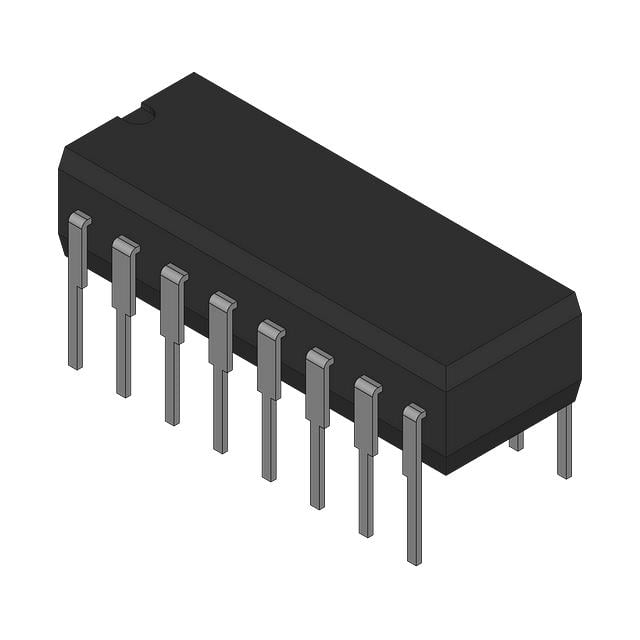
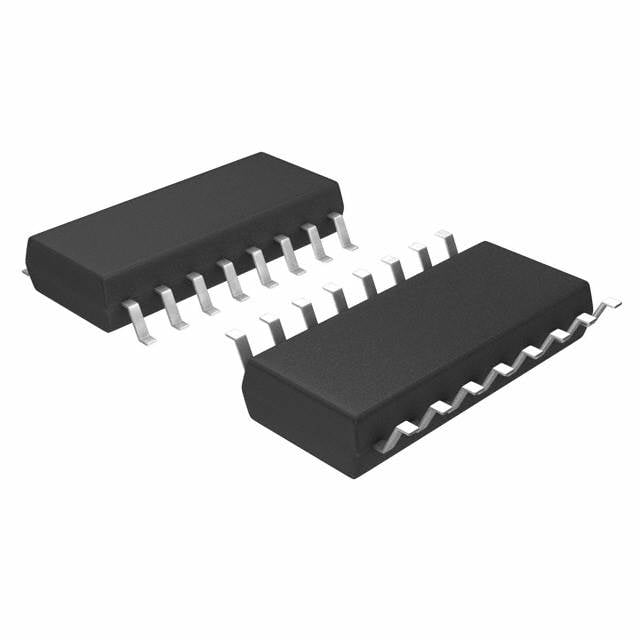
The Texas Instruments CD4024BM96 is a versatile CMOS integrated circuit implementing a 7-stage ripple-carry binary counter. It is designed for counting applications and frequency division, widely used in digital logic circuits, timing applications, and sequential control systems. The device operates with a wide supply voltage range and exhibits low power consumption, making it suitable for a variety of low-power digital applications.
General Overview
The CD4024BM96 is a 7-stage binary ripple counter that divides the input frequency by 2^7 (128). It counts input pulses on the clock pin and outputs a binary count on its seven output pins, representing the count in binary form. Each output corresponds to one bit of the count, with Q1 being the least significant bit and Q7 the most significant bit. The asynchronous reset input allows clearing the count to zero at any time.
This device is fabricated using CMOS technology, which provides high noise immunity and low static power consumption, making it ideal for battery-powered or energy-sensitive designs. The CD4024BM96 is suitable for a wide voltage range and is compatible with many logic families.
Key Features
* 7-stage binary ripple counter: Provides binary division by up to 128
* Wide supply voltage range: 3 V to 15 V for flexible system integration
* Low power consumption: Typical CMOS power efficiency
* Asynchronous reset input: Allows the counter to be reset to zero independently of the clock
* High noise immunity: Typical noise margin of 28% VDD
* Direct cascading: Outputs can be cascaded with other counters for extended counting range
* High output drive: Can directly drive CMOS and TTL inputs
* Operating temperature range: -55°C to +125°C, suitable for industrial environments
* Package: M96 plastic DIP or equivalent, supporting through-hole mounting
Electrical Specifications
* Supply Voltage (VDD): 3 V to 15 V
* Input Voltage Levels:
* High-level input voltage (VIH): Minimum 0.7 × VDD
* Low-level input voltage (VIL): Maximum 0.3 × VDD
* Output Voltage Levels:
* High-level output voltage (VOH): Typically VDD − 0.1 V at IO = -1 mA
* Low-level output voltage (VOL): Typically 0.1 V at IO = 1 mA
* Maximum Clock Frequency: Approximately 10 MHz at 10 V supply
* Power Dissipation: Typically low, in the range of a few milliwatts depending on frequency and load
* Input Current: Negligible static input current due to CMOS technology
Pin Configuration and Package Details
* Package Type: 16-pin Plastic DIP (M96)
* Pin Functions:
* Clock (CP): Input for counting pulses
* Reset (MR): Asynchronous reset input, active high
* Outputs (Q1 to Q7): Seven binary outputs representing the count value
* Power supply pins (VDD and VSS): Positive supply voltage and ground
Functional Description
The device counts rising edges on the clock input asynchronously. Each stage toggles at half the frequency of the previous stage, producing a binary count sequence across the outputs. The asynchronous reset pin overrides the counting operation, clearing all outputs to zero immediately when asserted. The ripple nature of the counter means that the outputs change state sequentially, which can cause propagation delays and glitches; this characteristic is important to consider in timing-sensitive applications.
Typical Applications
* Frequency division and clock generation
* Digital timers and event counters
* Pulse counting and measurement circuits
* Sequential logic controllers
* Digital clocks and frequency synthesizers
* LED display drivers in binary or BCD configurations
* Educational and prototyping purposes for teaching binary counting concepts
Performance Characteristics
The CD4024BM96’s CMOS technology allows operation at low supply voltages with minimal power consumption, making it an excellent choice for portable or low-power devices. Its wide operating voltage range offers flexibility across different system standards. The device exhibits stable operation over industrial temperature ranges and provides good noise immunity, essential in electrically noisy environments.
Its asynchronous reset feature provides quick resetting of the count, which is valuable in applications requiring fast initialization or synchronization. However, due to the ripple nature of the counter, output transitions are not simultaneous, and care must be taken when interfacing with synchronous logic.
Design Considerations
* Use proper decoupling capacitors close to the device’s power pins to minimize supply noise and ensure stable operation.
* For applications requiring synchronous counting, consider using synchronous counters instead of ripple counters to avoid glitches.
* When cascading multiple counters for higher bit counts, connect the carry-out or the most significant output of one device to the clock input of the next.
* Avoid exceeding maximum clock frequency specifications to prevent counting errors.
* Observe proper grounding and PCB layout practices to reduce noise susceptibility.
Summary
The Texas Instruments CD4024BM96 is a reliable, low-power CMOS 7-stage ripple binary counter offering versatile counting and frequency division capabilities. Its wide supply voltage range, asynchronous reset functionality, and robust industrial temperature rating make it suitable for a broad array of digital logic, timing, and counting applications. The device’s ability to operate with minimal power and drive various logic families ensures its continued relevance in both legacy and modern digital systems. Its simple interfacing and stable operation make it a valuable component in educational and industrial environments alike.