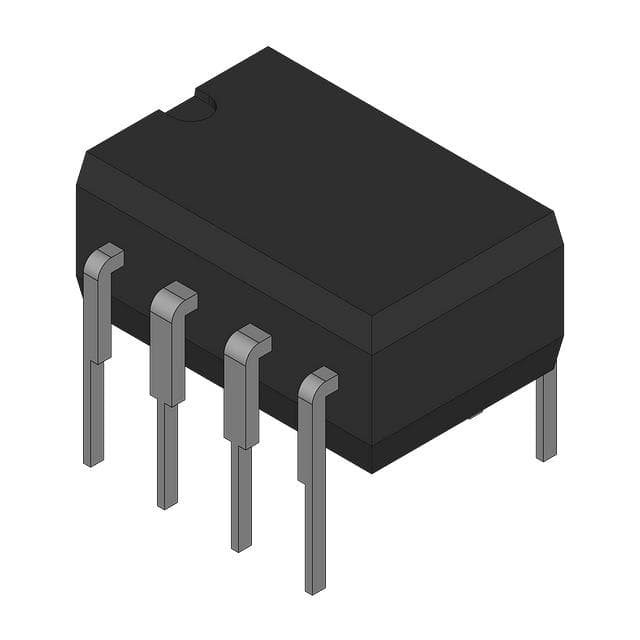
The Microchip MIC29204BN is a high-current, low-dropout (LDO) linear voltage regulator designed for high-performance power management applications requiring low dropout voltage, fast transient response, and stable operation under dynamic load conditions. It belongs to the MIC29xxx family of LDO regulators optimized for medium-to-high current linear regulation in industrial, automotive, and embedded electronic systems.
## Functional Architecture and Device Overview
The MIC29204BN is implemented as a series-pass linear regulator with an internal power transistor, precision reference, and error amplifier forming a closed-loop voltage regulation system. The device operates by continuously adjusting the conduction of the internal pass element to maintain a fixed output voltage determined by its internal reference and feedback network.
The regulator architecture is optimized for low dropout operation, enabling the output voltage to remain regulated even when the input-to-output differential voltage is relatively small. This characteristic is achieved through the use of a low saturation voltage pass element and a high-gain error amplifier.
The device is designed for fixed-output regulation configurations, providing stable voltage output without requiring external adjustment components in standard implementations.
## Electrical Regulation Mechanism and Feedback Control
The MIC29204BN operates using a classic negative feedback control loop. The output voltage is continuously sensed and compared against an internal precision reference voltage by the error amplifier. Any deviation between the sensed output and reference results in an amplified error signal that modulates the gate/base drive of the internal pass transistor.
This closed-loop regulation ensures that the output voltage remains stable under varying input voltage, load current, and temperature conditions, provided the device remains within its specified operating limits.
The internal architecture is designed to maintain loop stability across a wide range of output capacitance values, reducing the need for complex external compensation networks in most standard applications.
## Dropout Performance and Low Headroom Operation
A defining characteristic of the MIC29204BN is its low dropout voltage performance. The dropout region is defined as the condition where the input voltage approaches the output voltage plus the minimum required headroom for proper regulation.
In this region, the pass element operates near saturation, and the regulator transitions from active regulation to a pass-through mode. The low dropout design enables efficient operation in battery-powered or low-voltage distributed power systems where input voltage margins are limited.
The device maintains regulation as long as sufficient voltage headroom exists to support internal biasing and pass device control.
## Output Drive Capability and Load Regulation
The MIC29204BN is designed to support relatively high output current compared to general-purpose LDO regulators. The internal pass transistor is sized to handle significant load currents while maintaining stable thermal and electrical performance.
Load regulation is achieved through the high open-loop gain of the internal error amplifier, which minimizes output voltage variation across changes in load current. The regulator maintains consistent output voltage by dynamically adjusting the conduction state of the pass element in response to load transients.
The device is suitable for powering digital logic, microcontrollers, communication modules, and mixed-signal subsystems requiring stable regulated supply rails.
## Transient Response and Stability Behavior
The transient response of the MIC29204BN is determined by the interaction between the internal error amplifier bandwidth, pass device characteristics, and external output capacitor network. The regulator is designed to respond rapidly to sudden load changes while maintaining stability without oscillation.
Output stability is strongly dependent on the presence and characteristics of the external output capacitor. The datasheet specifies requirements for capacitance value and equivalent series resistance (ESR) to ensure loop stability. The internal compensation network is designed to tolerate a defined range of capacitor types while maintaining phase margin.
During load transients, the regulator temporarily adjusts pass device conduction to restore output voltage, with recovery time determined by loop dynamics and output capacitor charge/discharge characteristics.
## Power Dissipation and Thermal Performance
As a linear regulator, the MIC29204BN dissipates power proportional to the voltage drop across the device multiplied by the load current. This makes thermal management a critical aspect of system design, particularly in high-current applications or when operating with large input-output voltage differentials.
The device incorporates thermal protection circuitry that limits internal temperature by reducing or disabling output current when a defined thermal threshold is exceeded. This prevents permanent damage under excessive power dissipation conditions.
Thermal resistance between junction and ambient is influenced by PCB layout, copper area, and package thermal characteristics, which must be considered in system-level thermal design.
## Protection Features and Fault Handling
The MIC29204BN includes multiple internal protection mechanisms to ensure robust operation under fault conditions. These typically include current limiting, thermal shutdown, and safe operating area protection for the internal pass transistor.
Current limiting prevents excessive output current during overload or short-circuit conditions by restricting the drive to the pass element. Thermal shutdown disables or reduces conduction when junction temperature exceeds safe operating limits, providing self-protection against sustained overload.
These protection features are designed to operate autonomously without external control circuitry, ensuring reliable behavior in fault conditions.
## Noise Performance and Power Supply Rejection
The regulator exhibits low output noise characteristics suitable for sensitive analog and mixed-signal applications. Noise performance is primarily determined by the internal reference voltage stability and error amplifier noise contribution.
Power supply rejection ratio (PSRR) defines the ability of the regulator to attenuate input voltage ripple and noise. The MIC29204BN provides effective suppression of supply disturbances over a defined frequency range, making it suitable for post-regulation in switching power supply systems.
PSRR performance typically degrades at higher frequencies, where parasitic coupling and internal bandwidth limitations become dominant factors.
## Package Configuration and Mechanical Design
The MIC29204BN is provided in a through-hole or surface-mount package variant depending on suffix definition, designed for medium-to-high power dissipation applications. The package structure is optimized for thermal conduction from the silicon die to the PCB, enabling efficient heat spreading.
Mechanical design considerations include lead configuration, thermal pad structure, and compatibility with standard PCB assembly processes. The package is intended to support reliable operation in industrial and embedded system environments.
## Application Domains and System-Level Usage
The MIC29204BN is primarily used in linear post-regulation stages following switching converters, providing low-noise clean power rails for analog and digital subsystems. It is also used in standalone linear regulation applications where input-output differential voltage is sufficiently small to maintain acceptable power dissipation.
Typical application domains include microcontroller power supplies, communication modules, sensor subsystems, and mixed-signal analog front-end circuits. The device is particularly effective in systems requiring low noise and stable voltage rails without the complexity of switching regulator design.
## System Integration Considerations
Proper implementation of the MIC29204BN requires careful attention to input and output capacitor selection, PCB layout, and thermal design. Capacitors must meet stability requirements in terms of capacitance and ESR to ensure loop stability and transient performance.
Thermal design must account for worst-case power dissipation scenarios, including maximum input voltage and full load current conditions. Adequate copper area and thermal vias may be required to maintain junction temperature within safe limits.
Noise-sensitive applications benefit from short routing of feedback and output paths to minimize parasitic inductance and resistive losses.
## Conclusion
The Microchip MIC29204BN is a high-current low-dropout linear voltage regulator designed for efficient and stable power conversion in embedded and industrial systems. It integrates a precision reference, error amplifier, and internal pass transistor to provide regulated output with low dropout voltage, robust transient response, and comprehensive protection features. The device is optimized for low-noise linear regulation, post-switching power conditioning, and general-purpose voltage regulation in systems requiring reliable and thermally managed power delivery.