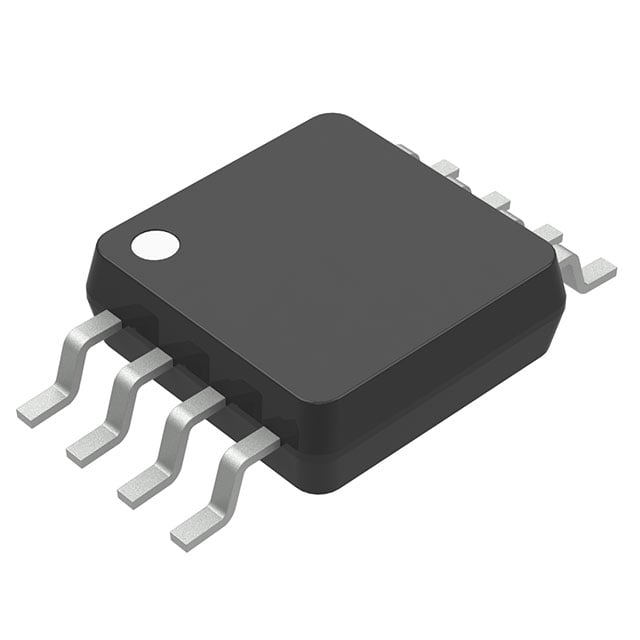
The MCP4011-503E/MS from Microchip Technology is a single-channel, non-volatile digital potentiometer designed to provide programmable resistance control in precision analog circuits. It integrates a resistor network with an array of MOSFET switches and digital interface logic, enabling precise adjustment of resistance without mechanical components. The device features non-volatile memory that retains the last wiper position across power cycles, ensuring deterministic performance after system startup. The MCP4011-503E/MS supports high-resolution resistance control, with a total nominal resistance of 50 kΩ, subdivided into 128 discrete wiper steps. The architecture is optimized for low-power operation, minimal wiper resistance, and stable analog signal paths, making it suitable for high-reliability industrial and embedded applications where repeatable resistance control is required.
## Functional positioning and device classification
The MCP4011-503E/MS is categorized as a non-volatile, single-channel digital potentiometer. Its primary function is to provide electronically adjustable resistance in analog circuits, replacing conventional mechanical potentiometers. The internal structure consists of a precision resistor ladder with integrated MOSFET switches controlled by a two-wire serial interface compatible with I²C communication protocols. The non-volatile memory element ensures that the wiper position is stored permanently, providing immediate restoration of the desired resistance value upon power-up without external programming. This functionality allows system designers to implement software-controlled analog tuning, programmable gain stages, and adaptive voltage dividers while maintaining compact form factors and eliminating mechanical wear limitations.
## Electrical parameters and resistance characteristics
The MCP4011-503E/MS has a total nominal resistance of 50 kΩ, corresponding to the "503" suffix in its part number. The wiper can be positioned at 128 discrete increments, yielding a step resolution of approximately 390 Ω per step. The wiper resistance between the wiper terminal and each end terminal is typically 75 Ω, which ensures minimal voltage drop and maintains signal integrity across the analog path. The end-to-end tolerance of the resistor network is specified at ±20%, while the device maintains stable performance over an industrial temperature range of –40°C to +125°C. Leakage currents are minimal, typically in the picoampere range, and parasitic capacitance is low, supporting high-fidelity analog signal transmission up to several hundred kilohertz.
The device operates over a supply voltage range from 2.7 V to 5.5 V, compatible with both 3.3 V and 5 V digital systems. Quiescent current is nominally below 1 μA, while active wiper transitions consume minimal dynamic current, enabling efficient integration in low-power and battery-operated designs. Digital logic levels conform to CMOS thresholds, facilitating direct interfacing with microcontrollers, FPGAs, and other system-on-chip controllers.
## Interface and control functionality
The MCP4011-503E/MS implements a two-wire serial interface consistent with I²C fast-mode operation, supporting clock frequencies up to 400 kHz. Device control is achieved through addressable commands, specifying the wiper register and the desired resistance position. Multiple devices can share a single I²C bus by configuring hardware-selectable device addresses, allowing scalable multi-potentiometer solutions. The non-volatile memory automatically stores the wiper position after each adjustment, eliminating the need for manual reprogramming or external memory devices. Timing parameters for setup, hold, and wiper transition comply with I²C specifications to ensure reliable operation even in multi-master environments.
## Timing and endurance specifications
Wiper step transition time is typically 10 μs, with a maximum specified delay of 50 μs under worst-case conditions. Non-volatile memory endurance supports at least 1 million write cycles, and data retention exceeds 100 years under nominal operating conditions. These specifications guarantee consistent long-term operation for applications that require frequent resistance adjustments or repeated calibration cycles.
## Package and mechanical considerations
The MCP4011-503E/MS is provided in an 8-pin SOIC package, which minimizes printed circuit board footprint while allowing easy surface-mount assembly. The package’s thermal resistance, specified at approximately 150°C/W from junction to ambient, ensures safe operation within the device’s specified voltage and power dissipation limits. The absence of moving parts increases reliability under shock and vibration, and the solid-state design provides noiseless resistance adjustments compared to mechanical potentiometers.
## Typical application scenarios
The MCP4011-503E/MS is particularly suitable for analog signal conditioning applications, such as programmable gain amplifiers, filter tuning, and voltage dividers. It can be employed in audio circuits for software-controlled volume adjustment, enabling precise and repeatable levels without introducing mechanical noise. The device is also applied in sensor calibration and reference voltage adjustment circuits, where precise trimming compensates for process or temperature-induced variations. Industrial automation systems benefit from its remote programmability, allowing software-defined control of resistance values in distributed measurement and control networks. Additionally, the device can be used in embedded systems requiring digital adjustment of analog parameters for calibration or adaptive control purposes.
## Design considerations
When integrating the MCP4011-503E/MS, attention should be paid to the wiper current limitations to prevent excessive voltage drops due to wiper resistance. Circuit designers should account for parasitic capacitance and load impedance to maintain analog signal fidelity. Proper decoupling of supply lines is recommended to mitigate voltage transients during wiper transitions. The I²C bus should be properly terminated with suitable pull-up resistors based on total bus capacitance and desired communication speed. Non-volatile memory writes should be sequenced according to timing requirements to maximize endurance and ensure reliable data retention.
## Conclusion
The MCP4011-503E/MS from Microchip Technology is a high-precision, single-channel non-volatile digital potentiometer that offers 50 kΩ total resistance with 128 discrete steps. Its low wiper resistance, industrial temperature operation, and I²C-compatible interface provide robust, repeatable, and software-controlled analog resistance adjustment. This device is highly suited for applications in industrial automation, audio control, sensor calibration, and embedded systems requiring reliable, compact, and noiseless variable resistance without the limitations of mechanical potentiometers. Its solid-state design, non-volatile memory retention, and low power characteristics make it a dependable component for high-reliability analog control and calibration applications.