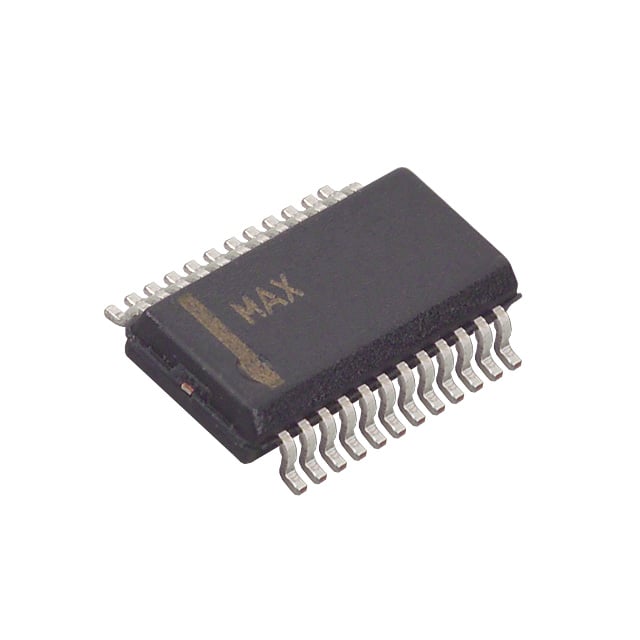
The MAX160CPN is a microprocessor-compatible, 8-bit Analog-to-Digital Converter (ADC) developed by Maxim Integrated. It is designed for high-speed data acquisition applications requiring direct interfacing with microprocessor-based systems. The device utilizes a Successive Approximation Register (SAR) conversion architecture, providing a balance between conversion speed, implementation simplicity, and system integration. The MAX160 family was developed for applications where relatively fast analog signal digitization is required while maintaining compatibility with standard digital control logic and parallel data buses. The MAX160CPN is supplied in an 18-pin PDIP package intended for through-hole mounting.
## Device Function and Product Positioning
The MAX160CPN belongs to the data acquisition product category and serves as a single-channel analog-to-digital conversion solution. Its primary function is to convert an analog input voltage into an 8-bit digital representation that can be processed by a microprocessor, microcontroller, digital signal processor, or other digital control circuitry.
The device is specifically designed as a microprocessor-compatible ADC, incorporating a parallel digital output interface that allows direct communication with digital systems. The converter employs a SAR architecture, a widely used ADC topology that provides deterministic conversion timing and moderate-to-high conversion rates without the complexity associated with flash converter architectures.
Because of its combination of conversion speed and straightforward digital interfacing, the MAX160CPN is suitable for embedded instrumentation, telecommunications equipment, industrial monitoring systems, and other real-time measurement applications.
## Conversion Architecture
The MAX160CPN employs a Successive Approximation Register conversion method. In a SAR ADC, the analog input signal is compared against internally generated reference levels through a binary search process. The conversion sequence progressively determines each output bit from the most significant bit to the least significant bit.
This architecture provides several technical advantages:
* Predictable conversion timing.
* Good accuracy for medium-resolution applications.
* Lower power and circuit complexity compared with flash ADCs.
* Straightforward integration with microprocessor-based systems.
The SAR approach used in the MAX160 enables relatively fast conversion while maintaining an economical implementation suitable for general-purpose data acquisition designs.
## Confirmed Electrical and Functional Characteristics
The following characteristics are consistently identified for the MAX160CPN:
| Parameter | Value |
| --------------------------- | --------------------------------------- |
| Device Type | Analog-to-Digital Converter |
| Resolution | 8 bits |
| ADC Architecture | Successive Approximation Register (SAR) |
| Number of ADC Channels | 1 |
| Input Type | Single-ended |
| Maximum Sampling Rate | 250 kSPS |
| Typical Conversion Time | 4 µs |
| Data Interface | Parallel |
| Reference Type | External |
| Analog Supply Voltage | 5 V |
| Digital Supply Voltage | 5 V |
| Operating Temperature Range | 0°C to +70°C |
| Package | 18-pin PDIP |
| Mounting Style | Through-hole |
The device operates from separate analog and digital 5 V supplies, simplifying integration into traditional TTL- and CMOS-based digital systems. The use of an external reference allows the designer to define the converter's full-scale input range according to application requirements.
## Analog Input Characteristics
The MAX160CPN supports a single analog input channel configured for single-ended operation. The converter digitizes one analog signal at a time and produces an 8-bit digital output corresponding to the sampled input level.
External reference implementation provides flexibility in defining measurement range and scaling. System designers can optimize converter performance by selecting a reference source appropriate for the required accuracy, stability, and temperature characteristics.
The single-ended input structure makes the device particularly suitable for sensor interfaces, monitoring circuits, instrumentation channels, and process-control measurement systems where the measured signal is referenced to a common ground.
## Digital Interface and System Integration
One of the defining characteristics of the MAX160CPN is its microprocessor-compatible parallel output interface. The parallel data format allows rapid transfer of conversion results into external digital logic.
Compared with serial ADC interfaces, a parallel interface can reduce data read latency and simplify interfacing with certain processor architectures and programmable logic devices. This feature was especially valuable in high-speed embedded systems and instrumentation equipment developed during the period in which the device was introduced.
The converter's control structure enables coordination between conversion initiation and data retrieval operations, facilitating deterministic sampling sequences in real-time systems.
## Speed Performance
The MAX160 is recognized for its high conversion speed within the 8-bit ADC category. The specified conversion time of approximately 4 microseconds corresponds to a maximum sampling rate of 250 kSPS.
This performance level makes the device suitable for applications involving:
* Rapid sensor data acquisition.
* Telecommunications signal monitoring.
* Digital signal processing front-end subsystems.
* Industrial control systems requiring fast measurement updates.
* Instrumentation equipment with moderate bandwidth requirements.
The conversion speed represented a significant advantage for microprocessor-based acquisition systems requiring rapid analog signal digitization.
## Package and Environmental Characteristics
The MAX160CPN is housed in an 18-pin Plastic Dual In-line Package (PDIP). This package offers several practical benefits:
* Ease of prototyping and laboratory evaluation.
* Compatibility with through-hole PCB manufacturing.
* Mechanical robustness.
* Convenient socket installation for development systems.
The specified operating temperature range of 0°C to +70°C places the MAX160CPN within the commercial temperature category, making it suitable for standard industrial, laboratory, telecommunications, and instrumentation environments operating within these limits.
## Typical Applications
According to device documentation, the MAX160CPN is intended for applications including:
* Digital Signal Processing (DSP) front-end acquisition systems.
* High-speed data acquisition equipment.
* Telecommunications systems.
* Process automation and industrial control.
* Electronic instrumentation.
* Avionics measurement subsystems.
In these applications, the converter functions as the interface between analog real-world signals and digital processing hardware, enabling measurement, monitoring, analysis, and control operations.
## Design Considerations
When integrating the MAX160CPN into a system, several design aspects are important:
The external reference input directly influences measurement range and conversion accuracy. Reference source quality therefore plays a significant role in overall system performance.
Separate analog and digital supply domains should be appropriately decoupled to minimize digital switching noise coupling into the analog conversion process.
The parallel interface requires sufficient PCB routing resources but offers rapid access to conversion results and simplified timing relationships in many processor-based architectures.
Since the device provides 8-bit resolution, it is most suitable for applications where moderate measurement precision is acceptable and conversion speed is a higher priority.
## Conclusion
The MAX160CPN is an 8-bit, single-channel, SAR-based analog-to-digital converter optimized for microprocessor-compatible high-speed data acquisition systems. It provides a 4 µs conversion time, up to 250 kSPS sampling capability, single-ended analog input operation, an external reference architecture, and a parallel digital interface. Operating from 5 V analog and digital supplies and packaged in an 18-pin PDIP form factor, the device was designed for instrumentation, telecommunications, process automation, avionics, and DSP-oriented acquisition applications where fast conversion speed and straightforward processor interfacing are primary design requirements.