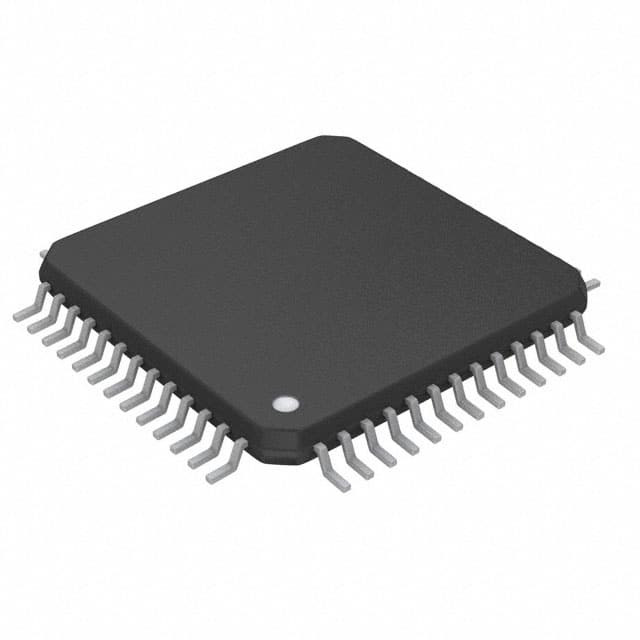
The Analog Devices AD677KR is a high-performance 16-bit successive approximation analog-to-digital converter designed for precision data acquisition and signal processing systems requiring both high dc accuracy and strong dynamic performance. The device belongs to the AD676/AD677 family, with the AD677 specifically providing a serial output interface optimized for DSP and microprocessor-based architectures. It integrates an internal sample-and-hold amplifier, precision reference support circuitry, autocalibration logic, and high-speed conversion capability into a compact package. The converter was developed for demanding instrumentation, industrial control, vibration analysis, medical instrumentation, communications, and audio-related acquisition systems where a combination of precision linearity and low distortion is essential.
The AD677KR employs a switched-capacitor charge redistribution SAR architecture combined with digital error correction and on-chip autocalibration. This approach allows the converter to achieve true 16-bit no-missing-code performance while maintaining relatively high throughput for its generation. Conversion throughput reaches 100 kSPS with a total conversion time of approximately 10 µs. The internal sample-and-hold stage provides accurate acquisition of rapidly changing analog input signals and supports a full power bandwidth of approximately 1 MHz. Unlike many earlier precision converters requiring extensive external trimming, the AD677 family integrates self-calibration functionality that automatically compensates internal offset and gain errors.
## Device Architecture and Internal Design
The AD677 is internally partitioned into separate analog and digital sections fabricated using different semiconductor processes optimized for their respective functions. The analog ADC core is manufactured using Analog Devices’ BiMOS II process technology, while the digital control circuitry uses a DSP-oriented CMOS process. This mixed-process implementation improves analog precision while maintaining efficient digital timing and interface compatibility.
The charge redistribution DAC structure inside the SAR conversion engine minimizes component mismatch sensitivity and enables excellent monotonicity. Digital correction circuitry compensates for residual internal nonlinearity, allowing the converter to achieve ±1 LSB integral nonlinearity performance in higher-grade variants. The architecture also contributes to excellent differential linearity, ensuring guaranteed no-missing-code behavior across the full 16-bit range.
An integrated sample-and-hold amplifier is a major advantage of the AD677. External sample-and-hold circuitry is therefore unnecessary in most applications. The SHA captures the input signal during acquisition and maintains a stable analog level throughout the conversion cycle, reducing aperture-related conversion uncertainty and improving dynamic accuracy for high-frequency input signals.
## Key Electrical Specifications
The AD677KR is one of the higher-grade commercial temperature variants within the AD677 family. Important specifications derived from the datasheet include:
* Resolution: 16 bits
* Maximum throughput: 100 kSPS
* Conversion time: 10 µs typical
* Integral nonlinearity: ±1 LSB typical/max depending on grade
* Differential nonlinearity: ±1 LSB maximum
* No missing codes: guaranteed to 16 bits
* Signal-to-noise plus distortion ratio: approximately 92 dB
* Total harmonic distortion: approximately –99 dB
* Peak spurious performance: around –101 dB
* Full power bandwidth: 1 MHz
* Input voltage range: typically ±5 V to ±10 V depending on reference
* Analog supply voltages: +5 V and ±12 V
* Power dissipation: approximately 450 mW with 10 V reference
* Output interface: serial
* Operating temperature range for KR grade: 0°C to +70°C
* Package type: narrow SOIC package
The 92 dB S/(N+D) specification is particularly important because it demonstrates that the device maintains strong dynamic performance suitable for spectral analysis and high-fidelity acquisition applications. For a converter originating from the early high-resolution SAR era, the distortion and noise characteristics are exceptionally strong.
## Analog Input Characteristics
The analog input stage is optimized for bipolar signal acquisition. Input range scaling is reference-dependent, allowing designers to configure either ±5 V or ±10 V full-scale ranges by selecting the appropriate reference voltage. This flexibility simplifies interfacing to industrial instrumentation signals and precision analog front-end stages.
The input structure exhibits relatively high input impedance because of the switched-capacitor sampling network. However, like many SAR converters, the instantaneous sampling current can be significant during acquisition. Consequently, the converter performs best when driven by low-output-impedance precision amplifiers capable of rapidly charging the internal sampling capacitor. High-speed precision op-amps with good settling behavior are generally recommended.
The full power bandwidth specification of 1 MHz indicates the converter can digitize relatively high-frequency input signals without severe amplitude attenuation. Nevertheless, to maintain full 16-bit settling accuracy, the external driver amplifier and anti-aliasing network must be carefully designed.
## Serial Interface and Digital Operation
One of the defining features of the AD677 compared with the parallel-output AD676 is the serial output interface. The serial interface reduces pin count and simplifies routing on DSP and embedded processing boards. The converter outputs data serially after conversion completion, allowing direct interfacing with digital signal processors and microcontrollers.
The interface is TTL compatible and supports straightforward timing relationships. Separate analog and digital grounds are provided to reduce digital switching noise injection into the analog conversion circuitry. In addition, the device separates digital and analog supply pins, which significantly improves mixed-signal system integrity.
The converter also includes an analog ground sense pin. This feature permits remote sensing of the signal source ground potential, reducing ground loop induced errors in distributed measurement systems where the signal source may be physically distant from the ADC.
## Autocalibration Functionality
A significant technical advantage of the AD677KR is its on-chip autocalibration capability. During calibration, the converter internally measures and compensates offset and gain errors caused by process variations, temperature drift, and internal component mismatch. This substantially reduces external trimming requirements and improves long-term measurement stability.
Autocalibration was especially important in precision 16-bit converters because manual calibration procedures were historically complex and expensive in production systems. By embedding calibration internally, Analog Devices simplified system-level implementation while maintaining high dc accuracy.
The calibration circuitry contributes to:
* Reduced offset drift
* Improved gain stability
* Better integral linearity
* Simplified manufacturing alignment
* Reduced maintenance recalibration requirements
## Dynamic Performance and Signal Integrity
The AD677KR was designed not only for precision measurement systems but also for ac signal acquisition applications. Its low THD and strong SNR performance make it suitable for FFT-based analysis systems, industrial vibration monitoring, sonar processing, and precision audio instrumentation.
The –99 dB THD specification indicates very low harmonic distortion introduced by the converter itself. This is critical in applications where spectral purity must be preserved. Similarly, the 92 dB S/(N+D) ratio approaches the theoretical dynamic range achievable from practical 16-bit conversion systems.
To achieve these specifications in real hardware, PCB layout quality is extremely important. Analog Devices recommends careful separation of analog and digital return currents, short reference paths, low-noise reference sources, and controlled clock routing. Proper decoupling of the ±12 V analog supplies and +5 V digital supply is essential to minimize conversion artifacts.
## Application Areas
The AD677KR was widely suited for high-end mixed-signal acquisition systems including:
* Precision industrial instrumentation
* Automated test equipment
* Spectrum analysis systems
* Medical diagnostic equipment
* Seismic data acquisition
* Digital audio analysis
* Radar and sonar processing
* Process control systems
* Scientific measurement equipment
Its combination of dc precision and dynamic signal quality allowed the same converter platform to support both metrology-oriented and waveform-oriented applications.
## Package and Thermal Considerations
The “KR” suffix corresponds to the SOIC package option and commercial temperature range. Compared with ceramic DIP versions, the SOIC implementation reduces board area while preserving electrical performance. Because the converter dissipates several hundred milliwatts during operation, adequate copper area and thermal management improve long-term stability and minimize thermal gradients affecting precision analog performance.
Although the AD677 family is now considered a legacy converter series compared with modern high-speed SAR ADCs, it remains technically significant because it represented an advanced integration level for precision 16-bit converters of its era. The device combined autocalibration, integrated sample-and-hold functionality, excellent dynamic specifications, and practical serial interfacing into a single component, making it a highly influential precision ADC architecture in industrial and instrumentation system design.