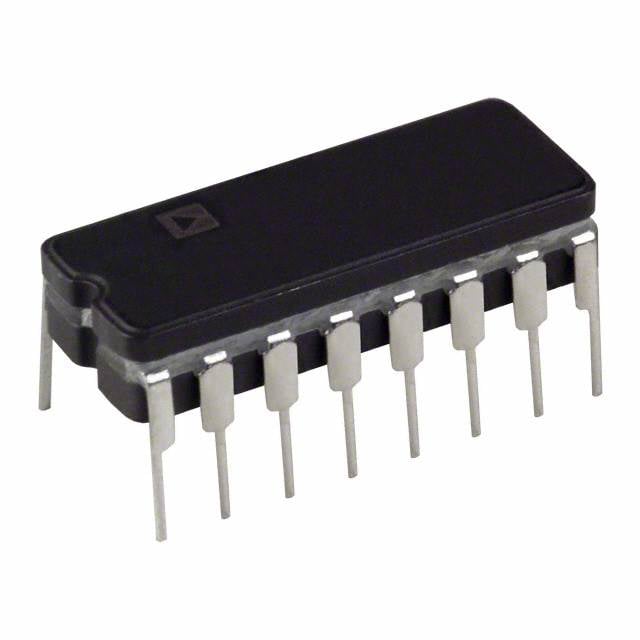
Q1: What is the Analog Devices AD623AR?
A1: The AD623AR is a low-power, precision instrumentation amplifier from Analog Devices, designed for high-accuracy signal amplification in applications such as sensor interfacing and signal conditioning.
Q2: What is the input voltage range of the AD623AR?
A2: The AD623AR has an input voltage range that allows for both single-supply and dual-supply operation, typically from 3V to 36V, with respect to ground.
Q3: What is the gain range of the AD623AR?
A3: The AD623AR has a programmable gain range from 1 to 1000, which can be set using a single external resistor, making it versatile for a variety of signal amplification needs.
Q4: What is the power consumption of the AD623AR?
A4: The AD623AR has a low power consumption, typically drawing 1.3 mA, making it suitable for battery-operated applications and energy-efficient systems.
Q5: How accurate is the AD623AR?
A5: The AD623AR features a low offset voltage of 25 µV (typical), a low input bias current, and excellent gain accuracy, providing precise amplification for sensitive signal measurements.
Q6: What is the maximum common-mode input voltage for the AD623AR?
A6: The AD623AR has a common-mode input voltage range that allows it to handle signals that are within the power supply voltage, typically allowing the common-mode range to be from 0V to (V+ - 2V).
Q7: Does the AD623AR offer rail-to-rail output?
A7: Yes, the AD623AR offers rail-to-rail output, which means it can output signals that are very close to the power supply rails, maximizing the usable output range.
Q8: What type of applications is the AD623AR used in?
A8: The AD623AR is commonly used in industrial process control, medical instrumentation, sensor interfaces, and data acquisition systems, where accurate and low-noise signal amplification is required.
Q9: Can the AD623AR be used with both single-supply and dual-supply configurations?
A9: Yes, the AD623AR can be used in both single-supply and dual-supply configurations, providing flexibility for different system designs.
Q10: What is the input impedance of the AD623AR?
A10: The AD623AR has a very high input impedance, typically 10^12 Ω, which ensures minimal current draw from the signal source, preserving the integrity of the signal.
Q11: What is the bandwidth of the AD623AR?
A11: The AD623AR offers a bandwidth of up to 1 MHz for a gain of 1, which decreases with higher gains. It is suitable for applications that require high-frequency signal processing.
Q12: Does the AD623AR feature any noise reduction capabilities?
A12: Yes, the AD623AR is designed with low noise characteristics, ensuring minimal noise contribution to the signal amplification, making it ideal for precision measurement applications.
Q13: What is the voltage offset of the AD623AR?
A13: The AD623AR has a low input offset voltage of typically 25 µV, which contributes to its high accuracy in low-level signal applications.
Q14: What is the maximum output voltage swing of the AD623AR?
A14: The AD623AR can drive its output very close to the supply rails, typically within 1.5V of the positive rail and within 0.5V of the negative rail when operating at a 5V supply.
Q15: Is the AD623AR available in a surface-mount package?
A15: Yes, the AD623AR is available in both surface-mount (SOIC) and through-hole (DIP) packages, making it suitable for a wide range of PCB designs.
Q16: How does the AD623AR handle temperature variations?
A16: The AD623AR has a low drift with temperature, with a typical offset voltage drift of 0.3 µV/°C, ensuring stable performance across a wide temperature range, from -40°C to +85°C.
Q17: What is the typical output noise of the AD623AR?
A17: The AD623AR features a low output noise, typically 10 nV/√Hz at 1 kHz, making it suitable for low-noise applications requiring accurate signal amplification.
Q18: How is the gain of the AD623AR adjusted?
A18: The gain of the AD623AR is set using an external resistor placed between pins 1 and 8. The gain is determined by the formula Gain = 1 + (50 kΩ / RG), where RG is the external resistor.
Q19: Can the AD623AR be used in automotive applications?
A19: Yes, the AD623AR is suitable for automotive applications that require precision signal amplification, as it operates over a wide temperature range and offers high reliability.
Q20: What is the typical response time of the AD623AR?
A20: The AD623AR typically has a settling time of 5 µs for a 10V step input, making it suitable for real-time signal amplification in dynamic systems.