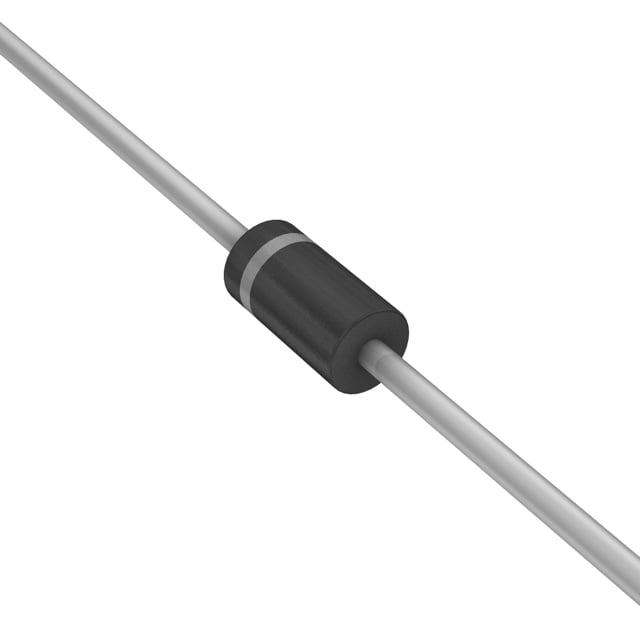
Q1: What is the Fairchild Semiconductor 1N4001?
A: The Fairchild Semiconductor 1N4001 is a standard recovery rectifier diode used for a wide range of electronic applications. It is commonly used to convert alternating current (AC) to direct current (DC) in power supplies and other circuits where current rectification is required. The 1N4001 is part of the 1N400x series, known for its reliability and cost-effectiveness.
Q2: What is the maximum repetitive peak reverse voltage (V_RRM) of the 1N4001?
A: The Fairchild 1N4001 has a maximum repetitive peak reverse voltage of 50V. This means that it can withstand a peak reverse voltage of up to 50V without being damaged, making it suitable for low to moderate voltage applications.
Q3: What is the forward current rating of the Fairchild 1N4001?
A: The 1N4001 is rated for a maximum forward current of 1A. This makes it ideal for use in applications where moderate current levels need to be rectified, such as in power supplies, chargers, and low-power electronic circuits.
Q4: What is the maximum forward voltage drop of the 1N4001?
A: The maximum forward voltage drop of the 1N4001 is 1.1V at a forward current of 1A. The forward voltage drop represents the voltage lost as the current flows through the diode and is an important factor in the efficiency of the rectification process.
Q5: What is the typical application of the Fairchild 1N4001?
A: The 1N4001 is commonly used in power rectification circuits, where it is employed to convert AC to DC. It is also used in low to moderate voltage power supplies, DC motor drives, battery chargers, and other circuits that require efficient rectification of electrical signals.
Q6: How does the 1N4001 diode function in a circuit?
A: The 1N4001 functions by allowing current to flow in one direction (forward direction) and blocking current in the reverse direction. When the input signal is positive, the diode conducts current, allowing it to pass through. When the input is negative, the diode blocks the current, preventing reverse flow, thus rectifying the AC input.
Q7: What is the reverse recovery time of the 1N4001?
A: The reverse recovery time of the 1N4001 is typically 2 microseconds. This time represents how long it takes for the diode to stop conducting after the polarity of the applied voltage has been reversed. A lower reverse recovery time is important for high-speed switching applications.
Q8: Is the 1N4001 suitable for high-frequency applications?
A: No, the 1N4001 is not designed for high-frequency applications. It is a general-purpose rectifier diode suited for low to moderate-frequency circuits, such as power supplies and AC-DC converters. For high-frequency applications, fast recovery diodes or Schottky diodes are more suitable.
Q9: What is the junction temperature range for the 1N4001?
A: The junction temperature range of the Fairchild 1N4001 is -65°C to +150°C. This wide operating temperature range allows the diode to be used in various environmental conditions, including industrial and automotive applications.
Q10: What is the power dissipation limit of the 1N4001?
A: The 1N4001 has a maximum power dissipation limit of 3W. Power dissipation occurs due to the forward voltage drop when current flows through the diode. This limit ensures that the diode remains within its thermal capabilities during operation.
Q11: Can the 1N4001 be used for high-power applications?
A: While the 1N4001 is suitable for moderate-power applications, it is not designed for high-power applications. For circuits that require higher current or voltage handling, a higher-rated diode or a Schottky diode with lower forward voltage and faster switching characteristics should be used.
Q12: What is the construction of the 1N4001 diode?
A: The 1N4001 is constructed using silicon material, which is common for general-purpose diodes. The silicon material allows for efficient rectification and ensures the diode can handle the typical voltage and current levels required in power supplies and similar circuits.
Q13: Does the 1N4001 have any thermal management features?
A: The 1N4001 does not have built-in thermal management features like a heatsink, but it is designed to operate efficiently within its thermal limits. Proper heat dissipation can be achieved by ensuring that the diode is used in circuits where the power dissipation does not exceed its 3W limit and adequate ventilation is provided.
Q14: How is the 1N4001 packaged?
A: The 1N4001 is typically packaged in a DO-41 (DO-204AL) axial lead package. This package type is widely used for diodes and allows for easy integration into through-hole circuits. The axial leads provide flexibility for installation on a circuit board.
Q15: What is the surge current rating of the 1N4001?
A: The 1N4001 can withstand a surge current of up to 30A for a short duration (8.3ms). This surge current rating is useful in applications where brief, high-current pulses may occur, such as when switching inductive loads or during power-up events.
Q16: What are the main benefits of using the 1N4001 diode?
A: The main benefits of the 1N4001 include its low cost, availability, and reliable performance in low to moderate voltage power rectification applications. It is a versatile and commonly used component in electronics, particularly in power supplies, battery chargers, and AC-to-DC conversion circuits.
Q17: How does the 1N4001 compare to other diodes in the 1N400x series?
A: The 1N4001 is part of the 1N400x series, which includes diodes with varying reverse voltage ratings. The 1N4001 has the lowest reverse voltage rating (50V) in the series, while other diodes such as the 1N4007 have higher ratings (up to 1000V). The choice of diode depends on the reverse voltage requirements of the specific application.
Q18: Is the 1N4001 suitable for use in high-voltage circuits?
A: The 1N4001 is not suitable for high-voltage circuits due to its maximum reverse voltage of 50V. For circuits requiring higher reverse voltage capabilities, diodes from the 1N400x series with higher voltage ratings, such as the 1N4007 (1000V), would be more appropriate.
Q19: Can the 1N4001 be used for rectification in a bridge configuration?
A: Yes, the 1N4001 can be used in a bridge rectifier configuration. In such a setup, four diodes are arranged to convert AC voltage to DC. The 1N4001 is commonly used in low-power bridge rectifiers for power supplies, chargers, and other AC-to-DC conversion applications.
Q20: How do I select the right diode for my application?
A: When selecting a diode for your application, consider factors such as the maximum reverse voltage, maximum forward current, power dissipation, and the application's operating conditions. The 1N4001 is a good choice for moderate power rectification at low to medium voltages. For higher reverse voltage or current, choose a diode with higher ratings within the 1N400x series or a different type of rectifier diode suitable for your specific requirements.