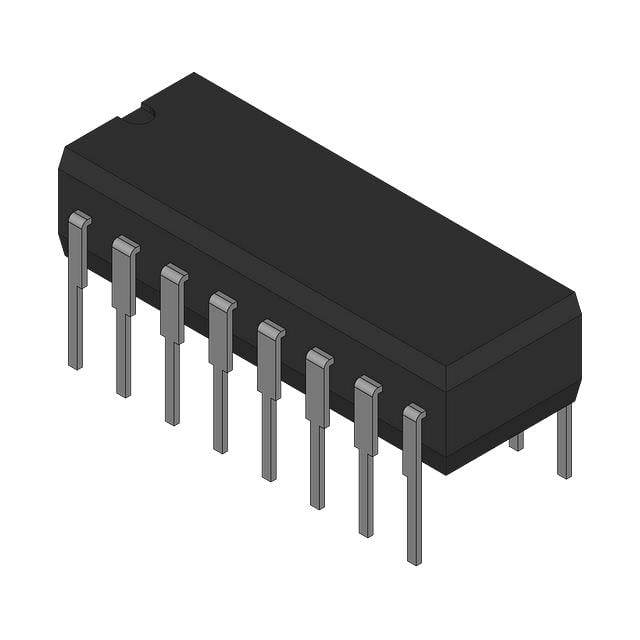
MC145026P
MC145026P
Obsolete
Description:  IC ENCODER 9LINE SIMPLEX 16-DIP
Manufacturer:  NXP Semiconductors
Datasheet:   MC145026P Datasheet
History Price: Obsolete
In Stock: 48700
MC145026P Specification
Specification
Part No
MC145026P
Category
Interface - Encoders, Decoders, Converters
Manufacturer
NXP Semiconductors
Series
4000
Packaging
Tube
Status
Obsolete
Environmental Compliance
Lead Free
Radiation Hardening
No
REACH SVHC
No SVHC
RoHS
Compliant
HS Code
-
Technical Parameter
Type
Encoder, Decoder
Applications
Remote Control
Voltage - Supply, Analog
2.5V ~ 18V
Voltage - Supply, Digital
2.5V ~ 18V
Mounting Type
Through Hole
Package / Case
16-DIP (0.300", 7.62mm)
Supplier Device Package
16-PDIP
MC145026P PDF Datasheet
MC145026P Related Parts
MC1042P
MC1042P
Motorola
DECODER/DRIVER, ECL, PDIP16
MC1043P
MC1043P
Motorola
DECODER/DRIVER, ECL, PDIP14
MC145026D
MC145026D
NXP Semiconductors
IC ENCODER 9 LINE SMPLX 16-SOIC
MC145026DR2
MC145026DR2
NXP Semiconductors
IC ENCODER 9 LINE SMPLX 16-SOIC
MC145027DW
MC145027DW
NXP Semiconductors
IC DECODER 5 ADDR 4 DATA 16-SOIC
MC145027DWR2
MC145027DWR2
NXP Semiconductors
IC DECODER 5 ADDR 4 DATA 16-SOIC
MC145027P
MC145027P
NXP Semiconductors
IC DECODER 5 ADDR 4 DATA 16-DIP
MC145028DW
MC145028DW
NXP Semiconductors
IC DECODER 9 ADDR 16-SOIC
MC145028DWR2
MC145028DWR2
NXP Semiconductors
IC DECODER 9 ADDR 16-SOIC
MC145028P
MC145028P
NXP Semiconductors
IC DECODER 9 ADDR LINES 16-DIP
MC1505L
MC1505L
Rochester Electronics
MC1505L
MC145026P Description

## Detailed Overview of NXP Semiconductors MC145026P

The MC145026P is a versatile integrated circuit (IC) designed for use in various telecommunications applications. It serves as a dual-tone multi-frequency (DTMF) generator and decoder, making it suitable for applications in telephone systems, remote controls, and other communication devices.

## Key Features

1. DTMF Generation and Detection:
- The MC145026P can generate DTMF tones to signal keypad inputs.
- It also decodes incoming DTMF signals, recognizing the standard frequencies associated with telephone keypads.

2. Compatibility:
- The device is compatible with both analog and digital signal processing environments, allowing for easy integration into existing systems.

3. Low Power Consumption:
- Designed for efficiency, the IC operates at low power levels, which is crucial for battery-operated devices.

4. Built-in Oscillator:
- The MC145026P includes an internal oscillator that can be used for generating the necessary clock signals, reducing the need for external components.

5. Pin Configuration:
- The device features a 16-pin dual in-line package (DIP), which simplifies mounting on printed circuit boards (PCBs).

6. Programmable Tone Duration:
- Users can program the duration of the generated DTMF tones, providing flexibility in application design.

7. High Noise Immunity:
- The IC offers excellent noise immunity, making it reliable even in noisy environments.

8. Easy Integration:
- The straightforward interface makes it easy to integrate into microcontroller-based systems.

## Specifications

| Parameter | Specification |
|---------------------------------|-----------------------------------|
| Supply Voltage (VDD) | 3.0 V to 15 V |
| Power Consumption | < 10 mA (typical) |
| DTMF Frequency Tolerance | ±1% |
| Tone Duration | Programmable (typically 50-1000 ms) |
| Operating Temperature Range | -40 °C to +85 °C |
| Output Levels | Typically 1.5 V to 3.5 V |
| Input Signal Range | 0.5 V to 5 V |
| Pin Count | 16 |
| Package Type | DIP (Dual In-Line Package) |

## Applications

The MC145026P is widely used in various applications, including:

1. Telephone Systems:
- Essential for producing and detecting DTMF tones in traditional and VoIP telephony.

2. Remote Controls:
- Utilized in remote control systems for appliances, allowing users to send commands via DTMF signaling.

3. Intercom Systems:
- Facilitates user interaction through DTMF input/output in intercom setups.

4. Home Automation:
- Enables control of home automation systems using DTMF signaling from phones.

5. Teleservices:
- Used in services that require user input via phone, such as customer support systems.

## Conclusion

The MC145026P from NXP Semiconductors stands out as a reliable and efficient DTMF generator and decoder suitable for a variety of telecommunications applications. Its combination of low power consumption, high noise immunity, and ease of integration makes it an excellent choice for designers looking to implement DTMF capabilities in their products.
MC145026P Compare Parts
  • MC145026P vs MC145028DWR2
  • MC145026P vs MC145028DW
  • MC145026P vs MC145027P
  • MC145026P vs MC145027DWR2
  • MC145026P vs MC145027DW
  • MC145026P vs MC145026DR2
  • MC145026P vs MC145026D
  • MC145026P vs MC1043P
  • MC145026P vs MC1042P
  • MC145026P vs MC1505L
  • MC145026P FAQ
    Q1: What is the NXP Semiconductors MC145026P used for?
    A1: The NXP Semiconductors MC145026P is used as a digital phase-locked loop (PLL) frequency synthesizer for radio communication applications.

    Q2: What is the main function of the NXP Semiconductors MC145026P?
    A2: The MC145026P is designed to generate stable, precise frequencies for use in radio transceivers and similar communication systems.

    Q3: What kind of modulation does the NXP Semiconductors MC145026P support?
    A3: The MC145026P supports both frequency modulation (FM) and amplitude modulation (AM) for communication systems.

    Q4: What is the operating voltage range of the NXP Semiconductors MC145026P?
    A4: The MC145026P operates within a voltage range of 4.5V to 5.5V.

    Q5: Does the NXP Semiconductors MC145026P have an integrated oscillator?
    A5: Yes, the MC145026P has an integrated oscillator for frequency generation.

    Q6: What is the frequency range of the NXP Semiconductors MC145026P?
    A6: The MC145026P can generate frequencies from 30 MHz to 1 GHz, depending on the application.

    Q7: Can the NXP Semiconductors MC145026P be used in mobile communication systems?
    A7: Yes, the MC145026P is commonly used in mobile communication systems for frequency synthesis.

    Q8: What is the output type of the NXP Semiconductors MC145026P?
    A8: The MC145026P provides a logic-level output for use in frequency synthesis applications.

    Q9: Is the NXP Semiconductors MC145026P suitable for use in satellite communication?
    A9: Yes, the MC145026P is suitable for satellite communication systems, providing stable and reliable frequency generation.

    Q10: How does the NXP Semiconductors MC145026P maintain frequency accuracy?
    A10: The MC145026P uses a PLL to ensure precise frequency control and minimize frequency drift.

    Q11: What is the power consumption of the NXP Semiconductors MC145026P?
    A11: The MC145026P has low power consumption, making it suitable for battery-powered devices.

    Q12: What is the temperature range for the NXP Semiconductors MC145026P?
    A12: The MC145026P operates within a temperature range of -40°C to +85°C.

    Q13: Can the NXP Semiconductors MC145026P be used in digital signal processing systems?
    A13: Yes, the MC145026P is often used in digital signal processing systems that require precise frequency generation.

    Q14: Does the NXP Semiconductors MC145026P provide frequency tuning?
    A14: Yes, the MC145026P offers frequency tuning through external components such as capacitors and inductors.

    Q15: What kind of applications can benefit from the NXP Semiconductors MC145026P?
    A15: Applications such as wireless communication, FM radio, and GPS systems can benefit from the MC145026P's frequency synthesis capabilities.

    Q16: What is the package type of the NXP Semiconductors MC145026P?
    A16: The MC145026P is available in a 16-pin dual in-line package (DIP).

    Q17: How does the NXP Semiconductors MC145026P handle spurious signals?
    A17: The MC145026P is designed to minimize spurious signals and noise, ensuring clean frequency output for communication systems.

    Q18: Is the NXP Semiconductors MC145026P suitable for use in radar systems?
    A18: Yes, the MC145026P is suitable for radar and other systems that require accurate and stable frequency synthesis.

    Q19: Does the NXP Semiconductors MC145026P support external frequency references?
    A19: Yes, the MC145026P can be driven by external frequency references for more precise frequency control.

    Q20: Can the NXP Semiconductors MC145026P be used for frequency hopping applications?
    A20: Yes, the MC145026P can be used in frequency hopping systems, providing fast and reliable frequency switching.
    Customer Reviews
    4.95 out of 5.00 stars from 143 customer reviews from all over the world
    Yago Santos Ferreira
    Brazil
    5 stars
    2026-03-31 06:15
    Always ask components from this seller. Very recommended.
    Michelle Flores
    United States
    5 stars
    2026-03-31 04:10
    100pcs ordered, 100pcs received. Sample tests good. Recommended!
    Anna Sørensen
    Denmark
    5 stars
    2026-03-31 03:29
    At last a place where the tl431 works as intended, took random 10 pcs of the 100 and testet in a circuit from datasheet all spot on 5.085v where it should be.
    Scott Hughes
    United States
    5 stars
    2026-03-30 22:45
    MXL7704-R3 as descried.
    Wojciech Nowak
    Poland
    5 stars
    2026-03-30 22:41
    rpi works like new
    Maria Clara
    Brazil
    5 stars
    2026-03-30 22:15
    Perfect for my Raspberry Pi