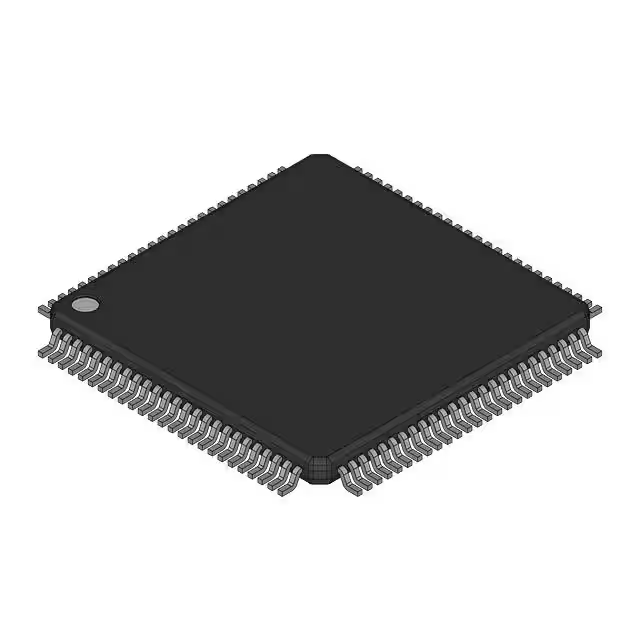
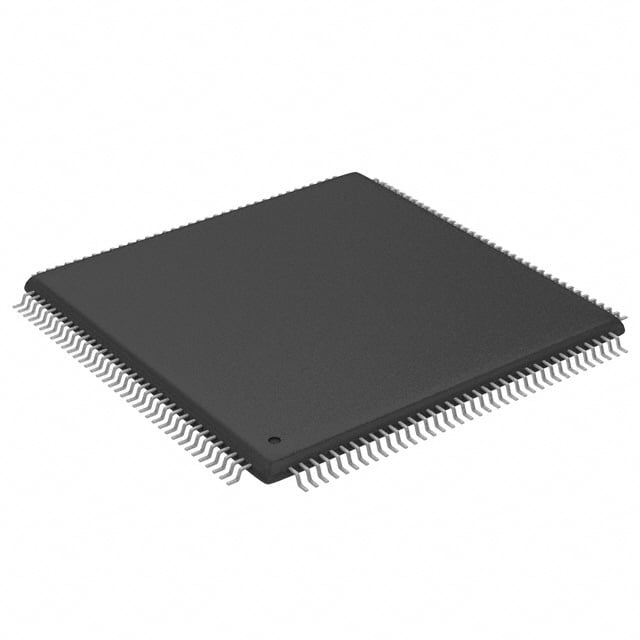
The Atmel AT6002-4AC is a high-performance Complex Programmable Logic Device (CPLD) designed for moderate-density logic integration in industrial and consumer applications. It belongs to the AT6000 family, which is optimized for deterministic timing, low power, and cost-effective design. The "2" indicates the relative logic capacity of the device within the family, supporting approximately 2,000 macrocells. The "-4" denotes the speed grade, representing the fastest operating performance for this model. The "AC" suffix identifies the commercial temperature range of 0°C to +85°C and the standard package type, which in this case is a PLCC or equivalent for easy integration in printed circuit boards.
## Logic Architecture
The AT6002-4AC is built around a hierarchical architecture of macrocells and programmable interconnects. Each macrocell consists of combinational logic, flip-flops, and output logic capable of implementing both registered and combinational functions. The CPLD architecture allows designers to implement predictable logic functions with deterministic timing due to fixed routing paths, unlike general FPGAs with variable routing delays.
The macrocells support synchronous and asynchronous operations, enabling implementation of counters, state machines, decoders, and other digital logic. Logic expansion is achieved by interconnecting multiple macrocells via the programmable interconnect matrix, which is organized for minimal propagation delay and reduced routing congestion.
## I/O Capabilities
The AT6002-4AC features up to 84 general-purpose I/O pins, configurable as inputs, outputs, or bidirectional lines. I/O banks support multiple voltage standards, including LVCMOS and TTL, allowing easy interfacing with other digital components. Output drive strength is programmable, enabling optimization of signal integrity based on PCB layout and connected loads.
The device provides internal pull-up resistors on input pins and configurable output enable control for bidirectional signals, making it suitable for bus-oriented designs. Signal timing and noise immunity are enhanced by selectable slew rate control.
## Memory and Logic Resources
While primarily a logic-focused CPLD, the AT6002-4AC includes small distributed memory elements for temporary storage, state retention, and flip-flop-based registers. These resources support pipelining, buffering, and intermediate calculation in logic-intensive designs.
Unlike SRAM-based FPGAs, the device does not provide large embedded block RAM or dedicated DSP multipliers, but the macrocell architecture supports efficient implementation of arithmetic and simple DSP functions through combinational logic networks.
## Clocking and Timing
The AT6002-4AC supports multiple clock domains with dedicated global clock routing to minimize skew across the device. The "-4" speed grade provides minimal propagation delay, with typical output-to-output timing in the sub-10 ns range, suitable for high-speed synchronous designs.
Deterministic timing ensures reliable operation in complex combinational and sequential logic, including state machines and counters. Fixed-function routing eliminates timing variability, allowing predictable performance across multiple devices.
## Configuration and Security
The AT6002-4AC is a non-volatile, EEPROM-based CPLD, which retains configuration without requiring an external programming device after power-up. This feature allows instant-on operation and eliminates the need for a separate configuration memory.
Security is inherent to the non-volatile architecture, protecting the logic configuration from unauthorized modification and providing IP protection for proprietary designs. JTAG support enables in-system programming, testing, and debugging while maintaining device security.
## Power Management
The AT6002-4AC is optimized for low power consumption, suitable for battery-powered and energy-sensitive applications. Static power is minimized by the EEPROM configuration, while dynamic power consumption is proportional to logic activity and I/O switching. Selectable drive strengths and output slew rate control allow further optimization of power dissipation.
Thermal management is straightforward due to low power density; however, proper PCB design with copper planes and vias enhances heat spreading for high-activity designs.
## Reliability and Environmental Ratings
The device operates reliably across a commercial temperature range of 0°C to +85°C. The PLCC package provides mechanical stability and supports standard surface mount assembly processes. The non-volatile architecture ensures long-term retention of logic configuration and predictable operation across multiple thermal cycles.
## Development Ecosystem
The AT6002-4AC is fully supported by Atmel’s development tools, including design entry, synthesis, simulation, and timing analysis software. Designers can create logic using schematic capture or HDL (VHDL/Verilog) languages. In-system programming via JTAG allows functional verification, debugging, and updates without removing the device from the PCB. Pre-verified IP cores for common functions such as memory controllers, UARTs, and bus interfaces accelerate development.
## Conclusion
The Atmel AT6002-4AC is a versatile CPLD providing approximately 2,000 macrocells of deterministic, low-power logic, flexible I/O support, and reliable non-volatile configuration. Its combination of predictable timing, high-speed operation, and robust I/O makes it suitable for embedded controllers, industrial automation, communication interfaces, and small-scale digital signal processing applications requiring secure, cost-effective logic integration.