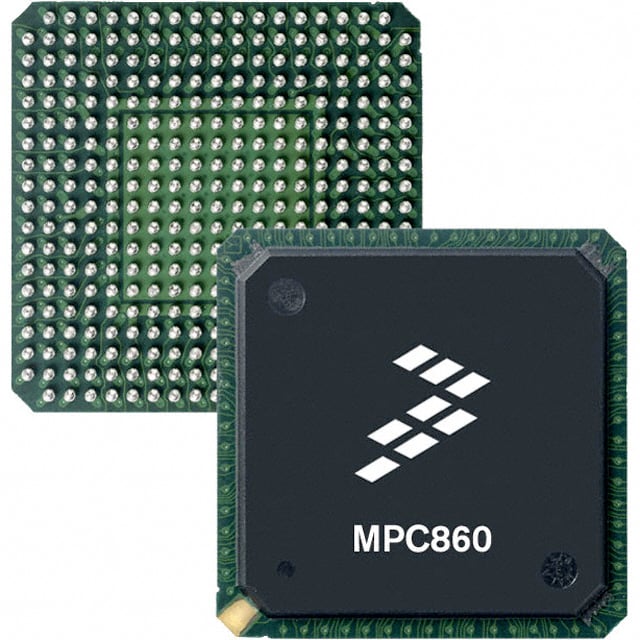
The NXP Semiconductors MPC885CVR133 is a high-performance microprocessor based on the PowerPC architecture, designed for embedded applications requiring robust processing capabilities and low power consumption. This processor is part of NXP's MPC880 family, which is well-suited for industrial, automotive, and communication systems. The MPC885CVR133 provides a blend of high-speed performance, flexible I/O options, and power-efficient design, making it ideal for real-time processing, control systems, and high-end embedded applications.
## Key Features:
* Architecture: The MPC885CVR133 is based on the PowerPC 603e core, an efficient, RISC-based processor that offers high performance and low power consumption for embedded applications.
* Clock Speed: This processor operates at a clock frequency of 133 MHz, providing sufficient processing power for a wide range of applications while keeping energy consumption manageable.
* On-chip Memory: The MPC885 includes integrated L1 (Level 1) cache and on-chip SRAM, which improve data access speed and overall system performance. The processor’s cache allows it to handle high-frequency operations efficiently.
* Bus Interface: The processor supports a 32-bit external bus interface, enabling it to interface with a variety of external memory and peripheral devices, offering scalability and flexibility for various system configurations.
* Power Management: The device features advanced power management techniques, including dynamic power management and low-power idle modes, ensuring energy efficiency and reducing heat generation, which is essential in embedded and portable devices.
* Integration of Peripheral Functions: The processor integrates a wide range of essential peripheral functions, reducing the need for external components. These include timers, interrupt controllers, and communication interfaces.
## Electrical Specifications:
* Supply Voltage (Vcc): The MPC885CVR133 typically operates with a core supply voltage of 3.3V.
* Operating Frequency: The processor is clocked at 133 MHz, offering a balance of performance and power efficiency for embedded control applications.
* Power Consumption: The processor’s low-power design allows for reduced power consumption while maintaining high performance. The typical power consumption is around 1.5W, which is quite low for its processing capabilities, making it suitable for power-constrained environments.
* Temperature Range: The device is rated to operate within the industrial temperature range of -40°C to +105°C, ensuring reliable operation in demanding environments such as automotive, industrial, and communications systems.
* Current Draw: The typical supply current at full load is approximately 500mA at 3.3V, depending on the load and operating conditions.
## Performance and Functionality:
* Processor Core: The PowerPC 603e core used in the MPC885CVR133 provides a 32-bit RISC architecture capable of delivering efficient instruction execution, making it well-suited for embedded applications with real-time requirements.
* Performance: With a clock speed of 133 MHz, the MPC885CVR133 provides sufficient performance for handling demanding control algorithms, real-time data processing, and high-speed communication tasks. The performance is enhanced by the processor’s parallel execution pipeline, which allows it to execute multiple instructions in parallel.
* Instruction Set: The processor supports the PowerPC ISA (Instruction Set Architecture), which includes a rich set of instructions optimized for embedded systems, offering powerful computational capabilities and flexibility for software developers.
* Cache Architecture: The processor includes 32KB of L1 cache (16KB instruction and 16KB data cache), which helps minimize memory access latency and improves data throughput for memory-intensive tasks.
* FPU (Floating Point Unit): The MPC885CVR133 includes a floating-point unit (FPU) for handling complex mathematical operations, enabling faster computation in applications that require heavy numerical calculations.
* I/O Interfaces: The processor features a range of communication interfaces, including I2C, SPI, UART, and CAN bus interfaces, enabling it to interact with various external peripherals and communication devices.
## Integrated Peripherals:
* Timers: The processor includes multiple general-purpose timers that can be used for various time-based applications such as generating periodic interrupts, controlling the operation of devices, and providing precise time delays.
* Interrupt Controller: An integrated interrupt controller allows the processor to handle multiple interrupt sources efficiently, prioritizing tasks based on urgency, which is crucial for real-time applications.
* DMA Controller: The Direct Memory Access (DMA) controller enables high-speed data transfers between peripherals and memory without burdening the CPU, improving overall system performance.
* Watchdog Timer: A watchdog timer is included to monitor the system and reset the processor in the event of a failure or if the software enters an undefined state.
## System Integration:
* System Clock: The processor supports external system clock frequencies up to 133 MHz, with the ability to interface with external clocks or generate its own internal clock signal.
* Bus Architecture: The MPC885CVR133 uses a 32-bit bus to connect with external memory and peripherals, providing a flexible and scalable interface for expanding the system.
* On-chip Debugging: The processor includes debugging features like JTAG (Joint Test Action Group) for real-time debugging, which aids in development and troubleshooting of embedded systems.
## Applications:
The MPC885CVR133 is widely used in applications that require real-time processing, high reliability, and efficient power management. Some of the typical application areas include:
* Automotive: The processor is suitable for use in automotive control systems such as infotainment, instrument clusters, and advanced driver-assistance systems (ADAS), where performance and safety are critical.
* Industrial Automation: The MPC885CVR133 is used in industrial control systems, robotics, PLC (Programmable Logic Controllers), and machine vision systems, where it can handle time-sensitive data and control tasks.
* Telecommunications: The processor is ideal for telecommunications equipment such as base stations and network routers, where efficient data processing and communication are needed.
* Consumer Electronics: The processor is used in embedded devices such as set-top boxes, audio/video equipment, and gaming consoles, providing efficient handling of multimedia data.
* Medical Devices: The MPC885CVR133 can be used in medical monitoring systems and diagnostic devices, where reliability and real-time performance are essential.
## Advantages:
* Power Efficiency: The low-power design of the MPC885CVR133 makes it an excellent choice for battery-powered or thermally sensitive embedded systems, offering a balance of performance and energy consumption.
* Scalability: With flexible I/O options and external bus interfaces, the processor can easily be adapted for use in a variety of system configurations and expanded for more complex designs.
* Robust Performance: The PowerPC 603e core offers reliable and efficient performance for real-time applications, enabling quick execution of tasks without compromising system reliability.
* Real-Time Capabilities: The integration of timers, interrupts, and the DMA controller ensures that the processor can handle real-time data processing requirements effectively, making it suitable for control systems and other time-critical applications.
## Conclusion:
The NXP Semiconductors MPC885CVR133 is a powerful, flexible, and efficient microprocessor based on the PowerPC architecture, making it an ideal solution for embedded applications in various sectors such as automotive, industrial, telecommunications, and consumer electronics. With a combination of high processing speed, low power consumption, and advanced peripheral integration, it provides a comprehensive solution for systems requiring real-time performance and reliability. The processor's rich feature set, including on-chip memory, communication interfaces, and advanced power management, allows for highly optimized and scalable system designs.